Pokemon DPS Calculator
Estimate move damage per second from base power, STAB bonus, type effectiveness, and cast time. Optionally factor attacker Attack against defender Defense using the Pokemon GO PvE damage approximation.
⚡Real Move Presets
📝Move & Matchup Inputs
The move's raw power value before any multipliers.
Multiplier depends on the STAB system chosen (GO vs main).
Used only in the stat-based damage model.
Used only in the stat-based damage model.
Positive for fast moves (gain), negative for charged (cost).
🔢Formula Snapshot
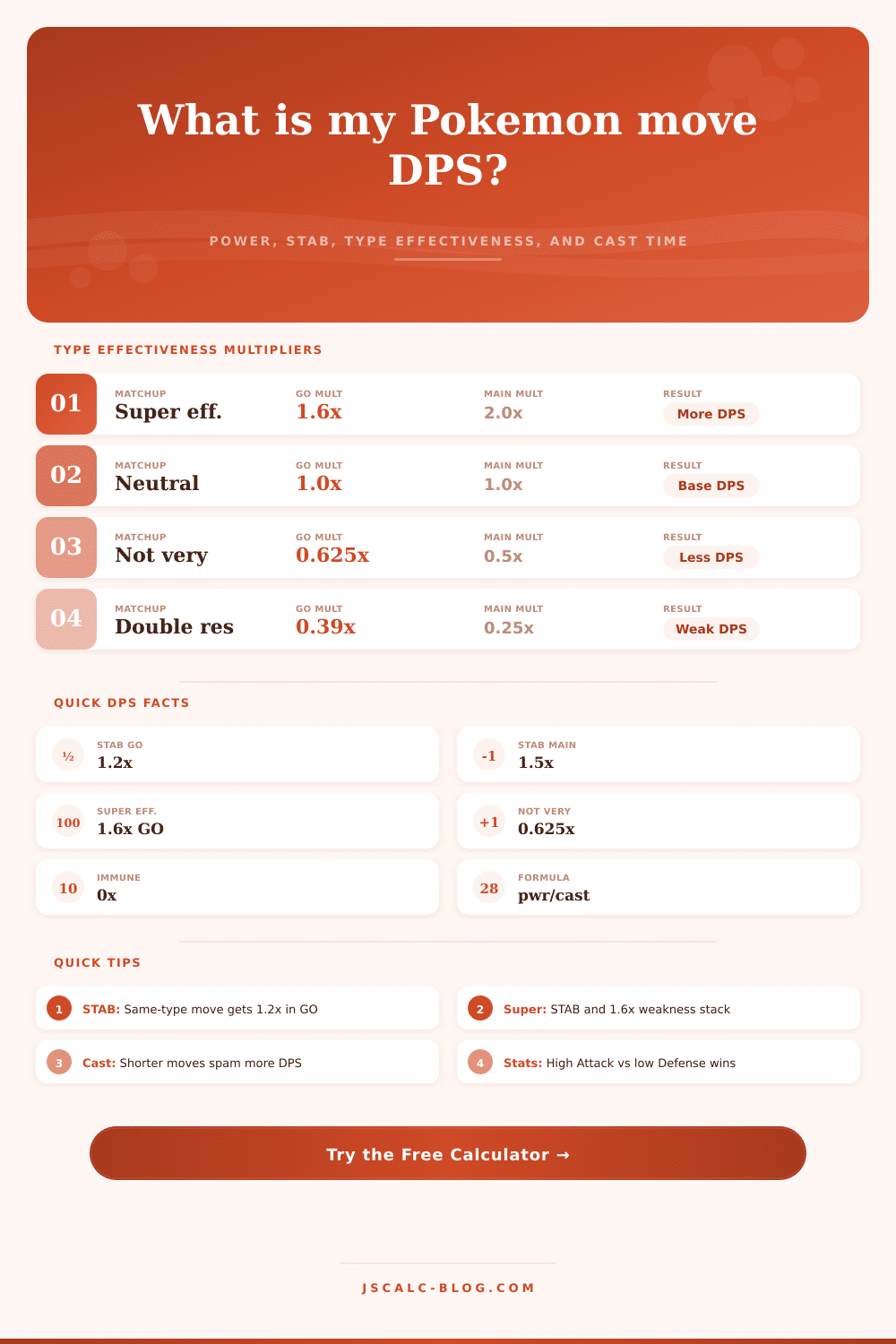
🗂Type Effectiveness Multipliers
| Matchup | Pokemon GO | Main Series | DPS Effect | Example |
|---|---|---|---|---|
| Super effective | 1.6× | 2.0× | Big boost | Water vs Fire |
| Neutral | 1.0× | 1.0× | Baseline | Normal vs Normal |
| Not very effective | 0.625× | 0.5× | Reduced | Fire vs Water |
| Double resisted | 0.39× | 0.25× | Very weak | Grass vs Bug/Steel |
| Immune | 0× | 0× | No damage | Normal vs Ghost |
✨STAB & Move Type Reference
| System | STAB Value | When It Applies | Notes |
|---|---|---|---|
| Pokemon GO | 1.2× | Move type matches user type | PvE and PvP default |
| Main series | 1.5× | Move type matches user type | 2.0× with Adaptability |
| No STAB | 1.0× | Off-type coverage move | Neutral baseline |
| Fast move | Adds STAB | Quick tap attack | Builds energy |
| Charged move | Adds STAB | Spends stored energy | Higher power |
📊Fast vs Charged Move DPS
| Move Type | Power | Cast Time | Raw DPS | Role |
|---|---|---|---|---|
| Fast (quick) | 10 | 0.5 s | 20.0 | Energy build |
| Fast (medium) | 16 | 1.0 s | 16.0 | Balanced tap |
| Charged (light) | 50 | 1.5 s | 33.3 | Fast spam |
| Charged (heavy) | 100 | 2.0 s | 50.0 | Nuke damage |
| Charged (ultra) | 140 | 3.5 s | 40.0 | Big single hit |
🗂DPS Comparison Grid (STAB 1.2×, cast 2.0 s)
| Move Power | Neutral DPS | STAB DPS | Super Eff. DPS | STAB+Super | Not Very |
|---|---|---|---|---|---|
| 40 | 20.0 | 24.0 | 32.0 | 38.4 | 12.5 |
| 60 | 30.0 | 36.0 | 48.0 | 57.6 | 18.8 |
| 80 | 40.0 | 48.0 | 64.0 | 76.8 | 25.0 |
| 100 | 50.0 | 60.0 | 80.0 | 96.0 | 31.3 |
| 120 | 60.0 | 72.0 | 96.0 | 115.2 | 37.5 |
| 140 | 70.0 | 84.0 | 112.0 | 134.4 | 43.8 |
| 160 | 80.0 | 96.0 | 128.0 | 153.6 | 50.0 |
| 180 | 90.0 | 108.0 | 144.0 | 172.8 | 56.3 |
⚙Full Formula Breakdown
📋DPS By Power (STAB 1.2×, cast 1.0 s)
| Power | Neutral (1×) | STAB Only | Super + STAB | Immune |
|---|---|---|---|---|
| 25 | 25.0 | 30.0 | 48.0 | 0.0 |
| 50 | 50.0 | 60.0 | 96.0 | 0.0 |
| 75 | 75.0 | 90.0 | 144.0 | 0.0 |
| 100 | 100.0 | 120.0 | 192.0 | 0.0 |
| 150 | 150.0 | 180.0 | 288.0 | 0.0 |
💡Practical DPS Tips
There’s that one raid boss everyone’s afraid to fight. You’re standing before him and you know your group can’t take him down. It is not for lack of strength. No, you’ve misunderstood how damage actualy accumulates. That’s where you went wrong.
People assume that the higher the base power of a move, the better. They look no further than that and quit. While a high base power move may do more damage per hit it could be slowing down your energy production or making you vulnerable. This results in much lower total damage output.
Why Speed Is Better Than Power
The calculator will do the math for you when you input your statistics so you don’t have to worry about trying to figure out what coefficient converts to what. Let this app does the thinking and let you think about tactics instead.
Battle efficiency isn’t measured in big numbers; it’s measured in damage per second, which cuts through all the deception and reveals the true currency. In terms of DPS, you’re measuring time against clock, how quickly your attacks depletes the opponent’s health bar. And this is where DPS comes into play when you’re comparing seemingly identical moves that act quite differently in combat. Sometimes, casting something faster with less base power will actualy yield greater results then something that hits harder due to its higher base power, because it takes less time to execute.
Frequency beats magnitude if the former are high enough. That’s where the inputs you dial in tell a story of your attacker’s capabilities. Raw potential is its base power, while multipliers like type effectiveness and STAB turn potential into performance. Same Type Attack Bonus is a reward for embracing who your Pokémon is. Stay faithful to your character and get a meaningful boost for sticking it out with them. This bonus even stacks with super effective damage in most games; so if you’ve got a combo of types that exploit a weakness, expect explosive results as multipliers compound fastly.
The secret variable is cast time. That’s both your attack speed and the period of exposure. Three second firing? Your attack is a long windup. It can be preempted, but it also risks burning precious time when your target decides to switch out instead. Quicker attacks let you put on quick pressure before they has a chance to react proactively. How does raw damage compare to the cost of waiting for your attack to animate through?
But even the finer details are governed by stats. Damage done scales based off Attack and Defense stats. So if your attacker has a low Attack stat (or the defender’s got sky-high Defense), that big-power move may not do as well as you expected. It’s not a linear relationship. Diminishing returns comes into play. When facing heavily defensive opponents, raising your own Attack only goes so far before it becomes worth switching to a different move with better type coverage.
Everything connects here with energy management. Charged attacks has higher DPS, and the faster you’re moving the more energy you generate. The faster you build up resources through fast, high-damage moves, the sooner you can spam out charged attacks. It’s a snowball effect, before the enemy has time to react, you’ve put them under consistent pressure and overwhelmed them. You don’t pick one move at a time, you create a system that efficienty cycles its own resources and keeps itself going.
It’s laid out in a reference table on the page that shows you how various matchups tip the scales. A super effective hit does a lot of damage. A move resisted barely scratches the opponent. Once you know those multipliers, you can predict what combos will shine and what ones won’t. You can turn abstract numbers into a choice. It turns fights from random events into a calculation of who is most likely to succeed and when.
At the end of the day, DPS is about understanding that a single shot is not everything. It’s about efficiency and flow instead of bursts of power. It’s about breaking down complex actions into simple metrics. This is where the tool shines because it shows you what you can’t see with naked eye. Your mind starts to connect the dots between numbers and you realize that sometimes being consistently good is better than being brilliant once.
Once you get that, each fight becomes a puzzle where you know you should of had the tools to piece them together. Hitting doesn’t matter as much as hitting smart. Every second need to count towards winning.