Gun DPS Calculator
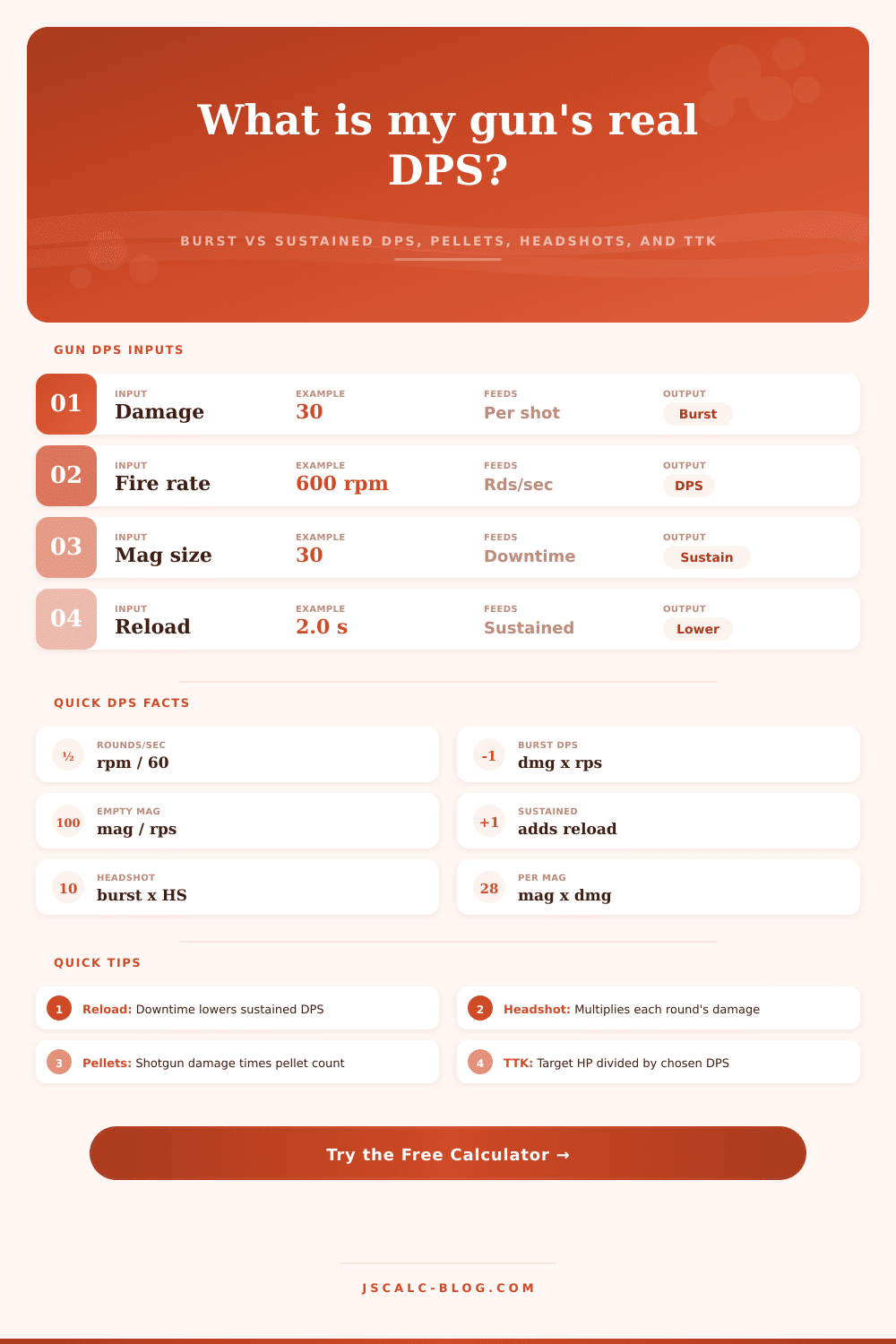
Compare burst DPS against sustained DPS with reload downtime for any FPS weapon. Enter damage per shot, fire rate, magazine size, reload time, pellets, and headshot multiplier to see damage per mag and time to kill.
🔫Weapon Presets
🎯Weapon Stats
Set to 8 to 12 for shotguns, 1 for single-projectile guns.
🔢Formula Snapshot
📊Weapon Class DPS Reference
| Weapon Class | Typical Damage | Fire Rate | Mag Size | Reload | Burst DPS Range |
|---|---|---|---|---|---|
| Assault Rifle | 28 to 36 | 560 to 700 rpm | 30 | 2.0 to 2.6 s | 270 to 400 |
| SMG | 18 to 26 | 800 to 1000 rpm | 25 to 35 | 1.6 to 2.2 s | 260 to 420 |
| Shotgun (8 pellets) | 10 to 14 per pellet | 70 to 120 rpm | 6 to 8 | 3.0 to 4.5 s | 110 to 220 |
| Sniper Rifle | 90 to 150 | 40 to 60 rpm | 5 to 10 | 3.0 to 4.0 s | 60 to 150 |
| LMG | 30 to 40 | 600 to 800 rpm | 75 to 150 | 5.0 to 8.0 s | 300 to 530 |
| Pistol (semi) | 24 to 40 | tap fire limited | 12 to 17 | 1.4 to 2.0 s | 120 to 300 |
| Marksman DMR | 50 to 70 | semi limited | 10 to 20 | 2.4 to 3.2 s | 200 to 420 |
| Minigun | 18 to 26 | 1200 to 1600 rpm | 150 to 300 | spin up delay | 380 to 660 |
🕐Fire Rate vs Burst DPS (30 damage, 1 pellet)
| Fire Rate (rpm) | Rounds / Second | Burst DPS | Empty 30-mag | Sustained (2 s reload) |
|---|---|---|---|---|
| 300 rpm | 5.0 | 150 | 6.0 s | 112.5 |
| 450 rpm | 7.5 | 225 | 4.0 s | 150.0 |
| 600 rpm | 10.0 | 300 | 3.0 s | 180.0 |
| 750 rpm | 12.5 | 375 | 2.4 s | 204.5 |
| 900 rpm | 15.0 | 450 | 2.0 s | 225.0 |
| 1000 rpm | 16.67 | 500 | 1.8 s | 236.8 |
| 1200 rpm | 20.0 | 600 | 1.5 s | 257.1 |
⚔Burst vs Sustained & Headshot Bonus
| Scenario (30 dmg, 30 mag) | Fire Rate | Reload | Burst DPS | Sustained DPS | Headshot Burst (2x) |
|---|---|---|---|---|---|
| Fast reload build | 600 rpm | 1.5 s | 300 | 200.0 | 600 |
| Standard reload | 600 rpm | 2.0 s | 300 | 180.0 | 600 |
| Slow reload | 600 rpm | 3.0 s | 300 | 150.0 | 600 |
| Extended mag (45) | 600 rpm | 2.5 s | 300 | 207.7 | 600 |
| High RPM SMG | 900 rpm | 2.0 s | 300 | 200.0 | 600 |
| Big drum LMG (100) | 650 rpm | 6.0 s | 325 | 245.3 | 650 |
⚙Full Formula Breakdown
📋Input Reference
| Input | Common Range | How It Is Used | Effect On DPS |
|---|---|---|---|
| Damage per shot | 10 to 150 | Multiplied by pellets and rounds/sec | Scales burst and sustained directly |
| Fire rate | 40 to 1600 rpm | Divided by 60 for rounds/sec | Raises burst, shortens mag time |
| Magazine size | 5 to 300 | Sets shots before reload | Larger mag lifts sustained DPS |
| Reload time | 1.4 to 8.0 s | Added to empty-mag time | Longer reload lowers sustained DPS |
| Pellets per shot | 1 to 12 | Multiplies damage per trigger pull | Boosts shotgun burst damage |
| Headshot multiplier | 1.2 to 3.0 | Multiplies each round's damage | Raises headshot DPS and cuts TTK |
💡Practical DPS Tips
If this sounds familiar, it’s because you’ve played a game like first-person shooter. You upgrade to better equipment and see your stats go up on paper but you still find yourself shot dead by someone with worse gear. Why? Because real life isn’t just about raw fire rate. It’s about how many shots hit targets over time, plus the time spent reloading in between. That’s the difference between theoretical potential and practical reality which is where most players lose track of there performance.
It looks good on paper until you look at clock. Nine-hundred rounds per minute is an intimidating number. A gun that shoots nine hundred times a minute must be pretty badass, right? But what happens when that mag empty in two seconds? Then you’re staring down the business end of a reload timer for almost half your engagement time.
Real Damage Is More Important Than Paper Stats
Plug in your own weapon statistics into the calculator above and it’ll do all the math for you. No need to divide and subtract by hand every time you change loadouts. When you hold down trigger, it displays sustained damage, not just peak output. High-fire-rate weapons is less effective due to the reload penalty. Stick two seconds in there and have a look at how fast the effective damage plummet. Downtime between bursts are far more crucial to your sustained output then a slightly increased fire rate. For competitive players, attachments that decreases reload time are frequently prioritized over ones with increased weight or in-game currency cost.
Once you understand the math, you has to make different decisions about your gear. The difference comes when you’re looking at headshots, which are a damage multiplier for each round fired. Let’s say that your gun does 30 damage per bodyshot and 60 on headshots. That drastically reduces the amount of time it takes to kill someone. But that assumes perfect accuracy, something no spreadsheet can ever account for. Theoretical dueling stats mean nothing when your recoil is off and you only hit with one in ten shots. Precision makes potential real so aim training trumps stat sheets.
Shotguns are another animal all together when it comes to this kind of calculation. Because you’re shooting several pellets on one trigger pull, you can’t just apply single projectile rifle formula. On a shotgun, we have to factor in the number of pellets that will make contact within a given distance. This explains why shotguns works well at close range but lose effectiveness past a certain point. It also explains why you can plug pellets into the shotgun calculator. It’s not just about raw numbers anymore, but rather an interaction between area covered and likelihood of hitting anything.
Another thing to consider for sustained performance is magazine size. A bigger mag means less reloading so you can stay in longer fight while still dealing high damage. That’s why light machine guns are so effective at suppression; even though they are slower to handle, they trade speed for steadiness. Their stream of bullets won’t stop nearly as frequently which is important when trying to pin down an enemy.
You can get a good idea where your custom loadout falls into the wider meta from the reference table on the page, which compares average stats across classes. At the end of the day, understanding the actual output of your weapon enable you to engage from an optimal range and position yourself correctly. Do I need to get off two headshots or can I shoot him in the body three times? Knowing it takes me a second to drop someone if I hit them in the body but only half a second if I nail them in the noggin, changes my style of play. When I know accuracy trumps spraying and praying, I no longer waste ammo. While the numbers don’t tell you exactly where to aim, they don’t have to. They give you a framework, a way to make decisions on the fly and trust your gut when you’re between life and death. Understanding those factors turns blind chance into measured odds; each shot matters towards the ultimate outcome.