Stair Rise and Run Calculator
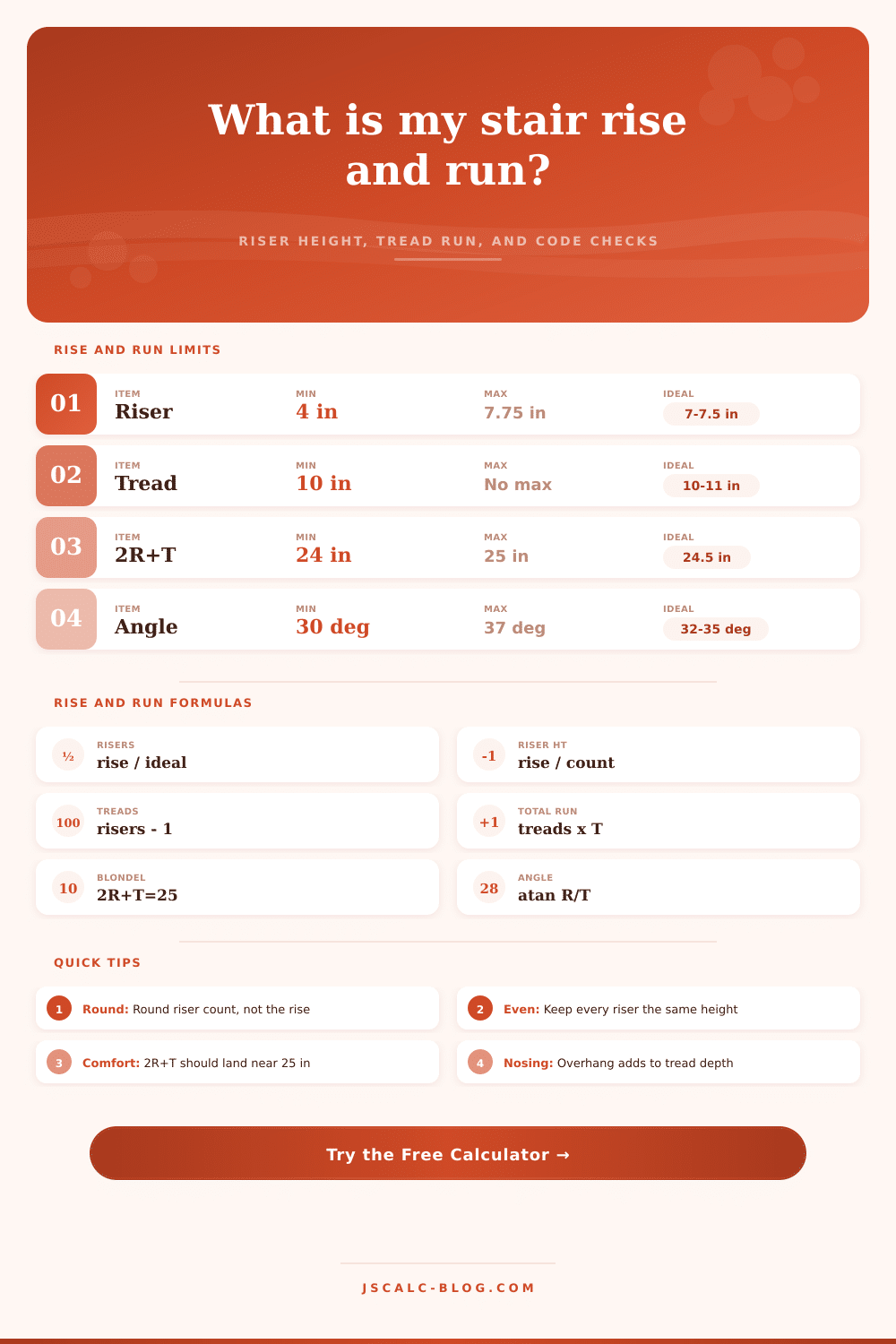
Turn a total floor-to-floor rise into an even riser height, tread run, step count, stair angle, and stringer length, then check every dimension against IRC rules like 2R+T, the 7-11 rule, and the comfort formulas.
🎯Real Stair Presets
📝Rise and Run Inputs
Finished floor below to finished floor above.
Used when solving from the ideal riser.
Used when the solve method is fixed count.
Horizontal run per step, less nosing.
Adds to walked depth, not to run length.
IRC allows 34 to 38 in above nosing line.
🔢Formula Snapshot
📐Code Compliance Check
| Rule | Requirement | Your Value | Result |
|---|---|---|---|
| Enter values above to run the code checks. | |||
🧮Ideal Riser Options For This Rise
| Try Riser | Risers Needed | Actual Riser | Tread Run | 2R + T | Angle | Code |
|---|---|---|---|---|---|---|
| The riser option table appears after calculation. | ||||||
⚖Comfort Rule Check
| Comfort Rule | Formula | Ideal Range | Your Result | Verdict |
|---|---|---|---|---|
| The comfort formulas fill in after calculation. | ||||
📊Stair Angle And Slope Reference
| Stair Type | Riser | Tread | 2R + T | Angle | Slope | Feel |
|---|---|---|---|---|---|---|
| Grand / low rise | 6.0 in | 12.0 in | 24.0 in | 26.6° | 1 : 2.0 | Very easy |
| Comfort residential | 7.0 in | 11.0 in | 25.0 in | 32.5° | 1 : 1.57 | Easy, ideal |
| Standard residential | 7.5 in | 10.5 in | 25.5 in | 35.5° | 1 : 1.40 | Common home |
| IRC maximum | 7.75 in | 10.0 in | 25.5 in | 37.8° | 1 : 1.29 | Legal limit |
| Steep utility | 8.25 in | 9.0 in | 25.5 in | 42.5° | 1 : 1.09 | Tight, steep |
| Ship / attic | 9.5 in | 7.0 in | 26.0 in | 53.6° | 1 : 0.74 | Alternating |
| Ladder stair | 10.0 in | 6.0 in | 26.0 in | 59.0° | 1 : 0.60 | Climb, hands |
⚙Full Formula Breakdown
📋IRC Rise And Run Limits
| Dimension | Code Minimum | Code Maximum | Comfort Target | Why It Matters |
|---|---|---|---|---|
| Riser height | 4 in | 7.75 in | 7 to 7.5 in | Tall risers cause trips and fatigue |
| Tread run | 10 in | No maximum | 10 to 11 in | Short treads leave no room for the foot |
| Riser variation | 0 in | 0.375 in | 0 in ideal | Uneven steps break walking rhythm |
| Tread variation | 0 in | 0.375 in | 0 in ideal | Largest and smallest must stay close |
| Nosing overhang | 0.75 in | 1.25 in | 1 in | Required where treads are under 11 in |
| Headroom | 80 in | No maximum | 80 in plus | Clear height measured from nosing line |
| Handrail height | 34 in | 38 in | 36 in | Measured vertically above the nosing |
💡Practical Rise And Run Tips
There it sits, above you: the ceiling of your basement, and you realize something, it’s time for you to climb up to your main level. That doesn’t seem too bad; the distance from your feet to the floor above could very well be a nice round one-hundred eight inches. But what the number fails to reveal is how much work has to go into making that space traversable in a manner that is safe.
Your stairs cannot resembles a ladder. And you certainly don’t want some crazy-long ramp cutting into your living space. Any time we step onto a set of stairs, we are combining our daily routine with laws of physics. The ratio makes all the difference. In theory, it’s easy math. In practice? Not so much.
Why Stair Safety Matters
I see where most folks just take whatever the handy round number is, divide it up between the number of rises in the stair, and call it good. Except, then they gets stairs with odd heights that really mess with you at night! Enter: the stair calculator up top. Once you enter in what size treads you want, and how tall from floor to floor your stairs are going to be, the calculator does all the careful math to figure out exactly how many inches each riser should of be.
No more guessing if adding another riser is better or worse, we’ve got the rounding figured out for ya! That way you don’t end up with a stair that’s half an inch higher then the others. And that makes for a huge trip hazard. The ones listed above have strict limitations, established by building codes (the International Residential Code) with good reason: Safety.
You don’t want the rise of each stair to be so steep that climbing becomes exhausting. So there’s a maximum of 7-3/4 inches. Nor do you want each step to be so shallow that you can’t find a solid footing. A bare minimum of 10 inches of tread depth helps make sure of this. Neither is arbitrary; these are best practices developed from decades of injuries in households nationwide. If you disregard them, you’re creating a dangerous obstacle course rather than a pathway to get around.
Designers have been studying stair rhythm for hundreds of years, and there’s actualy some data to back it up. The Blondel rule takes an average person’s stride into account. It says 25 inches equals twice the rise plus the tread depth. This basically means we naturaly take a step of that length when going up or down stairs. You’ll notice right away if yours are well outside this range. Short treads on steep stairs make you feel like you’re shuffling upwards. Shallow stairs with long treads makes you feel like you’re wading through mud.
This comfort measure is checked in the calculator automatically, so you can check whether your design would be comfortable before cutting any lumber. People tend to forget about the pitch of a stairway, how steep it is, until they attempt to race up it. For a typical house, thirty to thirty seven degrees of pitch tends to work out well. Any steeper begins to need careful attention and railings. Any flatter eats up precious floor space that might otherwise hold furnitures or storage.
This creates an exchange of height for ground space. The tool shows what the end result will look like in terms of angle and helps you see if it works within the architectural confines while still being usable. It’s not just the hard numbers that matter; it’s consistency. If all your stairs meet or exceed the code minimums but there’s variation in how high each rise is, it becomes dangerous because our brains predict where we’ll land on the next step after seeing what came before. When one suddenly deviates, we’re off track, causing us to misstep.
Making all riser heights the same is always best practice. A small mistake multiplies fast when scaling a lengthy stairway. It ends with a last step that feels wrong compared to all the others. A basic rise and run chart doesn’t show this, which adds another complication: handrail placement. The measurement isn’t taken from the ground surface (the deck), but instead the nosing line. So how do you figure out where the rail should go?
It depends off the pitch of the stairs; you don’t want to have to stretch your arms up too far or hunch over to grasp it. It is a minor detail, but it will make the stairs much safer and more comfortabley to use every day. Stairs are a combination of carpentry skills and geometry. Building stairs is as much about geometry as it is about carpentry. Get the rise and run right early on. This saves you from having to rebuild stringers when the last step doesn’t match up with landing.
Go slow with the math at the start. Taking a little time to be exact at the start will save you an annoying afternoon of sawdust and dissapears. Your poor feet will be glad you did it right the first time.