Arrow Kinetic Energy Calculator
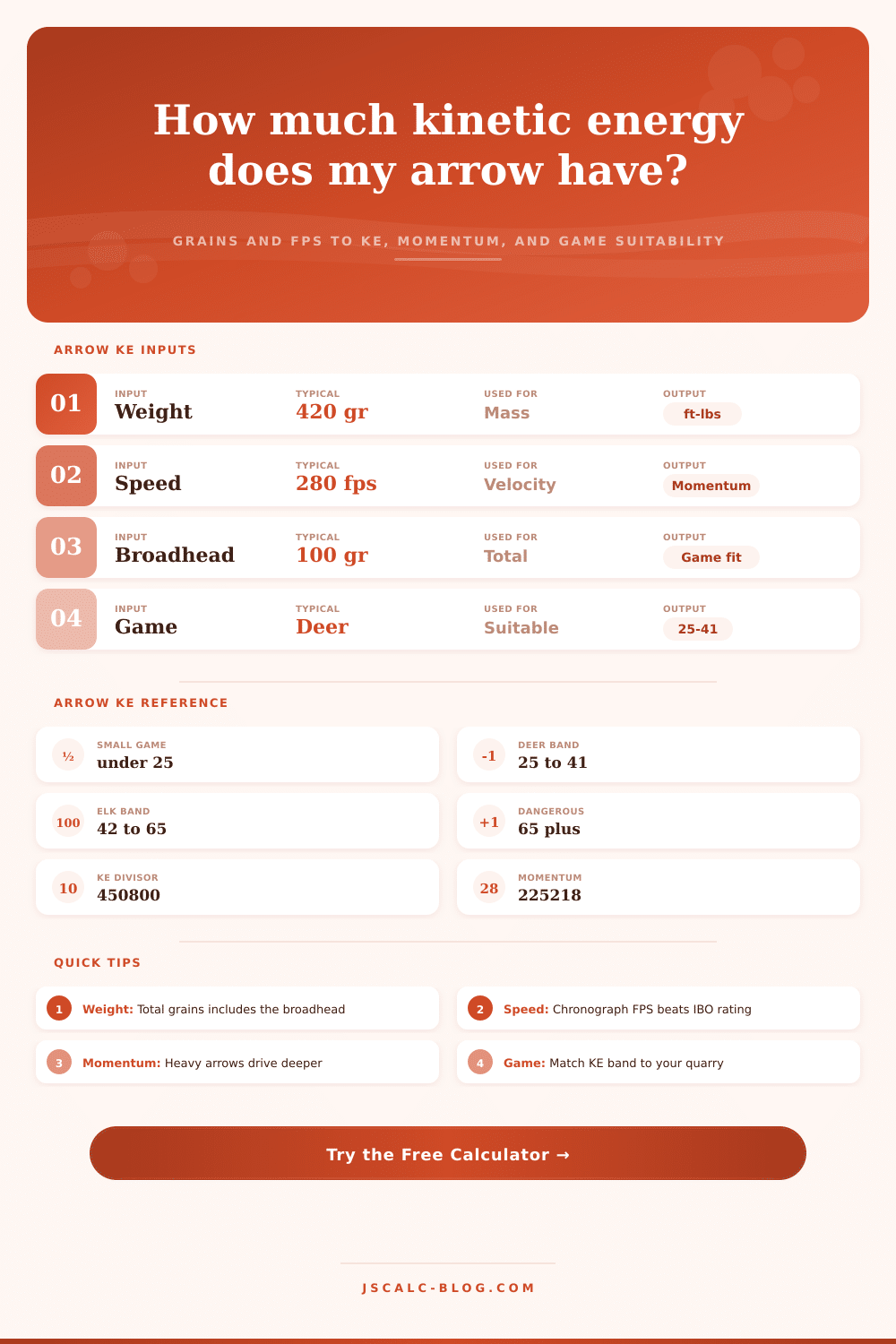
Enter your total arrow weight in grains and measured speed in FPS to find kinetic energy in ft-lbs, momentum in slug-ft/s, energy per grain, and whether your setup meets the KE band recommended for your chosen game.
🏹Real Archery Presets
📝Arrow Setup Inputs
Used when method is total finished weight.
Shaft GPI × length. Used in parts mode.
Chronograph reading beats the IBO sticker.
Display only. Does not change KE math.
Roughly 1 to 2 fps per foot of flight.
🔢Formula Snapshot
🦌KE Requirements By Game
| Game Class | Minimum KE | Comfortable KE | Example Animals | Notes |
|---|---|---|---|---|
| Small game | Under 25 | 15 to 25 | Rabbit, squirrel, turkey | Blunt or small broadheads |
| Medium / deer | 25 to 41 | 30 to 40 | Whitetail, mule deer, antelope | Most bowhunting sits here |
| Larger game | 42 to 65 | 45 to 60 | Elk, black bear, wild hog | Favor heavier arrows |
| Big / tough game | 55 to 65 | 60 to 65 | Moose, big elk, red stag | Bone-breaking energy helps |
| Dangerous game | 65 plus | 80 plus | Cape buffalo, brown bear | High momentum is essential |
📊Grain and Speed to KE Reference
| Arrow Weight | 250 FPS | 280 FPS | 310 FPS | 340 FPS | 370 FPS |
|---|---|---|---|---|---|
| 350 grains | 48.5 | 60.9 | 74.6 | 89.7 | 106.2 |
| 400 grains | 55.4 | 69.6 | 85.3 | 102.6 | 121.4 |
| 420 grains | 58.2 | 73.1 | 89.5 | 107.7 | 127.5 |
| 450 grains | 62.4 | 78.3 | 95.9 | 115.4 | 136.6 |
| 500 grains | 69.3 | 87.0 | 106.6 | 128.2 | 151.7 |
| 550 grains | 76.2 | 95.7 | 117.3 | 141.0 | 166.9 |
⚖Momentum Reference (slug-ft/s)
| Arrow Weight | 250 FPS | 280 FPS | 310 FPS | 340 FPS | 370 FPS |
|---|---|---|---|---|---|
| 350 grains | 0.389 | 0.435 | 0.482 | 0.528 | 0.575 |
| 400 grains | 0.444 | 0.497 | 0.550 | 0.604 | 0.657 |
| 420 grains | 0.466 | 0.522 | 0.578 | 0.634 | 0.690 |
| 450 grains | 0.499 | 0.559 | 0.619 | 0.679 | 0.739 |
| 500 grains | 0.555 | 0.621 | 0.688 | 0.755 | 0.821 |
| 550 grains | 0.610 | 0.684 | 0.757 | 0.830 | 0.904 |
🗂Arrow Setup Comparison Grid
| Setup | Total Weight | Speed | KE (ft-lbs) | Momentum | Best For |
|---|---|---|---|---|---|
| Youth bow | 300 gr | 200 fps | 26.6 | 0.266 | Small game, practice |
| Whitetail vertical | 420 gr | 280 fps | 73.1 | 0.522 | Deer at moderate range |
| Speed target rig | 350 gr | 350 fps | 95.1 | 0.544 | 3D and target flatness |
| Elk heavy arrow | 500 gr | 290 fps | 93.3 | 0.644 | Elk and larger game |
| Crossbow bolt | 400 gr | 400 fps | 142.0 | 0.710 | Crossbow hunting |
| Traditional recurve | 540 gr | 190 fps | 43.3 | 0.456 | Trad deer and stump |
| Big game bruiser | 650 gr | 265 fps | 101.3 | 0.765 | Moose, buffalo, bone |
⚙Full Formula Breakdown
📋Reference Values
| Item | Common Entry | How It Is Used | Effect On Result |
|---|---|---|---|
| Total grains | 350 to 650 gr | Mass in KE and momentum | Raises momentum most, KE less |
| Speed FPS | 190 to 400 fps | Velocity squared in KE | Biggest lever on kinetic energy |
| Broadhead | 75 to 200 gr | Adds to total grains | Heavier point lowers speed a bit |
| Speed loss | 1 to 3 fps/yd | Downrange speed estimate | Lowers KE at longer distance |
| FOC percent | 7% to 19% | Balance and flight only | No change to KE or momentum |
💡Practical Arrow KE Tips
By the time you get that string pulled back right, the arrow’s going. But the felt quickness isn’t a sign of everything that occurs when it hits a critical spot. For example, even if you’re shooting that arrow out of bow at three-hundred-fifty feet per second, it won’t penetrate hard bone or thick muscle unless you’ve got sufficient mass to do the deed.
While kinetic energy is typically thought to be how much damage will occur, most times it’s momentum that play a large role in penetrating deeply and ethically killing whatever is being shot. Once you know your arrow weight and speed, the equation above does all the work for you so you can stop wondering if you’ve got what it takes to back up your accuracy.
Why Heavy Arrows Are Better Than Fast Ones
Most archer focus too much on feet per second because it seems like power. It looks and sounds good flashing by you on a chronograph screen. But here is physics lesson: momentum increases at the same rate as mass, while kinetic energy increase with the square of velocity. So reducing arrow weight by fifty grains for an increase in ten feet per second, frequently means losing overall energy at the end of your shot.
Understanding what is realy happening down range is the key. Losing speed rapidly and falling off sharply due to air resistance make a light fast arrow a bad choice. But a heavier shaft cutting through the air like a bullet do maintain velocity better at longer ranges. This is exactly the reason heavy arrows take over in open plains or thick brush where wind drift is an ever-present enemy.
Keep in mind, however, you’re not just weighting your arrow shaft. The entire system matter, including the addition of massive weight from the broadhead, which changes both flight dynamics and the balance point completely. A five hundred grain projectile becomes possible by adding a two hundred grain fixed blade head to a three hundred grain shaft. This weight also impacts arrow speed while adding momentum coefficient to drive deeper penetration whether through thick fur or rib cages.
It’s all spelled out nicely in the reference table on the page that demonstrates the required energy band per class of game for consistent results. Generally deer hunting resides comfortabley in the thirty to forty foot-pound range, but black bear or elk demand a lot more oomph for sure kill no matter where they get hit.
For many hunters, bow speed is determined strictly by what manufacturer says. That figure is typically based off a best case scenario with minimal draw weight and superlight arrows. In reality we have a full limb load, a longer draw, heavier point, and a little friction from a string loop or release aid. Not accounting for this will lead to up to 30% overestimating how much energy you really has at the end of your range.
Instead measure your own rig out with a chrono or base it off known real world data from like rigs run by someone else who tests conservatively. With the calculator you can enter realistic speeds instead of the theoretical maximum and get your results based on what the thing actualy does out in the field.
Arrow stability is another factor when considering balance, but it is not necessarily related to actual kinetic energy equation. How balanced an arrow are contributes greatly to its ability to fly straighter, flatter, and therefore more accurately, ultimately allowing us to target critical areas where that kinetic energy makes a difference. So while a good set of numbers on paper may be great, if an arrow porpoises or wobbles in flight, we’re losing efficiency. There’s a spot for this as a reference point in the tool, but it doesn’t play into the underlying physics equations used to calculate stopping power.
In the end, it’s about choosing gear best suited for what you’re going after instead of hunting some mythical speed record. For example, there are plenty of times where a slow heavy arrow will be dead-on accurate and bring down an elk. In those cases, you can’t seem to get a fast light one to do anything but slip off on a hard shot because it lack the momentum to penetrate bone. Knowing these things allows you to create a setup that prioritizes reliability over bragging rights.
Shooting straight is nice but shooting something with enough oomph to put the beast down cleanly and humanely each time should of been the name of the game.