Lumber Calculator
Work out board feet, total linear feet, and how many boards or pieces a job needs. Choose a nominal size or enter custom rough dimensions, add a waste factor, and see the exact board-foot math.
🪵Real Lumber Presets
📝Lumber Inputs
Used only when size is Custom. Board feet use rough nominal inches.
Board list mode multiplies board feet by this count.
Used for Linear feet and Pieces modes.
Deck gap or fence spacing added to each board width in Pieces mode.
🔢Board Foot Snapshot
📏Nominal vs Actual Size Reference
| Nominal | Actual (in) | Actual (mm) | Board Ft / ft | Common Use |
|---|---|---|---|---|
| 1x2 | 0.75 × 1.5 | 19 × 38 | 0.167 | Furring, stakes |
| 1x4 | 0.75 × 3.5 | 19 × 89 | 0.333 | Trim, slats |
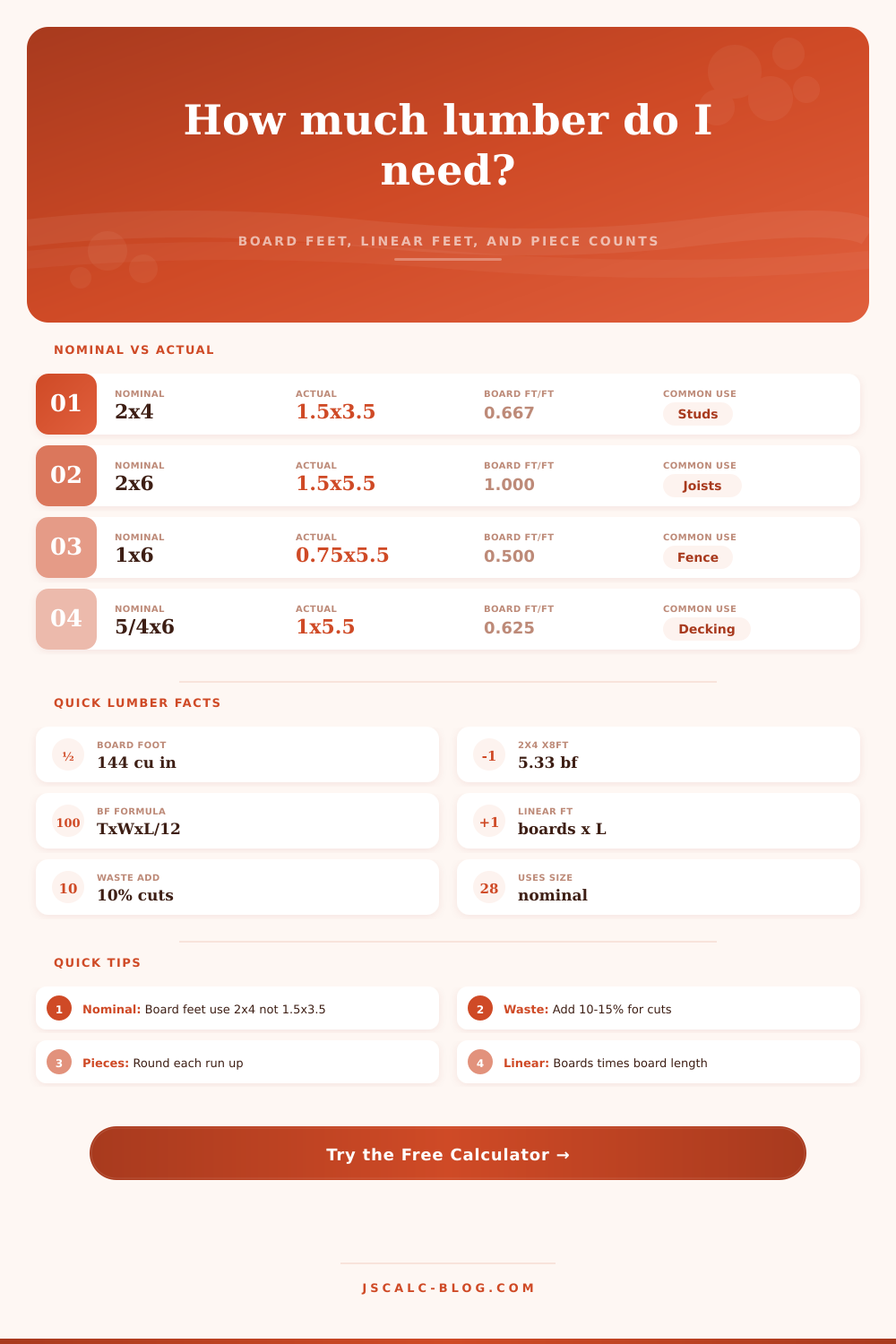
| 1x6 | 0.75 × 5.5 | 19 × 140 | 0.500 | Fence, shelving |
| 5/4x6 | 1 × 5.5 | 25 × 140 | 0.625 | Deck boards |
| 2x4 | 1.5 × 3.5 | 38 × 89 | 0.667 | Wall studs |
| 2x6 | 1.5 × 5.5 | 38 × 140 | 1.000 | Joists, plates |
| 2x8 | 1.5 × 7.25 | 38 × 184 | 1.333 | Floor joists |
| 2x10 | 1.5 × 9.25 | 38 × 235 | 1.667 | Rim, stringers |
| 2x12 | 1.5 × 11.25 | 38 × 286 | 2.000 | Beams, stairs |
| 4x4 | 3.5 × 3.5 | 89 × 89 | 1.333 | Posts |
📊Board Feet Per Standard Board
| Size | 8 ft | 10 ft | 12 ft | 14 ft | 16 ft |
|---|---|---|---|---|---|
| 1x4 | 2.67 | 3.33 | 4.00 | 4.67 | 5.33 |
| 1x6 | 4.00 | 5.00 | 6.00 | 7.00 | 8.00 |
| 2x4 | 5.33 | 6.67 | 8.00 | 9.33 | 10.67 |
| 2x6 | 8.00 | 10.00 | 12.00 | 14.00 | 16.00 |
| 2x8 | 10.67 | 13.33 | 16.00 | 18.67 | 21.33 |
| 2x10 | 13.33 | 16.67 | 20.00 | 23.33 | 26.67 |
| 2x12 | 16.00 | 20.00 | 24.00 | 28.00 | 32.00 |
📐Pieces To Cover A Run
| Run Length | 1x4 @ 3.5" | 1x6 @ 5.5" | 5/4x6 @ 5.5" | 2x6 @ 5.5" | With 0.25" Gap |
|---|---|---|---|---|---|
| 8 ft | 28 pcs | 18 pcs | 18 pcs | 18 pcs | 17 pcs (1x6) |
| 10 ft | 35 pcs | 22 pcs | 22 pcs | 22 pcs | 21 pcs (1x6) |
| 12 ft | 42 pcs | 27 pcs | 27 pcs | 27 pcs | 25 pcs (1x6) |
| 16 ft | 55 pcs | 35 pcs | 35 pcs | 35 pcs | 34 pcs (1x6) |
| 20 ft | 69 pcs | 44 pcs | 44 pcs | 44 pcs | 42 pcs (1x6) |
| 24 ft | 83 pcs | 53 pcs | 53 pcs | 53 pcs | 50 pcs (1x6) |
🗂Lumber Comparison Grid
| Scenario | Size | Length | Boards | Board Ft | Linear Ft |
|---|---|---|---|---|---|
| Stud wall pack | 2x4 | 8 ft | 20 | 106.7 | 160 |
| Deck surface | 5/4x6 | 12 ft | 34 | 255.0 | 408 |
| Fence run | 1x6 | 6 ft | 44 | 132.0 | 264 |
| Floor joists | 2x6 | 14 ft | 18 | 252.0 | 252 |
| Rim board order | 2x10 | 16 ft | 10 | 266.7 | 160 |
| Trim bundle | 1x4 | 10 ft | 30 | 100.0 | 300 |
⚙Full Formula Breakdown
📋Reference Values
| Item | Common Value | How It Is Used | Notes |
|---|---|---|---|
| Board foot | 144 cubic inches | Volume unit for pricing | 12 × 12 × 1 inch |
| Waste factor | 10% to 15% | Multiplies total board feet | Use more for angles |
| Stud spacing | 16 in on center | Sets stud count per wall | 24 in for some walls |
| Deck gap | 0.125 to 0.25 in | Added to board width | Lets boards drain |
| Standard length | 8 to 16 ft | Sold in 2 ft steps | Longer costs more per ft |
💡Practical Lumber Tips
“With 2×4’s, how many are you really going to get? You grab a stack off the lumber aisle at Home Depot, hold it up, and realize it is shorter than what the tag says. This difference, between what you have and what the tag promises (is where many projects fall apart).
Beyond simply purchasing sufficient lengths, there is also waste, volume, and odd rules of accounting when it comes to selling timber. This gets everybody on the board foot, which does not account for the fact that wood shrinks when it’s planed down. So even if you purchase a two by four, it’s only going to be about an inch-and-a-half thick, but they still charge you like it’s two inches.
How to Buy the Right Amount of Wood
Volume is measured in terms of what the industry calls its nominal green size (the size before drying and milling). Why? Because once you mill and dry your wood into stock size, it’s going to be smaller. If you measure out your stock and then attempt to convert board feet using those smaller sizes, you’re going to believe you have fewer board feet than you actualy do.
The calculator above accounts for that automatically so you can forget all about trying to remember what each grade or species shrinks by.
And then there are those linear feet. That’s not inches; that’s just straight-up length. Twenty-eight-foot boards is one hundred sixty linear feet of material. It is simple math to help you figure out how far you’ll be able to stretch your stuff.
Now if you’re installing decking or some sort of fence, where a long run is called for, you have to start thinking in pieces and not just linear feet. Because yes, a 1/4 inch gap may not seem like a lot on paper but over a 40 foot run, it will affect the number of pieces required, making you come up short by Sunday afternoon.
There’s an invisible tax associated with all DIY projects… Waste. Kerf loss means you lose some material as part of the cut. Not every board comes home straight. Not every board comes home without a knot or two. Ten to fifteen percent added to your total is not pessimism; it’s insurance that you won’t have to make a second trip back to the yard.
Set that percentage based off how hard the cuts are and your own confidence level. Ten percent is usually enough if you’re doing simple, ninety-degree-angle framing. Bump that to fifteen or more if you’re cutting forty-five-degree miters for trim work, misaligned saw blades will ruins boards quickly.
But most people make mistake of calculating exactly what they need and buying just enough to fit (and they are surprised when they don’t!) They fail to realize how imperfect these products of nature are. One bad warp or nasty rotting edge will take a whole board off the table. Having some more allows you to cull through the pile and choose best stuff for faces and then use the weird ones for behinds or blocking or hidden framing. And it lets you have some options in case the plan doesn’t line up with the site conditions.
For example, if you don’t feel like running the whole calculator but just need to do a quick lookup, it’s handy having the reference table included with the tool. For instance, if you are shopping around and want to compare price quotes from various yards, the reference tables will show you common sizes and how many board feet per linear foot they equal. This can be particularly helpful with premium softwoods and hardwoods as some places may quote per board foot, and other places only sell by the piece.
The two by six happens to be exactly one board foot per lineal foot so that makes mental math a little easier in the aisle.
The takeaway: Accurate estimating is a great way to save yourself some stress and a few bucks. It avoids the “oh crap I’m out of 3/4″ board” headache half-way through the job. And it also helps prevent overspending, keeping your bank account happy. You don’t have to be a math wiz to estimate correctly. Just know the nominal size of the wood, add some buffer for error, and let the figures tell you what to order on the list. Not your gut feeling. You should of added extra if the wood is moddern or luxuriusly warped.