Baking Conversion Calculator
Convert baking measurements between cups, grams, tablespoons, teaspoons, ounces, and milliliters using real ingredient densities, then scale any recipe up or down by a factor you choose.
🧁Quick Baking Presets
📝Conversion Inputs
Enter the quantity in the from-unit below.
2 doubles a recipe, 0.5 halves it.
🔢Conversion Snapshot
📊Ingredient Grams Per Cup Reference
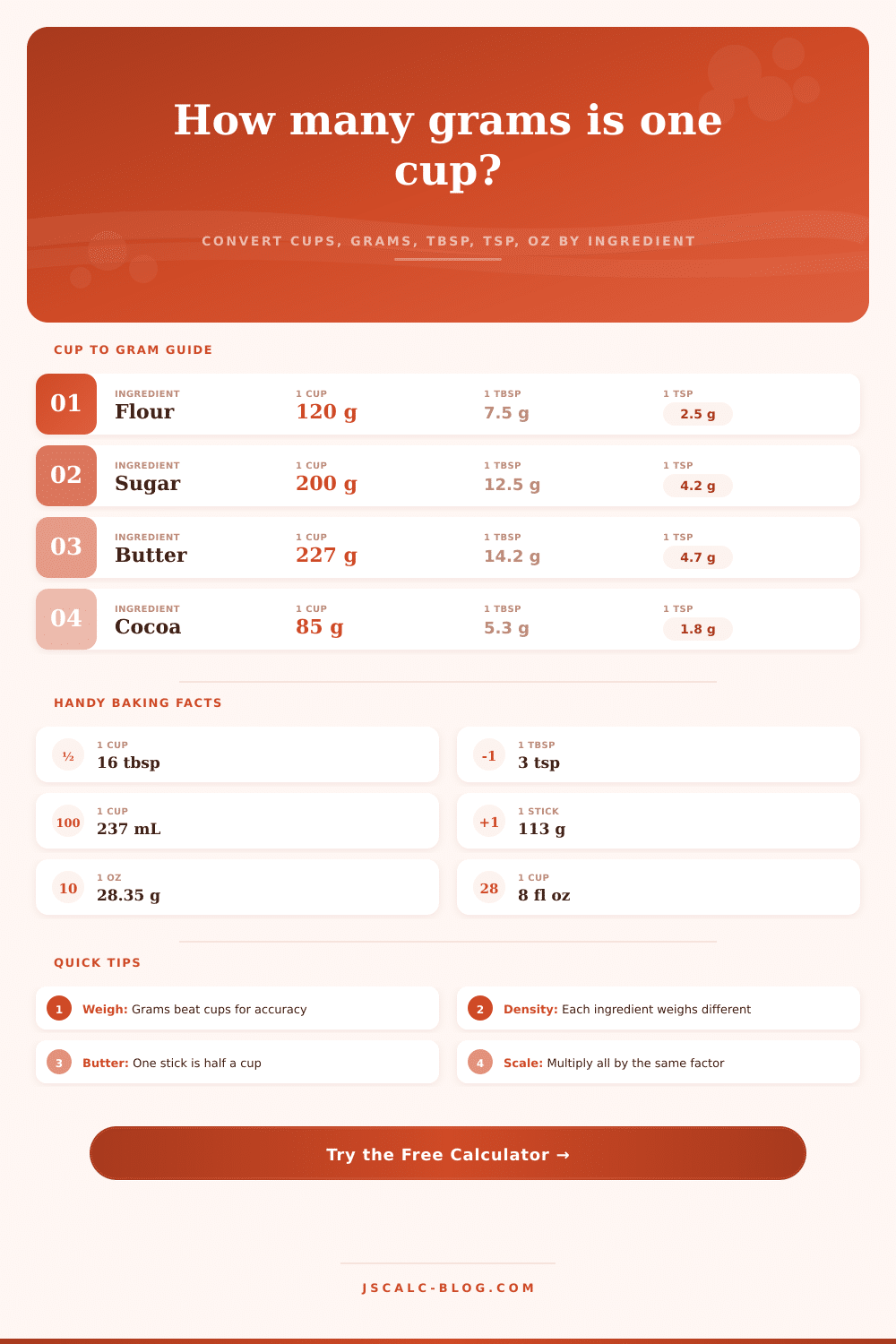
| Ingredient | 1 Cup | 1/2 Cup | 1 Tbsp | 1 Tsp | 1 Ounce |
|---|---|---|---|---|---|
| All-purpose flour | 120 g | 60 g | 7.5 g | 2.5 g | 0.24 cup |
| Granulated sugar | 200 g | 100 g | 12.5 g | 4.2 g | 0.14 cup |
| Brown sugar packed | 220 g | 110 g | 13.8 g | 4.6 g | 0.13 cup |
| Powdered sugar | 120 g | 60 g | 7.5 g | 2.5 g | 0.24 cup |
| Butter | 227 g | 113 g | 14.2 g | 4.7 g | 0.12 cup |
| Milk | 240 g | 120 g | 15.0 g | 5.0 g | 0.12 cup |
| Cocoa powder | 85 g | 42 g | 5.3 g | 1.8 g | 0.33 cup |
| Honey | 340 g | 170 g | 21.3 g | 7.1 g | 0.08 cup |
| Rolled oats | 90 g | 45 g | 5.6 g | 1.9 g | 0.32 cup |
🥄Volume Measure Equivalents
| Volume | Cups | Tablespoons | Teaspoons | Milliliters | Fluid Ounces |
|---|---|---|---|---|---|
| 1 cup | 1 | 16 | 48 | 236.6 mL | 8 fl oz |
| 3/4 cup | 0.75 | 12 | 36 | 177.4 mL | 6 fl oz |
| 1/2 cup | 0.5 | 8 | 24 | 118.3 mL | 4 fl oz |
| 1/3 cup | 0.333 | 5.33 | 16 | 78.9 mL | 2.7 fl oz |
| 1/4 cup | 0.25 | 4 | 12 | 59.1 mL | 2 fl oz |
| 1 tablespoon | 0.0625 | 1 | 3 | 14.8 mL | 0.5 fl oz |
| 1 teaspoon | 0.0208 | 0.333 | 1 | 4.9 mL | 0.17 fl oz |
🧈Butter Sticks Reference
| Butter | Sticks | Cups | Tablespoons | Grams | Ounces |
|---|---|---|---|---|---|
| Half stick | 0.5 | 1/4 cup | 4 | 57 g | 2 oz |
| One stick | 1 | 1/2 cup | 8 | 113 g | 4 oz |
| Two sticks | 2 | 1 cup | 16 | 227 g | 8 oz |
| Three sticks | 3 | 1.5 cups | 24 | 340 g | 12 oz |
| Four sticks | 4 | 2 cups | 32 | 454 g | 16 oz |
🗂Recipe Scaling Comparison Grid
| Original | Half (0.5x) | 1.5x | Double (2x) | Triple (3x) | Grams at 2x |
|---|---|---|---|---|---|
| 1 cup flour | 1/2 cup | 1.5 cups | 2 cups | 3 cups | 240 g |
| 1 cup sugar | 1/2 cup | 1.5 cups | 2 cups | 3 cups | 400 g |
| 1/2 cup butter | 1/4 cup | 3/4 cup | 1 cup | 1.5 cups | 227 g |
| 2 tsp baking powder | 1 tsp | 3 tsp | 4 tsp | 6 tsp | – |
| 1 tsp salt | 0.5 tsp | 1.5 tsp | 2 tsp | 3 tsp | – |
| 3 eggs | 1.5 eggs | 4.5 eggs | 6 eggs | 9 eggs | – |
| 1 cup milk | 1/2 cup | 1.5 cups | 2 cups | 3 cups | 480 g |
| 3/4 cup cocoa | 6 tbsp | 1.125 cups | 1.5 cups | 2.25 cups | 128 g |
⚙Full Formula Breakdown
📋Common Baking Conversions
| You Have | You Want | Rule Used | Result |
|---|---|---|---|
| 1 cup flour | Grams | Cups × 120 | 120 g |
| 250 g sugar | Cups | Grams ÷ 200 | 1.25 cups |
| 4 oz butter | Grams | Ounces × 28.35 | 113 g |
| 3 tbsp cocoa | Grams | Tbsp ÷ 16 × 85 | 15.9 g |
| 500 mL milk | Cups | mL ÷ 236.588 | 2.11 cups |
| 2 cups honey | Grams | Cups × 340 | 680 g |
💡Practical Baking Tips
Take a cup of flour. Then take a cup of honey. Both fit comfortabley inside the same container, yet one is light and airy, the other heavy and dense. Understand this disparity? That’s what causes home bakers to fail time after time: using cups (volume) instead of weights.
Use the calculator above to choose which ingredient you’re working with; it’ll do the rest of the number-crunching for you. You don’t need to guess. You won’t have to eyeball each cup and wonder how heavy something should be based off its density. It is a small detail, but it makes a huge difference for texture.
Why Weights Are Better Than Cups
Chemistry is precision, and baking is chemistry in disguise as comfort food. And when your recipe asks for two cups of all-purpose flour, that’s based on the assumption that you’re scooping it up with a cup measure using the spoon-and-level method (without packing the flour down into the cup). But what happens if you scoop straight from the flour bag? You’ll probably end up with a cup measure of flour containing twenty-five percent more than called for. This extra amount, forty-five grams, might mean the difference between a dense brick and a tender sponge cake.
The chart on the page spells it out: A cup of granulated sugar weighs nearly twice as much as cocoa powder per cup. Know your weights and understand differences in your ingredients. You will begin to realize why substituting ingredients by volume won’t typically work unless you adjust other ratios to account for the changed mass.
Know your weights, understand the differences in your ingredients, and you begins to realize why substituting ingredients by volume won’t typically work unless you make adjustments to other ratios to account for the changed mass. And then there’s the mess that often gets made as people scale up a recipe, which is where most improvisation goes wrong. “I’m going to a party, so I’ll double this batch of cookies,” you think, and double the recipe’s ingredients willy-nilly. Except baking soda (or baking powder) doesn’t increase at the same rate as the other bulk items such as sugar or flour! With the app, you simply enter how many servings you want, or specify a scale factor to increase or decrease by, and everything will move in lock step.
There’s also the option to switch back and forth between US ounce measurements and metric gram ones, handy if you’re using a recipe sourced from overseas. No matter which unit system you use, the way things convert makes sense. This helps avoid one of the most frequent mistakes: confusing weight ounces with fluid ounces, which sound alike yet are measured completly differently.
For example, when I buy a stick of butter, it’s been divided into neat measurement markings to make my life easier. This means that a stick of butter is equal to a half-cup, or four ounces. It is also approximately one hundred thirteen grams. In the US, this system is pretty standardized, but if I’m reading an international recipe that lists measurements in weight, they may never mention anything about “sticks.”
Use the calculator to do your thinking for you. It converts back and forth between formats to match each ingredient’s set density. If I want to learn how much honey I have in a certain amount, and I remember that it’s heavy due to its thickness, I don’t have to remember that honey is roughly three-hundred forty grams per cup. All I have to do is identify what ingredient I’m working with and let the calculator use its appropriate number for the math.
But baking also has its own kind of rhythm, and experience (not just math) plays a part in how well you know it. You may know exactly how much flour weighs (one hundred twenty grams), but you don’t necessarily know if your eggs is cold enough or if the air is too moist. That’s still very much something you need to feel and sense.
The calculator takes away your worry about whether you’re measuring with a heaping tablespoon or a level one. It uses that mental space for thinking about things like timing and mixing methods that will affect the outcome. It makes vague directions into clear goals that anyone can consistently achieve. At its core, it’s all about getting consistent results from any batch of whatever you’re making. This includes bread dough, whether strong or weak, or cake batter, whether delicate or sturdy. It could also be a loaf of bread, a soufflé, or a meringue.
If you know exactly what goes into each ingredient, you have some sense of control over the finished result. You can stop guessing and begin to create, confidently. It has nothing to do with being strict about measurement itself, but rather having an idea of weight behind that number as the end result.
After seeing just how heavy a cup truly is, you’ll never think of that measuring cup the same way ever again. You should of seen the difference yourself.