Stair Carpet Calculator
Work out exactly how much carpet it takes to cover a staircase. Each step needs enough material to wrap the tread depth, drop down the riser, and roll over the bullnose, so this tool adds those three pieces per step, multiplies by your step count, adds any landing, and returns total running length in feet, area in square feet and square yards, padding, and cost for a runner or a full-width install.
🏠Real Staircase Presets
📏Staircase & Carpet Inputs
Count the treads you actually walk on, not the risers.
Front-to-back run of the step, typically 10-11 in.
Vertical face of the step, usually 7-7.75 in.
Extra to wrap the bullnose lip, about 1.5 in.
Full width covers the whole step; a runner leaves wood on the sides.
Wall-to-wall width of the staircase. Used for full width.
Common runners are 27 or 32 in. Used only for runner style.
Flat run of any mid-stair or top landing to also cover.
10% for plain carpet; raise to 15-20% for patterns.
Carpet is priced by the square yard at most stores.
Stair pad is thin and firm; set 0 to skip padding cost.
Optional labor per step; leave 0 for a materials-only quote.
🔢Project Snapshot
📐Steps to Carpet Length Chart
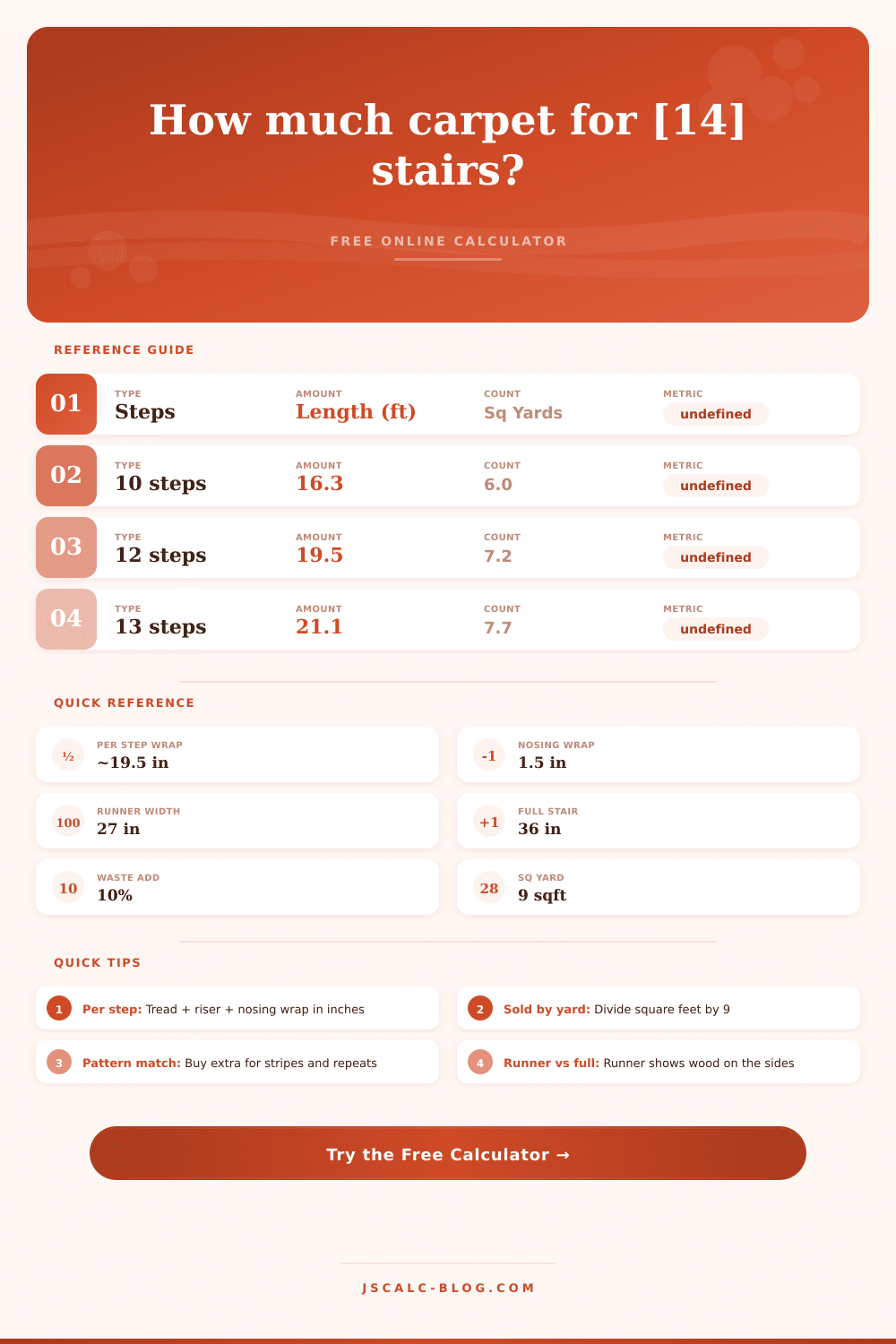
| Steps | Per Step | Length (in) | Length (ft) | Full Width 36in Sq Yd |
|---|---|---|---|---|
| 10 steps | 19.5 in | 195 | 16.3 | 6.0 |
| 12 steps | 19.5 in | 234 | 19.5 | 7.2 |
| 13 steps | 19.5 in | 253.5 | 21.1 | 7.7 |
| 14 steps | 19.5 in | 273 | 22.8 | 8.3 |
| 15 steps | 19.5 in | 292.5 | 24.4 | 8.9 |
| 16 steps | 19.5 in | 312 | 26.0 | 9.5 |
| 18 steps | 19.5 in | 351 | 29.3 | 10.7 |
🧱Runner vs Full Width
| Coverage | Typical Width | 14-Step Sq Yd | Look | Best For |
|---|---|---|---|---|
| Full width | 36 in | 8.3 | Wall-to-wall, no wood showing | Busy family stairs, warmth, quiet |
| Runner 32 in | 32 in | 7.4 | Narrow wood border on both sides | Wide stairs that want a border |
| Runner 27 in | 27 in | 6.2 | Classic strip down the middle | Showing off hardwood treads |
| Runner 22 in | 22 in | 5.1 | Slim traditional runner | Narrow staircases, formal homes |
📑Square Feet to Square Yards
| Square Feet | Square Yards | Cost @ $25/yd | Cost @ $35/yd | Cost @ $50/yd |
|---|---|---|---|---|
| 45 sqft | 5.0 | $125 | $175 | $250 |
| 54 sqft | 6.0 | $150 | $210 | $300 |
| 63 sqft | 7.0 | $175 | $245 | $350 |
| 72 sqft | 8.0 | $200 | $280 | $400 |
| 81 sqft | 9.0 | $225 | $315 | $450 |
| 90 sqft | 10.0 | $250 | $350 | $500 |
💰Carpet Price Per Yard Ranges
| Grade | Price / Sq Yd | Fiber | Wear | Notes |
|---|---|---|---|---|
| Builder / budget | $12 - $22 | Polyester (PET) | Light | Fine for low-traffic runners |
| Mid-range | $25 - $40 | Nylon or triexta | Medium-heavy | Best value for busy stairs |
| Premium | $45 - $70 | Solution-dyed nylon | Heavy | Stain and crush resistant |
| Wool / patterned | $75 - $150+ | Wool, wool blend | Heavy | Buy extra to match the repeat |
🗃Staircase Carpet Comparison
| Scenario | Steps | Length (ft) | Sq Ft +10% | Sq Yd | Cost @ $30 |
|---|---|---|---|---|---|
| Full width 36 in | 14 | 22.8 | 75.1 | 8.3 | $250 |
| Runner 27 in | 14 | 22.8 | 56.3 | 6.3 | $188 |
| 13-step basement | 13 | 20.3 | 67.0 | 7.4 | $164 |
| Landing + 12 steps | 12 | 23.0 | 75.9 | 8.4 | $253 |
| 16 steps tall | 16 | 25.7 | 84.7 | 9.4 | $282 |
| Narrow 30 in stair | 14 | 22.8 | 62.6 | 7.0 | $209 |
| Wide 42 in stair | 14 | 22.8 | 87.6 | 9.7 | $292 |
| Budget runner 27 in | 13 | 21.1 | 52.3 | 5.8 | $93 |
⚙Full Formula Breakdown
💡Practical Stair Carpet Tips
The reason most people fail with a DIY floor project is because they think in two dimensions, treating stairs as if they’re rectangles on the ground. They measure footprint from overhead, purchase carpet for the rectangle, then discover halfway up the first flight that they’re out of material. Because stairs are three dimensional, they take more fabric than their shadow would indicate. That’s where the calculator comes in: it handle the geometry for you, making what would be a difficult space question into an easy square yardage figure that you plug into your shopping cart at the store.
This is where people go wrong: They forget about the riser. An L-shaped profile covered in fabric are a step. But it has a horizontal part… The tread; and then a vertical part, the riser, which the carpet needs to cover. There is also a piece called the nosing that stick out from the front. The carpet needs to cover this piece too so the fabric folds around the outside of it. All these little things add up.
Why Stairs Need More Carpet Than You Think
Let’s say the riser is seven-and-a-half inches, and the tread is eleven (those are standard figures). Add one to two inches because the fabric wraps around the nosing when it comes out beyond edge. Now we’re talking almost two feet of carpet per step. If there are, say, fourteen steps (that’s conservative), that’s like having more than twenty-two linear feet of carpet running down your staircase. And yet, those stairs takes up far fewer square feet on a floor plan.
This brings us back to the Width Variable. Does this change if you choose full coverage or a runner? It sure does. With a runner, there will be wood exposed on the side of the stairs. That’s classic and it saves material. However, it also means you has to find a way to keep it in place using secure rods and finish the edges so no one trips. With full coverage, the carpet goes all the way across from wall to wall. That will mask any scuffed up wood, add some warmth, and reduce sound. You can switch this instantly with tool. Selecting a runner will use whatever width you specify as the runner. Picking full width will assume you want whole stair covered.
Why is that important? Because carpet is priced per square yard. Each additional inch of width adds to the overall cost. Another intuitive pitfall occurs in the amount of waste allowed. Intuitively you might think that all you have to do is purchase exactly as much material as your measurement dictates. Not so. There will be cuts at each step. You must carefully align the seams. You also need extra length if there is a pattern or texture direction in your carpet that you want to carry through from one tread to the next. That way the lines will flow properly.
A standard plain carpet can allow a ten percent waste buffer. For those with patterns, textures, or stripes, fifteen to twenty percent is common. This helps trim out mistakes and provides a repeat length to ensure the design matches up on either side. It is always better to buy more than needed then to hunt down a matching dye lot months later because the remaining piece of carpet is long gone.
The other thing most people don’t realize until it’s time to check out is padding. There is a different type of padding for stairs (thinner & stiffer) than there is for padding on flat flooring. This padding hold the carpet tight up against the riser and doesn’t allow for any tripping. The padding covers roughly the same area as the carpet face. So if you know the sq yd for carpet then use that number here.
Again, labor runs a wide range. Some companies will quote you per stair because it takes more time to secure each one individually; others will quote by the sq ft. Consider this when estimating so that you aren’t shocked by your final bill. Now armed with this knowledge, you can confidently order knowing what makes stairs use so much more material. Instead of winging it with guesses from floor plan, you realize it’s the nosing and vertical risers that determines the length needed. You’re aware that waste comes from both pattern matching and style of coverage. You will also have an idea of how wide to measure.
So with all these variables accounted for you can order with a little less hope and a lot more math. Keep in mind that next staircase you encounter is nothing but a pile of verticals and horizontals begging to be covered. Measure accurately, include your safety margin, then order extra to ensure there won’t be any leftovers to stress over. Actualy, you should of checked the width first. Making sure everything is moddern looking is easy if you use math rather than luck. You’ll recieve better results if you plan ahead.