Speed Distance Time Calculator
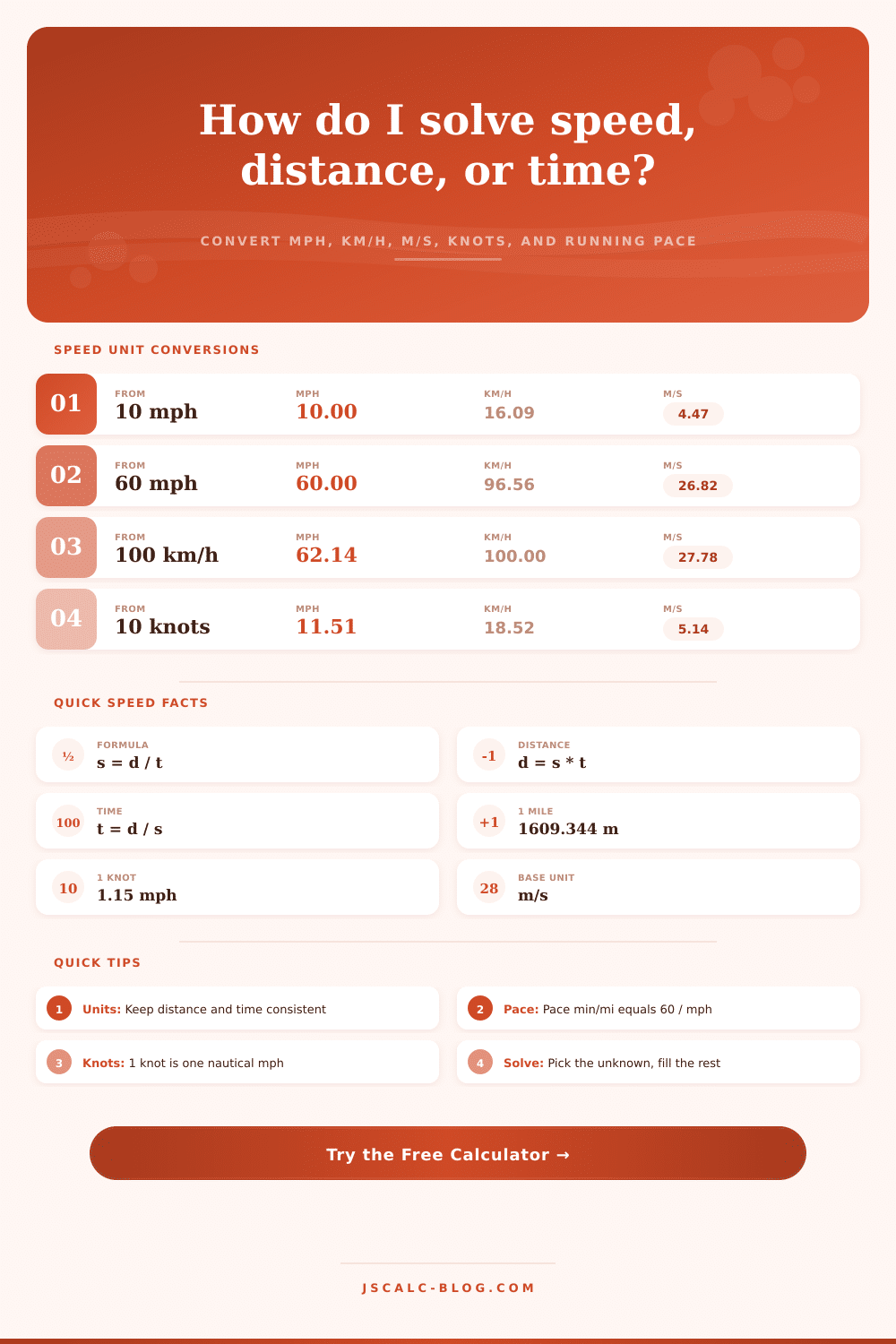
Solve for speed, distance, or time using speed = distance / time and its rearrangements, then read the answer in mph, km/h, m/s, knots, feet per second, and running pace all at once.
🎯Real Travel Presets
📝Inputs
The gap covered between start and finish.
The rate of travel while moving.
Enter hours, minutes, and seconds; blanks count as zero.
🔢Formula Snapshot
🔄Speed Unit Conversion
| Given Speed | mph | km/h | m/s | knots | ft/s |
|---|---|---|---|---|---|
| Enter values above to fill the speed conversion table. | |||||
🏃Running Pace Reference
| Pace min/mi | Speed mph | Speed km/h | Pace min/km | 5K Time |
|---|---|---|---|---|
| 6:00 | 10.00 | 16.09 | 3:44 | 18:38 |
| 7:00 | 8.57 | 13.79 | 4:21 | 21:44 |
| 8:00 | 7.50 | 12.07 | 4:58 | 24:51 |
| 9:00 | 6.67 | 10.73 | 5:36 | 27:57 |
| 10:00 | 6.00 | 9.66 | 6:13 | 31:04 |
| 11:00 | 5.45 | 8.78 | 6:50 | 34:10 |
| 12:00 | 5.00 | 8.05 | 7:27 | 37:16 |
| 13:00 | 4.62 | 7.43 | 8:05 | 40:23 |
📏Distance Unit Conversion
| Given Distance | Miles | Kilometers | Meters | Feet |
|---|---|---|---|---|
| Enter values above to fill the distance conversion table. | ||||
🗂Common Travel Speed Comparison
| Activity | mph | km/h | m/s | Pace min/mi | 1 Mile Takes |
|---|---|---|---|---|---|
| Walking, casual | 3.0 | 4.83 | 1.34 | 20:00 | 20 min |
| Brisk walk | 4.0 | 6.44 | 1.79 | 15:00 | 15 min |
| Easy jog | 5.0 | 8.05 | 2.24 | 12:00 | 12 min |
| Running, steady | 7.0 | 11.27 | 3.13 | 8:34 | 8.6 min |
| Cycling, cruising | 15.0 | 24.14 | 6.71 | 4:00 | 4 min |
| City driving | 30.0 | 48.28 | 13.41 | 2:00 | 2 min |
| Highway driving | 65.0 | 104.61 | 29.06 | 0:55 | 55 sec |
| High-speed rail | 186.0 | 299.34 | 83.15 | 0:19 | 19 sec |
| Airliner cruise | 575.0 | 925.37 | 257.05 | 0:06 | 6 sec |
| Speed of sound | 767.0 | 1234.37 | 342.88 | 0:04 | 4.7 sec |
⚙Full Formula Breakdown
📋Reference Values
| Quantity | 1 Unit Equals | Base Value | Handy Note |
|---|---|---|---|
| 1 mile | 1.609344 km | 1609.344 m | 5280 feet in a mile |
| 1 kilometer | 0.621371 mi | 1000 m | Metric distance base |
| 1 knot | 1.150779 mph | 0.514444 m/s | One nautical mile per hour |
| 1 mph | 1.609344 km/h | 0.44704 m/s | Multiply m/s by 2.23694 |
| 1 m/s | 3.6 km/h | 2.236936 mph | SI speed unit |
| 1 hour | 60 minutes | 3600 s | Keep time consistent |
💡Practical Speed Tips
There are moments when you want to figure out how far something is or how long it takes. Perhaps you’re waiting on a train platform, wondering if the next stop is actualy closer then it feels. Maybe you’re mapping out a driving trip and deciding if taking scenic route adds too much to the journey. Those are time, distance, and speed problems.
On paper, they seem like no big deal; you can do the algebra so you just plug in numbers. But real world doesn’t give you clean values with same units. Your watch say hours and minutes, but that map over there says kilometers. That sign on the freeway? It’s miles per hour.
How This Calculator Helps You
This calculator handles those mixed unit easily. Then it just solves for missing variable. If you drive for X amount of time at Y speed, it’ll tell you how far you went. Or if you want to drive a set distance by a certain time, it’ll calculate your average speed that you must maintain.
You specify the one you don’t know first and then populate the other two with whatever units make sense for your scenario. You can put in distance in kilometers or feet. You can enter time as a combination of seconds and hours. You can use speed in meters per second or knots. Once you enter those numbers, calculator does all the math for you. You no longer has to convert everything into its base unit before doing any division.
You may be asking yourself: What do all these numbers mean? Why don’t they give me the answer? The number show your average speed. It doesn’t tell you anything about what your speed was each individual second along the way. Even if you had your cruise control set at 60 miles per hour, you wouldn’t average that same speed if you stopped for coffee along the trip.
This has practical implications for understanding your logistics. When a runner does a five-kilometer race, their average run could of been eight minutes per mile. But that average conceals that they sprinted first kilometer and then jogged final two. Here, the pace metric in the result help us see it differently by flipping the ratio. It shows time per unit distance rather than distance per unit time.
Most folks mess up at the unit conversion step. Here’s why: Inside, calculator turns all units into meters/second (which is the default scientific basis). Then it spits out your answer again in whatever system you want. Thus, there are no silly issues where someone uses miles and another person use kilometers in the same calculation.
For sailors, about a knot = 1 mile/hour, which is a convenient approximation. Technically, though, since a nautical mile is based off the circumference of the earth, a knot = 1.15 miles per hour. The conversion tables provided with the tool lay this out clearly. Without having to remember any strange numbers, you can visualize what a certain velocity would mean in various systems.
When you’re driving, you think in terms of hours and miles per hour. When you’re running, you think in terms of minutes per mile. If you’re an engineer building something, you probably care about things in meters per second. The beauty of this is that it make it easy for you to jump from one way of thinking to another.
You can say “the plane is moving at 500 mph.” And if you want to compare it to another flight plan, you can look instantly at what it translates to in knots or kilometers per hour. It takes the mental effort away from having to hold several different conversion in your mind when making a decision.
But part of this has to do with psychology too: the way we perceive time and speed. Because we think about distances instead of pace, we tend to underestimate travel times. One-hundred miles doesn’t seem like much until you’re crawling along at ten miles per hour in traffic. Instead of taking two hours, that journey now require ten hours.
The calculator brings those expectations back to earth by making you consider all three variables; together. It tells you that speed isn’t just something you read off your dashboard. It’s a tradeoff between distance traveled and time spent traveling.
Whether we’re talking about a cross country move, or a race in which you have to time your sprints, the math never changes. You just change units and how you describe things. By understanding those averages and conversions, you can plan better trips. Train for them more effectively. Understand the world around you a bit more precisely. Make abstract numbers concrete plans.