Special Assessment Calculator
Estimate your share of a local public improvement such as paving, sewer, sidewalk, or streetlights. Split the total project cost by lot, by front foot, or by assessed value, then amortize your share as a bond lien to see the annual installment, monthly cost, and total interest over the repayment term.
🚧Real Improvement Scenarios
📝Project and Property Inputs
How the district spreads cost among benefiting parcels.
Full assessable cost of the local improvement.
Used for the per lot equal-share method.
Sum of all assessed frontage in the district.
Frontage of your parcel along the improvement.
Combined assessed value of all district parcels.
Assessed value of your own parcel.
Bond rate on the financed assessment. Use 0 to prepay in cash.
Number of annual installments on the lien.
🔢Formula Snapshot
📋Allocation Methods Compared
| Method | Formula | Basis of Charge | Best Fit For |
|---|---|---|---|
| Per Lot | cost / lots | Equal per parcel | Uniform residential blocks |
| Per Front Foot | (cost / total ft) x your ft | Street frontage | Paving, sidewalk, curb |
| By Assessed Value | (your value / total value) x cost | Property value share | Mixed-value districts |
| Area Basis | (your area / total area) x cost | Square footage of land | Drainage, large parcels |
| Unit Basis | cost / dwelling units | Units served | Sewer and water taps |
🛣Typical Improvement Costs
| Improvement | Typical Unit Cost | Common Method | Usual Term |
|---|---|---|---|
| Asphalt street repaving | $40 to $70 per front foot | Front foot | 10 years |
| Concrete sidewalk | $15 to $30 per front foot | Front foot | 5 to 10 years |
| Sanitary sewer extension | $120 to $250 per foot | Per lot or unit | 15 to 20 years |
| Water main | $100 to $200 per foot | By value or front foot | 15 to 20 years |
| Curb and gutter | $20 to $40 per front foot | Front foot | 10 years |
| LED streetlights | $3,000 to $6,000 per light | Per lot | 5 to 10 years |
| Storm drainage | $50 to $120 per foot | Area or value | 20 years |
🗄Term and Rate Comparison Grid
| Term | Rate | Annual Installment | Total Interest | Total Repaid | Vs Prepay |
|---|---|---|---|---|---|
| 5 yr | - | - | - | - | - |
| 10 yr | - | - | - | - | - |
| 15 yr | - | - | - | - | - |
| 20 yr | - | - | - | - | - |
⚙Formula Breakdown
💡Assessment Planning Tips
Then one day you get a surprise in the mail: a special assessment. And you might be concerned when you open it up to see what’s being charged. But don’t worry, it isn’t a clerical error. It turns out that the town want to repave your street, or install some kind of drainage in your alley, or replace an old sewer line down the block. So they’ve drawn a map of those affected, and you’re on it. That means you benefit from better infrastructure, and now they’re billing you for it.
It’s called a special assessment, a separate payment from your property taxes that covers only a single capital improvement and not general city expenses. In theory at least, it makes sense: if your property benefit from new concrete, your property helps pay for the concrete. In practice? Not so simple. It gets complicated, with elaborate financing options and tricky allocation systems, and could land you in long-term debt unless you know how to read fine print.
How Special Assessments Work and How to Pay Them
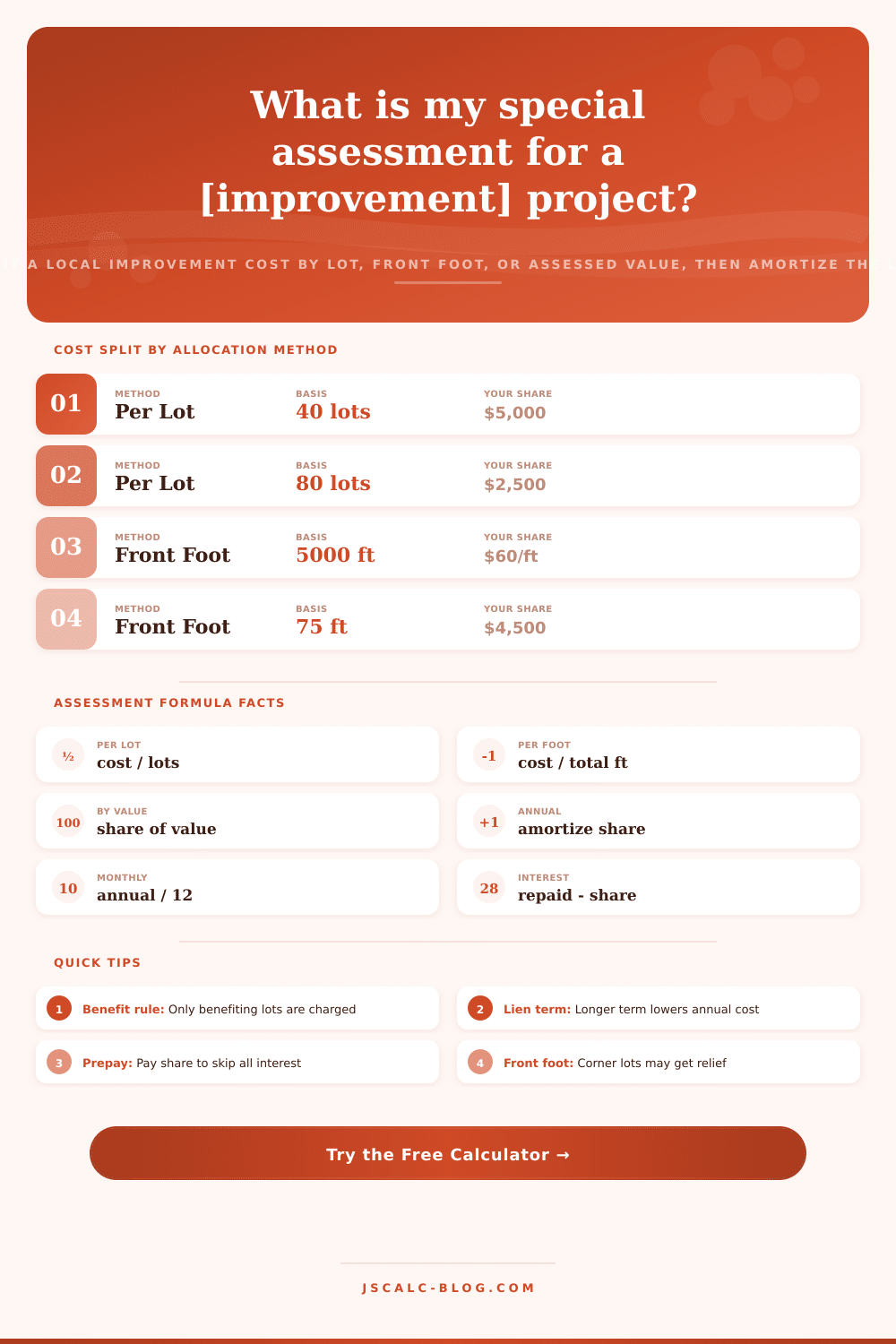
First: How does your municipality attach the cost to your door? It divide up the bill by parcel in one of three ways. Municipalities generally use one of three methods to split the bill, such as dividing the total cost evenly across all lots that benefit from the project (called the per lot method), which is great if the block is fairly even and all houses are pretty uniformly benefited. Others attach the cost according to how many feet along your property line is improved, which sounds fair enough when you’re paving streets (your larger lot will get more new pavement). And others apply the cost according to the value of your house compared with total value in the district (the assessed value method); here it tries to apply the cost to properties of different values in the same ratio. The mathematics vary dramatically depending on the methodology, so being clear about which one applies to your work is the difference between getting a bill you can handle or one that comes as a financial shock.
However, most owners don’t. Or can’t!… Pay the entire assessment in one lump sum. Instead, they finance it as a “bond” lien on their property’s title. This essentially converts a one-off building expense into long-term loan that you repay through installments over many years. The calculator below does the amortization math for you; but knowing how it works gives you power to negotiate favorable terms.
Your yearly payment depend a lot on the repayment period (the number of years) and the interest rate. If you extend the lien over a longer period, then your annual payment decreases … which may be appealing, at first glance, since it saves you money every month. But it also increases the total amount of interest you’ll pay over time. If you stretch out the lien to 20 years just to eke out a few dollars in monthly savings, you’ll end up shelling out much more money for that convenience.
If you’re liquid enough, it’s often best to prepay. Depending on the district, there may be a thirty- to sixty-day window before issuance when you can pay your share upfront to dodge any interest charges at all. Otherwise, prepare yourself for an interest rate that feels like punishment next to other kinds of loans. Remember that these are bonds that carry some risk and administrative costs for the issuer.
If you opt to finance, select the briefest repayment period that doesn’t push you into financial hardship. Annual payments won’t vary much from, say, a fifteen-year vs. A ten-year lien, but the interest you’ll save over the life of the loan could amount to hundreds or thousands of dollars. Keep in mind: it’s not about dollar amounts alone.
A well-thought-out assessment will increase property value for everyone, including those who purchased before the assessment or prepaid and may have paid nothing but still benefited. Conversely, poorly planned assessments can become an equity problem if the cost burden exceed the benefit received. Make sure that what you’re paying for is what you’re getting. Are you being assessed for sidewalk repair but only receiving a new slab on half of your lot? Question how this was allocated. Model various scenarios using the tools provided. Determine how sensitive terms and interest rates are. Go into the assessment hearing with clear expectations.
The best defense against overpayment is knowledge. Treat special assessments as investments in your piece of the pie instead. It is basically a tax until you learn better. It builds value through physical upgrades & maintenance to the stuff that makes your neighborhood habitable. The problem isn’t being forced to pay for enhancements, it’s paying at a fair rate AND doing so efficiently. When you analyze the finance deal, examine how money is allocated & consider prepaying, you seize ownership of what otherwise seems foisted upon you.
You’ll see the concrete set in mere days, yet the financial consequences last for years. So plan, double-check the math & guard your equity. That paper on your countertop is a bill, yes; but also a line item on the balance sheet for your place’s long-term value.