Property Value Appreciation Calculator
Project pure home value growth over time with future value = current value x (1 + annual appreciation) raised to the number of years. Compare conservative, moderate, and hot market scenarios, factor in value-add improvements, and see the inflation-adjusted real value. No mortgage, no tax, just appreciation.
🏠Real Market Scenario Presets
📝Home and Appreciation Inputs
Today's market value or recent appraisal of the property.
Expected yearly growth. US long-run average is 3 to 5 percent.
Holding period, how far into the future to compound.
Used for real, inflation-adjusted value. Set 0 to skip.
Lump-sum value added by a renovation in the chosen year.
Year the improvement is added, then it keeps compounding.
Slow or cooling market column in the milestone grid.
Strong-demand metro column in the milestone grid.
🔢Formula Snapshot
📈Milestone Grid - Value by Scenario
| Year | Conservative | Moderate (Yours) | Hot Market |
|---|---|---|---|
| - | - | - | - |
Conservative and hot rates come from the input fields; the moderate column uses your main appreciation rate. Values update on every calculation.
📊Appreciation Multiplier Reference
| Annual Rate | 10 Years | 20 Years | 30 Years | Doubles In |
|---|---|---|---|---|
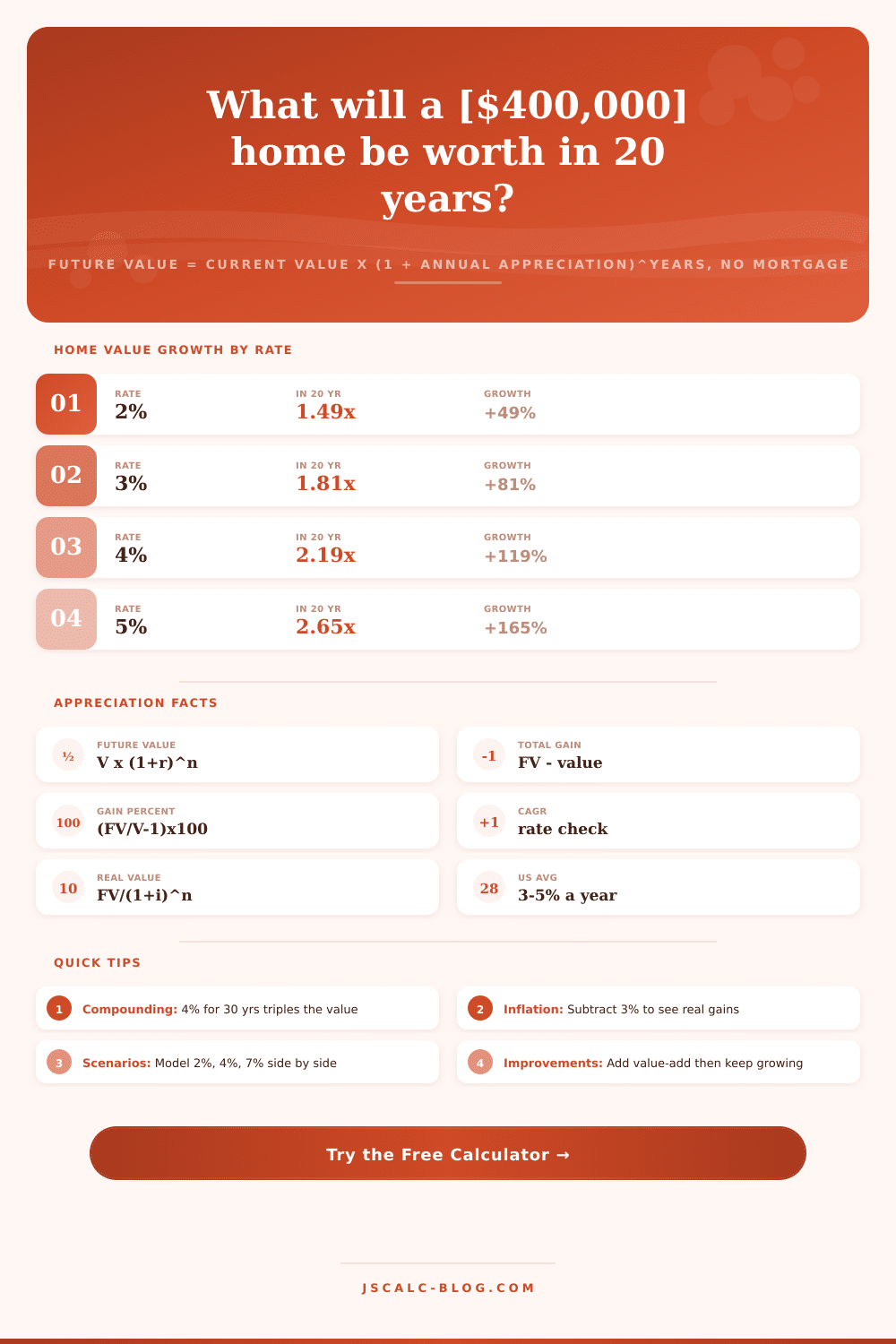
| 2% | 1.22x | 1.49x | 1.81x | 35 years |
| 3% | 1.34x | 1.81x | 2.43x | 23 years |
| 4% | 1.48x | 2.19x | 3.24x | 18 years |
| 5% | 1.63x | 2.65x | 4.32x | 14 years |
| 6% | 1.79x | 3.21x | 5.74x | 12 years |
| 7% | 1.97x | 3.87x | 7.61x | 10 years |
| 8% | 2.16x | 4.66x | 10.06x | 9 years |
The doubling time uses the Rule of 72, an approximation: 72 divided by the annual rate.
🗃Scenario Comparison Grid
| Scenario | Rate | Years | Start Value | Nominal FV | Real FV (3%) | Total Gain |
|---|---|---|---|---|---|---|
| Cooling market | 2% | 20 | $400,000 | $594,379 | $329,187 | $194,379 |
| Steady suburb | 3% | 20 | $400,000 | $722,444 | $400,000 | $322,444 |
| US long-run avg | 4% | 20 | $400,000 | $876,449 | $485,281 | $476,449 |
| Strong region | 5% | 20 | $400,000 | $1,061,319 | $587,656 | $661,319 |
| High-growth metro | 6% | 20 | $400,000 | $1,282,854 | $710,320 | $882,854 |
| Hot boom market | 7% | 20 | $400,000 | $1,547,437 | $856,850 | $1,147,437 |
| Long hold slow | 3% | 30 | $400,000 | $970,908 | $400,000 | $570,908 |
| Long hold avg | 4% | 30 | $400,000 | $1,297,336 | $534,566 | $897,336 |
Real FV columns discount the nominal figure by 3 percent inflation per year to show buying power in today's dollars.
⚙Formula Breakdown
💡Home Appreciation Planning Tips
The math of real estate is not art; it’s math. More precisely, it’s the math of compounding. In your bank account, as you know, money earns interest. But did you realize that so does your house? That’s what the calculator above helps with, the question you find yourself asking upon seeing your property tax bill: How much will this house appreciate in twenty years?
It strips out the property taxes and mortgage payments so you can see only the pure appreciation of the underlying asset. This is, franky, rare and useful. There’s no straight line to appreciation; there’s only a curve. On paper, standard formula says that the future value is equal to today’s value times the rate raised to power of years.
How to Calculate House Value Growth
Sounds dry? In practice, it’s a dramatic story. When you plug in numbers, you get to see that curve emerge. “Four percent per year doesn’t sound like much,” you say, and then you raise it to the third decade. That’s when the magic happens. Because the base value is so low, early appreciation builds gradualy. But after the value increase, every additional percentage increase stacks higher, adding more dollars than before.
Homeowners underestimates this acceleration, they’re hard-wired to think linearly, not exponentially. There’s no such thing as the right appreciation rate to count on indefinitely. In boom markets, everything expand; in slumpy markets, everything contracts. That’s why it’s better to model scenarios rather than guess at an appreciation rate.
Your suburb may have remained steady for years, but what if interest rates spike? What if your ‘hood suddenly becomes popular with tech workers? The app allows you to run both of these estimates: a conservative estimate, and a hot market projection. Having those two extremes side-by-side grounds your expectations. If it looks like the numbers is running slowly, you won’t sell too soon. If it sounds unrealistically good, you won’t buy to late.
Nominal value is where we get tripped up. Doubling the value of your house doesn’t make you twice as wealthy if all other prices has also doubled. Inflation eats away at our wealth quietly. That’s why the calculator has an option to adjust for inflation. By entering your desired inflation rate, it tells you what your future equity is realy worth… Its purchasing power in today’s dollars.
For example, if your house increases in value by six percent per year, while inflation averages three percent, then your true return will be around three percent. And that’s the number you want to plug into your retirement calculations. Always look beneath the headline number, and see how much you’re actualy gaining.
But improvements alter the calculation. Renovating means injecting capital, yes, spending money (into your property). By finishing a basement or upgrading a kitchen, you increase the underlying value from which growth compound moving forward. Fifty grand spent on upgrades in year five begins to grow starting then. It doesn’t simply sit there. That’s why the calculator includes the improvement amount in whatever year you specify, allowing it to compound along with the rest of the house. This captures the core of being an active homeowner more accurate than passive appreciation.
It’s easy to use and demands honesty. Input your current market value (no decade-old nostalgia). Select an appreciation rate from historical norms in your area (typically 3-5% annually for the long term). Choose your investment horizon: Flip or nest egg? Five years or thirty? Optional: include inflation. Voila! It’ll show you the percentage increase, total gain, and future value. Scroll down the milestone grid and notice how arc steepens with time.
That’s what this calculator is for: converting hazy dreams into hard data. Real estate is both financial and emotional, but you can’t base a decision on emotion alone. You may want to know if you should sell or hold, or if you should spend additional money improving your property. In these cases, understanding its appreciation potential, all by itself, are helpful. This takes the guess-work out of your long term plan.
You don’t have to guess right; you only have to grasp the concept of compounding, and put the figures in front of you so that you can run them yourself. The numbers don’t give a damn about your emotions. But they’ll reward your patience, given time to compound over decades.