Comparable Sales Adjustment Calculator
Value a home the way appraisers do with the sales comparison approach. Enter your subject property and up to three recent comparable sales, apply feature adjustments with the correct sign, and reconcile a single weighted indicated value while watching the 25 percent gross adjustment guideline.
🏠Real Appraisal Scenarios
📍Subject Property and Adjustment Rates
Gross living area of the home being valued.
Total bedroom count.
Full baths; use 0.5 for a half bath.
Number of covered garage spaces.
Total site area of the subject lot.
In-ground pool present or not.
Contributory value per extra square foot.
Value of one additional bedroom.
Value of one full bathroom.
Value of one garage space.
Contributory land value per square foot.
Flat adjustment applied for a pool difference.
🏢Comparable Sales (up to 3)
Comparable 1
Closed sale price of comp 1.
Relative weight for the final blend.
Comparable 2
Closed sale price of comp 2.
Relative weight for the final blend.
Comparable 3
Closed sale price of comp 3. Set to 0 to skip.
Relative weight for the final blend.
🔢Formula Snapshot
📊Live Comparison Grid
| Line Item | Subject | Comp 1 | Comp 2 | Comp 3 |
|---|---|---|---|---|
| Sale price | -- | -- | -- | -- |
📋Adjustment Sign Rule Reference
| Feature | Comp vs Subject | Direction | Reasoning |
|---|---|---|---|
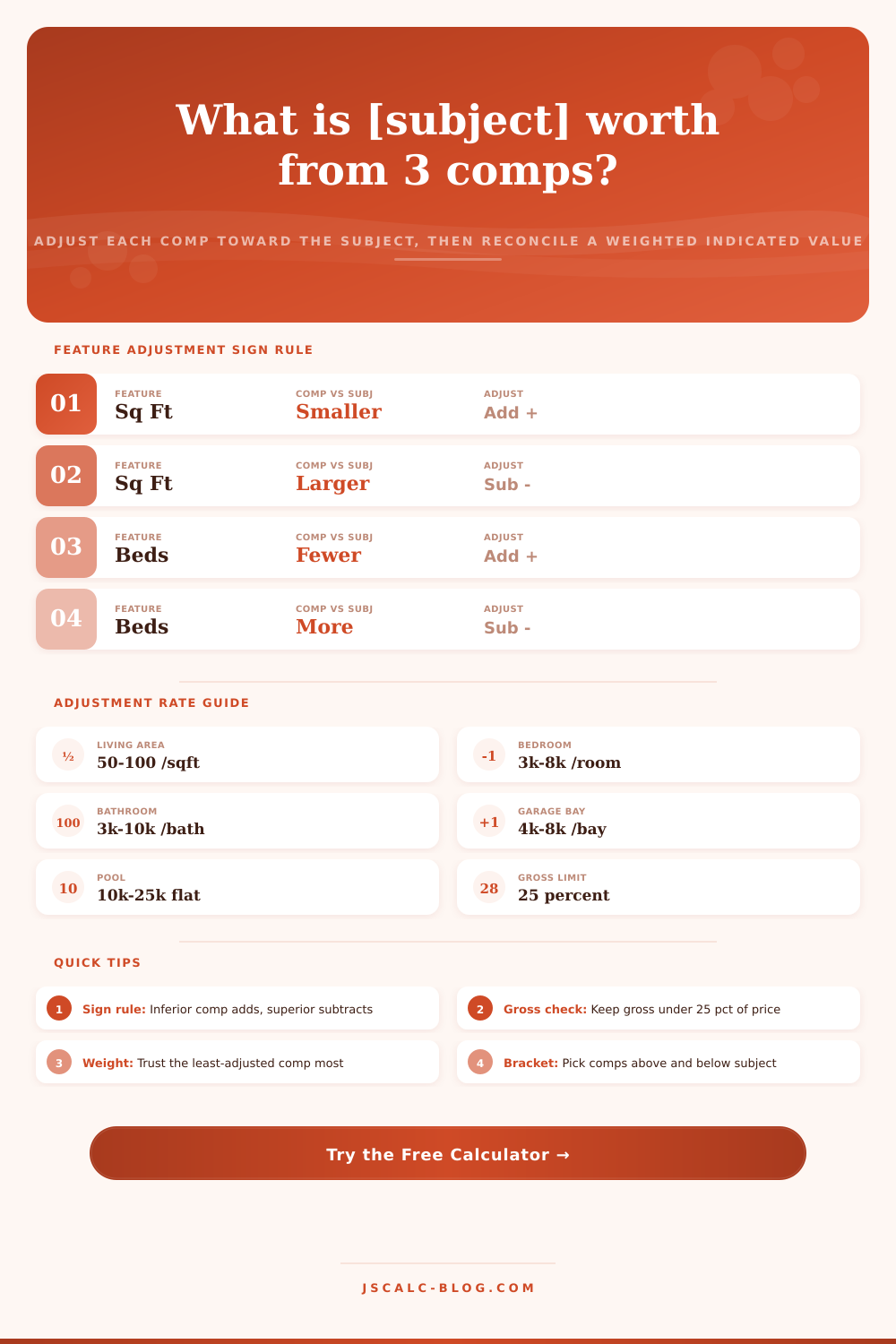
| Living area | Comp smaller | Add + | Comp is inferior, raise it toward subject |
| Living area | Comp larger | Subtract - | Comp is superior, lower it toward subject |
| Bedrooms | Comp has fewer | Add + | Subject offers more sleeping space |
| Bathrooms | Comp has more | Subtract - | Comp has extra bath value to remove |
| Garage | Comp has fewer bays | Add + | Subject parking is superior |
| Lot size | Comp smaller lot | Add + | Subject land is worth more |
| Pool | Comp has none | Add + | Subject amenity not in the comp price |
| Pool | Comp has pool | Subtract - | Remove amenity the subject lacks |
💰Typical Adjustment Rate Ranges
| Feature | Common Range | Unit | Notes |
|---|---|---|---|
| Living area | $50 - $100 | per sq ft | Use market-derived paired sales |
| Bedroom | $3,000 - $8,000 | per room | Only if it changes utility |
| Bathroom | $3,000 - $10,000 | per bath | Full baths worth more than halves |
| Garage bay | $4,000 - $8,000 | per bay | Varies with climate and region |
| Lot size | $2 - $10 | per sq ft | Land value falls at the margin |
| Pool | $10,000 - $25,000 | flat | Contributory, not cost to build |
| Gross guideline | 25% | of price | Fannie Mae reviewer flag |
⚙Formula Breakdown
💡Appraisal Adjustment Tips
Sometimes Zestimate misses nuances about a house. Maybe it has a tiny lot or a weird extra half bath. That’s when computer estimate fall short. To correct for these oddities, pros do what’s called the sales comparison approach. They’ll comb through recent sale in the area, then nudge up and down prices until they matches yours (feature-by-feature). It’s tedious on paper, but it converts raw sale price into useful data points.
Once you input your specifics, math happens inside our calculator. Then you’re free to think about logic, not the arithmetic. The premise behind this approach is that a rational buyer won’t pay more for one house then they could spend on another similar house that they want just as much.
How to Calculate Your Home Value
Because no two houses are alike, appraisers begins with a list of recent sales and make adjustments for variances in features. Example: Your house has two more bedrooms than the comparable; so, you must increase the value of that comparable to make up for what it lacks. What was your comparable worth with two more bedroom? That’s the adjustment.
Here’s where people often get confused when they first hear about the sign rule: You always move the comparable toward the subject. When the comparable is inferior on some feature, you give it money. When it’s superior, you take money away from it. The calculator does this for you automaticaly. It compares the attribute of your subject to each of the comps so the signs can never flip backwards.
How do you determine adjustment rates? It is partly science and partly art. The numbers represent what the addition adds to home’s value, which is typically less than true construction expenses. Fifteen thousand may be what it costs to add a bath, yet your buyers will only shell out an additional five grand for the luxurius. So five grand is the right amount for the grid. Inflated figures will twist your outcome above and beyond what real world would justify.
Real estate pros base their rates based off side-by-side sales analysis. That means they’ll look at two similarly configured house where one has just one difference: a bathroom, perhaps, or a garage bay. Start by finding the typical market range. The reference table on this page shows some typical ranges by feature. In a snowy locale, that garage bay could be worth eight thousand bucks; in a car-centric city where plenty of off-street parking exists on the streets, maybe it’s only three thousand.
You can also reconcile up to three comps into a final indicated value with the tool. And reconciliation isn’t simply an average. It’s a weighted average. For example, if you have one comp that is nearly identical to yours and another that is significantly different, use more similar one more heavily in your final value. The further away from your subject property a comp is, the less an appraiser trust it after adjustment (because there’s more room for error). With the calculator you can weight each of the sales accordingly, mixing them together to create a final value which takes into account their level of reliability. This is what distinguishes a rough guess from a defensible estimate.
The most important check is the Gross Adjustment Percentage. When the total amount of absolute adjustments equals or exceeds 25% of the sale price, the lender flag it and so do reviewers. This means the comp’s adjustments was made too big to match your subject, so it is probably not a good comparison. The calculator calculates this for you and warns you when a comp has been pulled on a string too tight. It makes you either discard the data accordingly or find some stronger comps. You should of checked that first.
A good tip: bracket your own house. Select an above-home-size comp, ideally at least one higher; and below-your-house-size comp. Why? So that when you adjust for features, they go in opposite directions. That cancels some bias, putting the end result smack dab in the middle of the likely range.
Most similar sales are within spitting distance of a solid appraisal. If you’re thinking about your house’s value, don’t think in terms of “X dollars per square foot.” Think about every feature as its own factor. That turns fuzzy intuition into itemized proof. Instead of asking how much your house is worth, you prove exactly how much it’s worth.