Sound Velocity Calculator
Find the speed of sound in air by temperature, in water and seawater, and through solids like steel and aluminum. Also solve Mach number, travel time over a distance, and the lightning-to-thunder gap.
🎯Real Sound Scenarios
📝Sound Inputs
Only affects air. Uses the unit chosen below.
Used only when medium is Custom fixed speed.
Used when the fourth result is thunder distance.
🔢Formula Snapshot
🌍Speed of Sound by Medium
| Medium | Speed m/s | Speed ft/s | Speed mph | Vs Air 20°C | Notes |
|---|---|---|---|---|---|
| Enter values above to load the medium comparison. | |||||
🌡Air Temperature Effect
| Temp °C | Temp °F | Speed m/s | Speed ft/s | Speed mph | Vs 0°C |
|---|---|---|---|---|---|
| The temperature table appears after calculation. | |||||
✈Mach Number Reference
| Mach | Label | Speed m/s | Speed mph | Example |
|---|---|---|---|---|
| 0.30 | Low subsonic | 103 | 230 | Light aircraft cruise |
| 0.80 | High subsonic | 274 | 614 | Airliner cruise speed |
| 1.00 | Sonic | 343 | 767 | Sound barrier at 20°C |
| 1.30 | Transonic | 446 | 997 | Early supersonic dash |
| 2.00 | Supersonic | 686 | 1535 | Concorde class cruise |
| 3.20 | Fast supersonic | 1098 | 2455 | SR-71 reconnaissance |
| 5.00 | Hypersonic | 1715 | 3836 | Scramjet test vehicle |
⛈Thunder Distance Guide
| Gap (s) | Miles | Kilometers | Feet | Meters | Rule of Thumb |
|---|---|---|---|---|---|
| The thunder distance table appears after calculation. | |||||
🗂Sound Scenario Comparison Grid
| Scenario | Medium | Condition | Speed m/s | Speed mph | Vs Air 20°C |
|---|---|---|---|---|---|
| Cold winter air | Air | –20°C | 319 | 713 | 0.93x |
| Room temperature | Air | 20°C | 343 | 767 | 1.00x |
| Hot desert day | Air | 45°C | 358 | 801 | 1.04x |
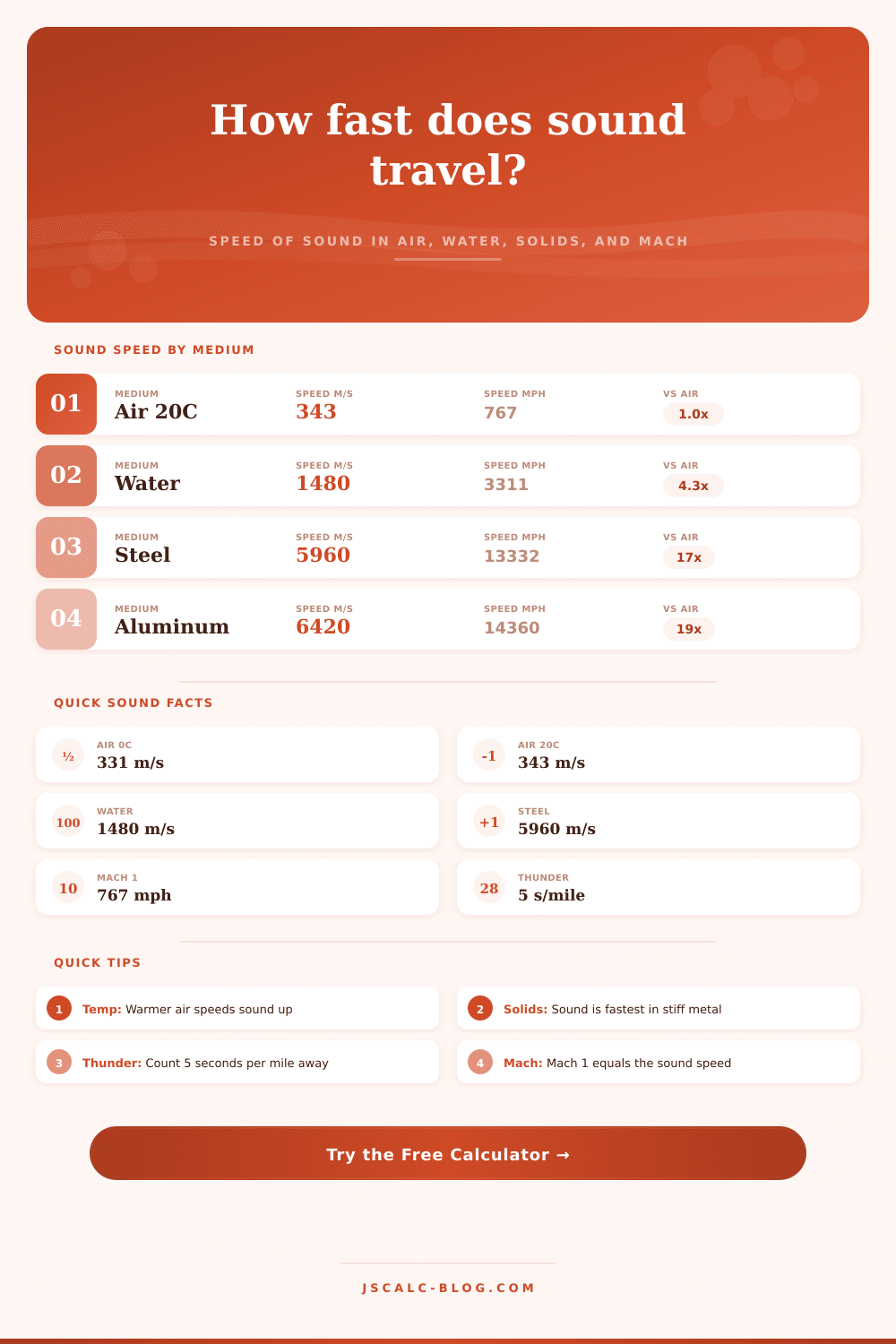
| Swimming pool | Fresh water | Typical | 1480 | 3311 | 4.31x |
| Ocean sonar | Seawater | Typical | 1522 | 3405 | 4.44x |
| Ear on the rail | Steel | Typical | 5960 | 13332 | 17.4x |
⚙Full Formula Breakdown
📋Reference Values
| Item | Typical Value | How It Is Used | Effect on Result |
|---|---|---|---|
| Air at 0°C | 331.3 m/s | Base speed in the formula | Anchor for the temperature curve |
| Temp rise | +0.606 m/s per °C | Warmer air moves sound faster | Higher speed and shorter travel time |
| Fresh water | 1480 m/s | Fixed medium speed | About 4.3x faster than air |
| Steel | 5960 m/s | Fixed medium speed | About 17x faster than air |
| Mach 1 | Equals medium speed | Reference for object speed | Object Mach scales with it |
💡Practical Sound Tips
The reason we know lightning precedes thunder (besides watching the occasional movie) is that sound moves slower than light. That delay give us an idea of distance… Closer if the delay is brief; farther away if the gap gets longer.
That’s just one instance where measuring speed of something reveals a lot about how environment works. In this case, the speed of a pressure wave through the air depend on the material and its conditions. (The calculator does the math for you.)
How Temperature Changes Sound Speed
In our example, when you hear thunder, the sound has taken some time to travel from the cloud back to you. Why? Because your ear wait for air molecules to pick up vibration and send it along to you, whereas your eye sees light immediately.
The speed of sound isn’t a given like gravity, as many think; it change according to warmth. The warmer the air the faster its molecules move and collide, sending vibrations faster. For every 10 degrees C the speed increase about six meters/second. This is a significant variable in determining how far away a bolt of lightning hit was or how to time sound during an outdoor performance.
Why? Because we incorrectly perceive colder air as moving slowly, what’s actualy important is how fast the particles that carry the wave are moving. Sound works different in water than in air. Sound travels roughly four times as fast through water (compared to room temperature air), and although it is denser, it is also much less compressible. For example, this is why your voice does not travel far in air, but whales can reach each other from miles away.
From the table: Steel transmits vibration almost twenty times faster than air does, which is one reason engineers rely on it to sense when their frames are stressed before any damage becomes visible to the naked eye. Not only does density matter, but also material’s stiffness.
Mach numbers measure speed by dividing an object’s speed by speed of sound (for example, if it moves twice as fast than the speed of sound, it is moving Mach 2). So when we say a plane breaks the sound barrier, there’s no exact number on your speedometer they’re hitting. Depending on the weather conditions, it might still be below the sound barrier even though it is going faster then another jet over that warm runway.
That’s where the tool comes in. You can plug in various temperatures and see where the Mach speed will change. Whether it’s for a physics problem or trying to figure out a calculation in aviation, it takes the guessing out.
There’s an old saying that says five seconds equals one mile for thunder distance. That works out to about a mile per five-second interval, under average (sea level) conditions. At higher elevations, though, sound speed slow down a bit. Sound also moves faster in warm air, and slower in cold air. The calculator takes all those factors into account: no need to remember complicated atmospheric math.
It converts scientific knowledge into real-world use. Whether your goal is safety from lightning or simply following a set of moddern model airplane scale rules. It turns the intangible world of science into something tangible.
Next time you’re outdoors when thunder rolls through the area, listen carefuly. You are actualy taking a measurement of sky’s temperature without even knowing it.