Implied Probability Calculator
Convert American, decimal, and fractional betting odds into implied probability and back, measure the sportsbook vig or overround on a two-way market, and read the break-even win rate every price demands.
🎲Real Odds Presets
📝Odds Inputs
Choose how you want to enter the price. Fields below change to match.
Used only to illustrate profit and return.
Enter a positive underdog or negative favorite price.
Total return per 1 unit staked, must exceed 1.00.
Example 5/1 means profit of 5 for every 1 risked.
Your estimated win chance, converted back to fair odds.
One outcome of the two-way market.
The opposite outcome; the pair reveals the vig.
🔢Conversion Snapshot
📊Odds Format Conversion Reference
| American | Decimal | Fractional | Implied Probability | Read As |
|---|---|---|---|---|
| -1000 | 1.10 | 1/10 | 90.9% | Overwhelming favorite |
| -500 | 1.20 | 1/5 | 83.3% | Heavy favorite |
| -300 | 1.33 | 1/3 | 75.0% | Strong favorite |
| -200 | 1.50 | 1/2 | 66.7% | Clear favorite |
| -150 | 1.67 | 2/3 | 60.0% | Modest favorite |
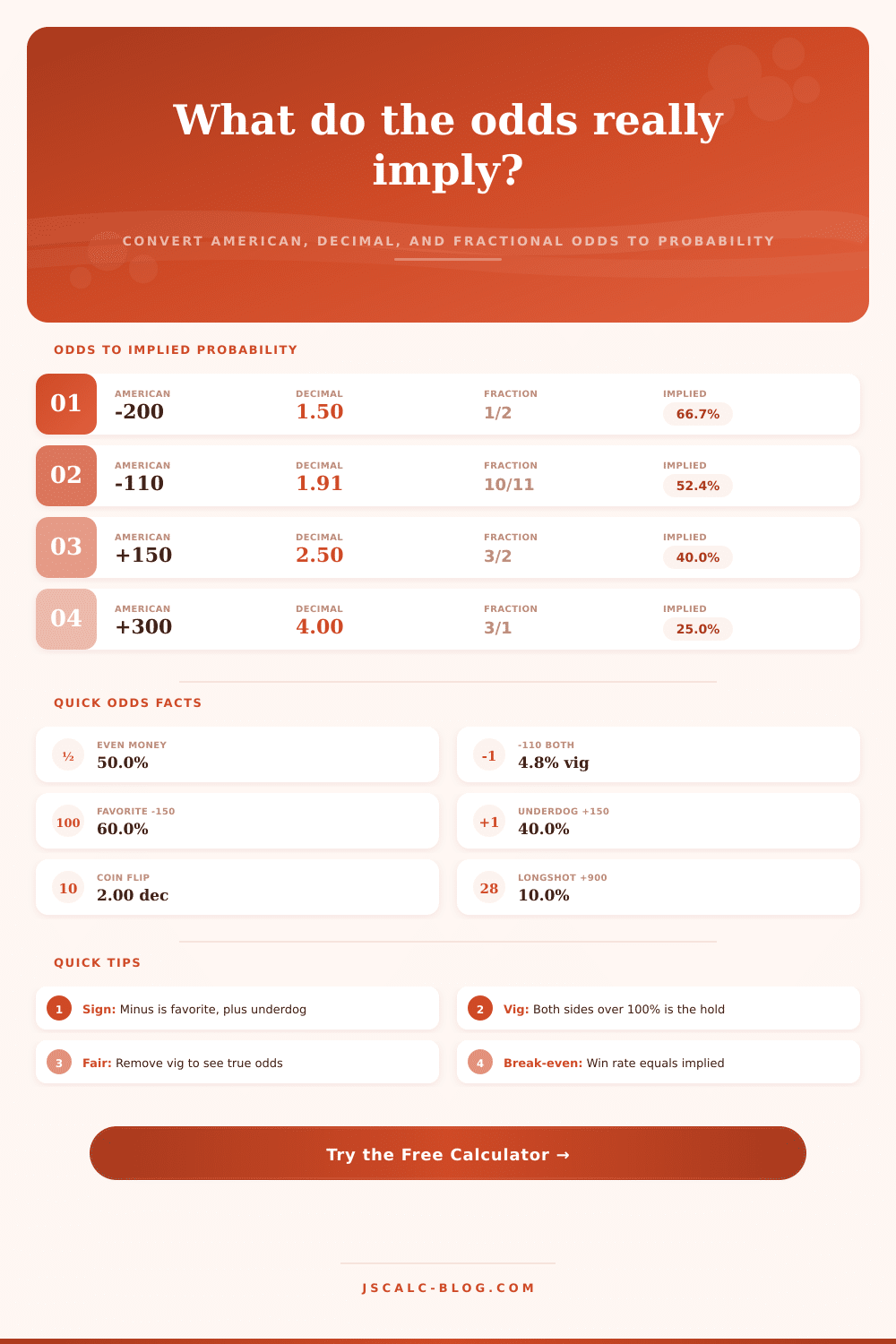
| -110 | 1.91 | 10/11 | 52.4% | Standard juice |
| +100 | 2.00 | 1/1 | 50.0% | Even money |
| +150 | 2.50 | 3/2 | 40.0% | Modest underdog |
| +250 | 3.50 | 5/2 | 28.6% | Clear underdog |
| +400 | 5.00 | 4/1 | 20.0% | Big underdog |
| +900 | 10.00 | 9/1 | 10.0% | Longshot |
🎯Break-Even Win Rate Reference
| Odds | Decimal | Implied / Break-Even | Profit per $100 | Wins Needed of 100 |
|---|---|---|---|---|
| -300 | 1.33 | 75.0% | $33.33 | 75 wins |
| -200 | 1.50 | 66.7% | $50.00 | 67 wins |
| -110 | 1.91 | 52.4% | $90.91 | 53 wins |
| +100 | 2.00 | 50.0% | $100.00 | 50 wins |
| +120 | 2.20 | 45.5% | $120.00 | 46 wins |
| +200 | 3.00 | 33.3% | $200.00 | 34 wins |
| +300 | 4.00 | 25.0% | $300.00 | 25 wins |
| +500 | 6.00 | 16.7% | $500.00 | 17 wins |
💰Payout & Vig Comparison Grid
| Market | Side A | Side B | Implied A | Implied B | Overround | Hold % |
|---|---|---|---|---|---|---|
| No-vig fair | +100 | -100 | 50.0% | 50.0% | 100.0% | 0.0% |
| Standard -110 | -110 | -110 | 52.4% | 52.4% | 104.8% | 4.5% |
| Reduced juice | -105 | -105 | 51.2% | 51.2% | 102.4% | 2.4% |
| Wide spread | -120 | +100 | 54.5% | 50.0% | 104.5% | 4.4% |
| Lopsided line | -250 | +200 | 71.4% | 33.3% | 104.8% | 4.5% |
| Heavy hold | -130 | -130 | 56.5% | 56.5% | 113.0% | 11.5% |
| Prop-style | -140 | +110 | 58.3% | 47.6% | 105.9% | 5.6% |
| Sharp market | -108 | -102 | 51.9% | 50.5% | 102.4% | 2.3% |
⚙Full Formula Breakdown
📋Vig, Overround & Hold Explained
| Term | What It Means | How To Read It | Bettor Impact |
|---|---|---|---|
| Implied probability | Win chance baked into a price | Convert the odds you see | Your break-even win rate |
| Overround | Sum of both sides implied | Values above 100% | Shows the built-in margin |
| Vig or juice | The book fee inside the line | Overround minus 100% | Lowers long-run return |
| Hold percent | Margin as share of the market | (over − 1) / over | The book edge per dollar |
| Fair (no-vig) odds | Prices rescaled to 100% | Normalize each side | Truer probability estimate |
💡Practical Odds Tips
The odds say one thing. The game says another. Most bettors make their money based off that gap between what they think should happen, and what the market prices them to believe will happen. Why? They’ve confused value with likelihood.
Once you get comfortabley plugging in your line, the calculator do all the math for you. You no longer have to guess if a price is actualy worth a bet or if it just makes you feel smarter on paper. Implied probability isn’t so much about predicting future as it is about auditing the cost of your ticket.
How to Find Value in Betting Odds
Odds is nothing but a series of numbers where a portion of each number is the bookmaker’s guess at how likely something will happen. So if you’re facing decimal odds of 2.50, you may look at them and say “I’m going to win one out of two point five times.” What’s actualy happening is a bit more complex. To figure out the raw implied probability you simply divide one by the decimal. Here it equals 40%. That means you must win 40% of the time for every dollar wagered just to break even. Not accounting for any fees.
Simple math? Sure. But make a mistake here and you’ll end up on a losing streak while assuming you have an edge when in fact you do not.
But that doesn’t mean sportsbooks operates like a charity. To ensure they makes money either way, they construct a margin into their lines. We call it juice or vig. That’s where the implied probabilities inflates. Because if you see both sides of a coin flip at -110, then the math tell us there’s an implied probability around 52.4% on each side. That equals more than 104%, adding them both up. That’s the percentage which is going toward the house. It’s taking its cut. You can see all of this made clear in reference table on the page.
Different types of markets have different amount of hidden costs. That margin must be stripped away to arrive at true odds of any event. Doing so levels the chances, brings them back down to earth where they belong in reality at a grand total of 100%. That gives us fair odds without the overhead from the bookie.
The fair chance can then be compared to your own calculated chance of one team beating another. Is there any genuine value? If you think a team has a 55% chance to win but their odds after removing the vig suggest only 48%, you’ve found an edge. Anything below your own estimation mean you’re overpaying and not getting enough bang for your buck.
I think one of the biggest mistakes people make is focusing solely on who they think will win without considering if the price is right. Sure, you might bet on someone and win but if the odds were to short to account for long-term variance, you’ll still end up losing money. On the other hand, if you’re betting on someone because you think the value is there even though he/she has a low probability of winning, those are smart plays.
You can also use the tool to reverse the calculation. Say you think a team has a 60% chance to win. Simply enter in that percentage and you’ll be able to determine what the fair American or decimal odds should of been. That way, you can set your own standard prior to seeing what’s available from any sportsbook. Force yourself to define your edge first and then go find a price that honors that edge.
Numbers aren’t everything. For instance, a line may appear attractive on its own merits but be less appealing once you factor in motivational elements, weather, or recent injuries. The calculator serve as a mathematical starting point, while your judgment fills in the blanks of contextual factors. In other words: You’re haggling with the marketplace. Understanding what break-even rate applies to each stake informs your expectations. Does it take a 75% win rate to turn a profit? Then you’d better have a lot of confidence in your pick.
Many people falls into the trap of chasing marginal action which gradually erodes their bankroll. In the end, it’s all about risk management and margins. Betting is a business. And if you know where to look, the numbers will show you the hidden costs. But they won’t lie.
Strip out the vig, convert odds to probabilities, and you’re no longer making guesses; you’re doing math. Instead of games, you see market in terms of prices. This shift in perspective separates the observer from the participant. This distinction is what makes an informed bettor different than a casual one. You no longer watch the scoreboard. You read the value. It is the same game, but with a sharper eye.