Hash Collision Probability Calculator
Estimate the birthday-paradox probability that at least two of your hashed items share the same digest. Pick a hash algorithm or custom bit length, enter how many items you hash, and see the collision odds, the output space N = 2^b, and how many items push you to a 50 percent or custom-probability collision.
🔑Real Hashing Scenario Presets
📝Hash and Item Inputs
Sets the hash output space N = 2 to the power of the bit length.
Used when algorithm is set to custom. N = 2^b outputs.
The k count. Enter the leading number, e.g. 1 or 3.4.
Scientific exponent. 9 means one billion (1 x 10^9) items.
Reverse calc: how many items reach this collision chance.
Controls rounding on the result cards and breakdown.
🔢Formula Snapshot
📋Hash Output Space by Algorithm
| Algorithm | Bit Length b | Output Space N = 2^b | Typical Use |
|---|---|---|---|
| CRC32 | 32 | 4.295 x 10^9 | Error check, not security |
| Custom 64-bit | 64 | 1.845 x 10^19 | Hash tables, short IDs |
| Custom 96-bit | 96 | 7.923 x 10^28 | Truncated digests |
| UUID v4 | 122 | 5.316 x 10^36 | Random unique IDs |
| MD5 | 128 | 3.403 x 10^38 | Checksums, broken crypto |
| SHA-1 | 160 | 1.461 x 10^48 | Legacy, Git object IDs |
| SHA-256 | 256 | 1.158 x 10^77 | Modern security standard |
| SHA-512 | 512 | 1.341 x 10^154 | High-margin hashing |
🎉The Classic Birthday Problem
| People in Room | Days N = 365 | Shared Birthday P | Reads As |
|---|---|---|---|
| 5 | 365 | 2.7% | Very unlikely |
| 10 | 365 | 11.7% | Roughly 1 in 9 |
| 23 | 365 | 50.7% | Even odds |
| 30 | 365 | 70.6% | More likely than not |
| 40 | 365 | 89.1% | Almost certain |
| 50 | 365 | 97.0% | Nearly guaranteed |
| 60 | 365 | 99.4% | Practically sure |
| 70 | 365 | 99.9% | Effectively certain |
📊Collision Probability at Item Counts
| Hash | Bits | Items k | Approx Collision P | Comment |
|---|---|---|---|---|
| CRC32 | 32 | 1,000 | 1.16 x 10^-4 | 1 in 8,590 |
| CRC32 | 32 | 100,000 | 68.8% | Likely collision |
| MD5 | 128 | 1 x 10^9 | 1.47 x 10^-21 | Negligible by count |
| MD5 | 128 | 2.2 x 10^19 | 50% | Birthday bound |
| SHA-1 | 160 | 1 x 10^12 | 1.73 x 10^-24 | Vanishing |
| SHA-256 | 256 | 1 x 10^18 | 4.32 x 10^-42 | Effectively zero |
| UUID v4 | 122 | 1 x 10^9 | 9.40 x 10^-20 | Safe for IDs |
| 64-bit | 64 | 5 x 10^9 | 73.7% | Collision likely |
🗃Bit Length Comparison Grid
| Algorithm | Bits b | Output Space N | k for 50% | k for 1e-9 P | Security Level | Status |
|---|---|---|---|---|---|---|
| CRC32 | 32 | 4.3 x 10^9 | 77,163 | 2.93 | 16-bit | Integrity only |
| Custom 64 | 64 | 1.8 x 10^19 | 5.06 x 10^9 | 1.92 x 10^5 | 32-bit | Weak |
| Custom 96 | 96 | 7.9 x 10^28 | 3.31 x 10^14 | 1.26 x 10^10 | 48-bit | Marginal |
| UUID v4 | 122 | 5.3 x 10^36 | 2.71 x 10^18 | 1.03 x 10^14 | 61-bit | Good for IDs |
| MD5 | 128 | 3.4 x 10^38 | 2.17 x 10^19 | 8.25 x 10^14 | 64-bit | Broken crypto |
| SHA-1 | 160 | 1.5 x 10^48 | 1.42 x 10^24 | 5.40 x 10^19 | 80-bit | Deprecated |
| SHA-256 | 256 | 1.2 x 10^77 | 4.01 x 10^38 | 1.52 x 10^34 | 128-bit | Recommended |
| SHA-384 | 384 | 3.9 x 10^115 | 7.42 x 10^57 | 2.82 x 10^53 | 192-bit | Strong |
| SHA-512 | 512 | 1.3 x 10^154 | 1.37 x 10^77 | 5.18 x 10^72 | 256-bit | Very strong |
⚙Formula Breakdown
💡Collision Risk Tips
Intuition might tell you that hashing one billion records with SHA-256 is fine, there’s just too many different possible outputs for it to go wrong. Unfortunatly, that intuition breaks down because collision math deals in pairs, not single items. This calculator help connect the dots between theoretical security and real-world risk.
The underlying idea is that numbers comes from something called the birthday paradox, a statistical quirk about how the likelihood that any two things will share some trait increases far faster than your intuitive (linear) mind think. It doesn’t require filling whole thing up before you’re finding duplicates, just enough pairs that they’ll probably overlap with each other.
Why Collisions Happen Faster Than You Think
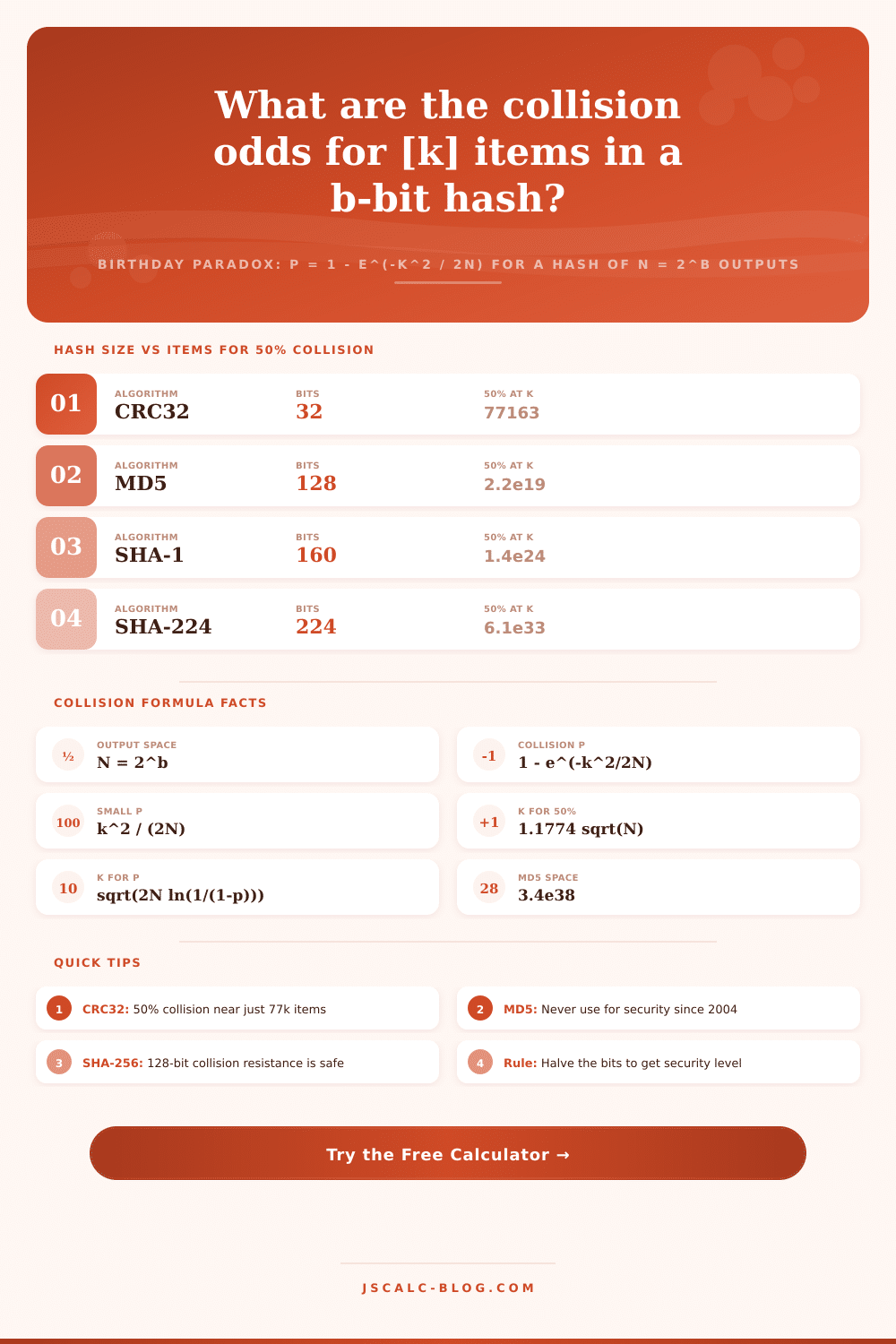
The key here is the output space: the number of possible hashes you can get from any given input, which we call $N = 2^b$, where $b$ is the bit length of your hash function. Then the collision probability for some number $k$ of hashed inputs is about $1, e^{-k^2/2N}$. Note that this has an exponent of $k^2/2N$. This is what makes things go crazy. As that fraction gets larger, chance of having a collision approaches one; when it’s tiny, there’s almost no chance of a collision. This is why it should of been calculated in logspace rather than trying to compute $2^{512}$ in your browser.) The tool use logarithmic space so your browser doesn’t crash trying to calculate these massive exponents directly.
This insight also protect systems from nasty surprises. Engineers who know that bigger is always better for hashes don’t realize the halving effect exists. A $b$-bit hash only has roughly $b/2$ bits of collision resistance. Consider a 64-bit identifier. You probably reason that there’s plenty of room left. According to calculator, it takes only slightly more than five billion items before your probability of collision hits 50 percent. That’s much less then all of the available space, which is almost 18 quintillion. The square root relationship tells you the danger zone comes way earlier than you’d expect.
Take UUID version 4, which relies on 122 random bits. That’s a big number! So it seems like it should be pretty secure. But in practice, it has an effective security level more like 61 bits. For nearly all applications this is still an extremely low probability of collision. But if you’re creating identifiers in the trillions, then things become difficult. With the tool, you can instantly test what those scenarios look like, and don’t have to wrestle with understanding scientific notation yourself. See just how many UUIDs it would take to push the probability over your comfort threshold.
Not so with shorter hashes such as CRC32. It has a mere 32 bits, which results in an output space of slightly more than four billion possibilities. According to calculator, it takes about 77,000 entries for there to be a 50 percent chance of a collision. That’s pretty darn small. In other words, if you’re using checksums as a method of file integrity within a large dataset, your silent duplicates are going to arrive fast. It doesn’t make CRC32 invalid, but rather it points out that its purpose isn’t uniqueness enforcement, it’s error detection.
The tool even shows how the probability rises quickly as bit length drops. These days, a hash function like SHA-256 has 128 bits of collision resistance, which is considered secure from birthday attacks. It’s large enough to be bordering on physically impossible with today’s tech, meaning you would need so many things that the chances of it happening are equal. But if you’re working with a hash function, you should know what you can trust it for.
If you truncate a SHA-256 digest to conserve space, then you’ve cut your length in half (twice) and thus cut your effective security in half, too. Once again, there’s a good chance you don’t realize how unsafe this makes your data. This also lets you invert the calculation. What if I want to know how many items are safe at a specific amount of risk? That’s just as easy: you pick some target level of probability (e.g. “one in a billion”) and it tells you how many things would need to be stolen before you go over that line. That’s handy when doing capacity planning. It turns airy-fairy crypto talk into hard engineering constraints. From then on, you’re not guessing; now you’re designing with limits.
In the end, it’s all about collision probability, i.e., taking steps to reduce risk up to some level of tolerance. This goes against what our linear brains expect, which explains why numbers seem so counter-intuitive. Instead of relying on fear, pick a hash length based off the size of your real-world data set, not an arbitrary estimate of it. The math works regardless if you’re searching for duplicate files or creating a distributed database. Just take enough samples until you have a match, and the birthday paradox says it will be faster than you’d expect.