Final Drive Gear Ratio Calculator
Combine your transmission gear ratio with the axle or differential ratio to get the overall final drive, then find engine RPM at any road speed, cruise speed at a target RPM, or the axle ratio needed to hit a chosen highway RPM.
🎯Real Drivetrain Presets
⚙Drivetrain Inputs
1.000 is a direct top gear; below 1.000 is overdrive.
Ring gear teeth divided by pinion teeth, e.g. 41 / 11 = 3.73.
Loaded rolling diameter of the drive tire.
Used when the diameter method is tire size.
Used in RPM mode and axle mode.
Used in speed mode and as the target in axle mode.
Sets the theoretical top speed in the selected gear.
🔢Formula Snapshot
🚗Final Drive by Transmission Gear
| Gear | Trans Ratio | Axle Ratio | Final Drive | RPM at Speed | Top Speed (redline) |
|---|---|---|---|---|---|
| Enter values above to build the per-gear table. | |||||
📊RPM by Axle Ratio at Speed
| Axle Ratio | Final Drive | RPM at Speed | vs Current | Character |
|---|---|---|---|---|
| The axle sweep appears after calculation. | ||||
🗂Overdrive vs Direct Comparison Grid
| Setup | Trans Gear | Axle | Final Drive | RPM at 70 | Best For |
|---|---|---|---|---|---|
| Deep overdrive | 0.62 | 3.55 | 2.20 | 1,850 | Flat highway economy |
| Tall overdrive | 0.70 | 3.73 | 2.61 | 2,190 | Balanced cruiser |
| Mild overdrive | 0.82 | 3.73 | 3.06 | 2,570 | Rolling hills, some load |
| Direct drive | 1.00 | 3.73 | 3.73 | 3,130 | Classic 4-speed top |
| Direct + steep axle | 1.00 | 4.10 | 4.10 | 3,440 | Quick launch, towing |
| Low gear crawl | 2.48 | 4.56 | 11.31 | 9,490 | Off-road, heavy pull |
📋Common Axle Ratios Reference
| Axle Ratio | Ring / Pinion | Feel | Fuel | Typical Use |
|---|---|---|---|---|
| 2.73 | 41 / 15 | Very relaxed | Best | Highway economy cars |
| 3.08 | 40 / 13 | Relaxed | Great | Daily sedans |
| 3.42 | 41 / 12 | Balanced | Good | All-round trucks, SUVs |
| 3.73 | 41 / 11 | Sporty | Fair | Performance, light tow |
| 4.10 | 41 / 10 | Aggressive | Lower | Muscle cars, towing |
| 4.56 | 41 / 9 | Very steep | Lowest | Big tires, off-road |
| 4.88 | 39 / 8 | Crawler | Lowest | 35 in+ tires, rock crawl |
⚙Full Formula Breakdown
💡Practical Final Drive Tips
Learn how force transfers to the pavement. Don’t get hung up on horsepower numbers.
The last mechanical action that transmits power to your tires is called final drive ratio. It will dictate whether you launch from a dead stop in an explosion of force or hum along highway without a peep. To nail this one, you must understands how your differential interacts with your transmission gear ratios. Multiplication is the simplest idea at the heart of it all.
How Gear Ratios Change Your Car’s Power and Speed
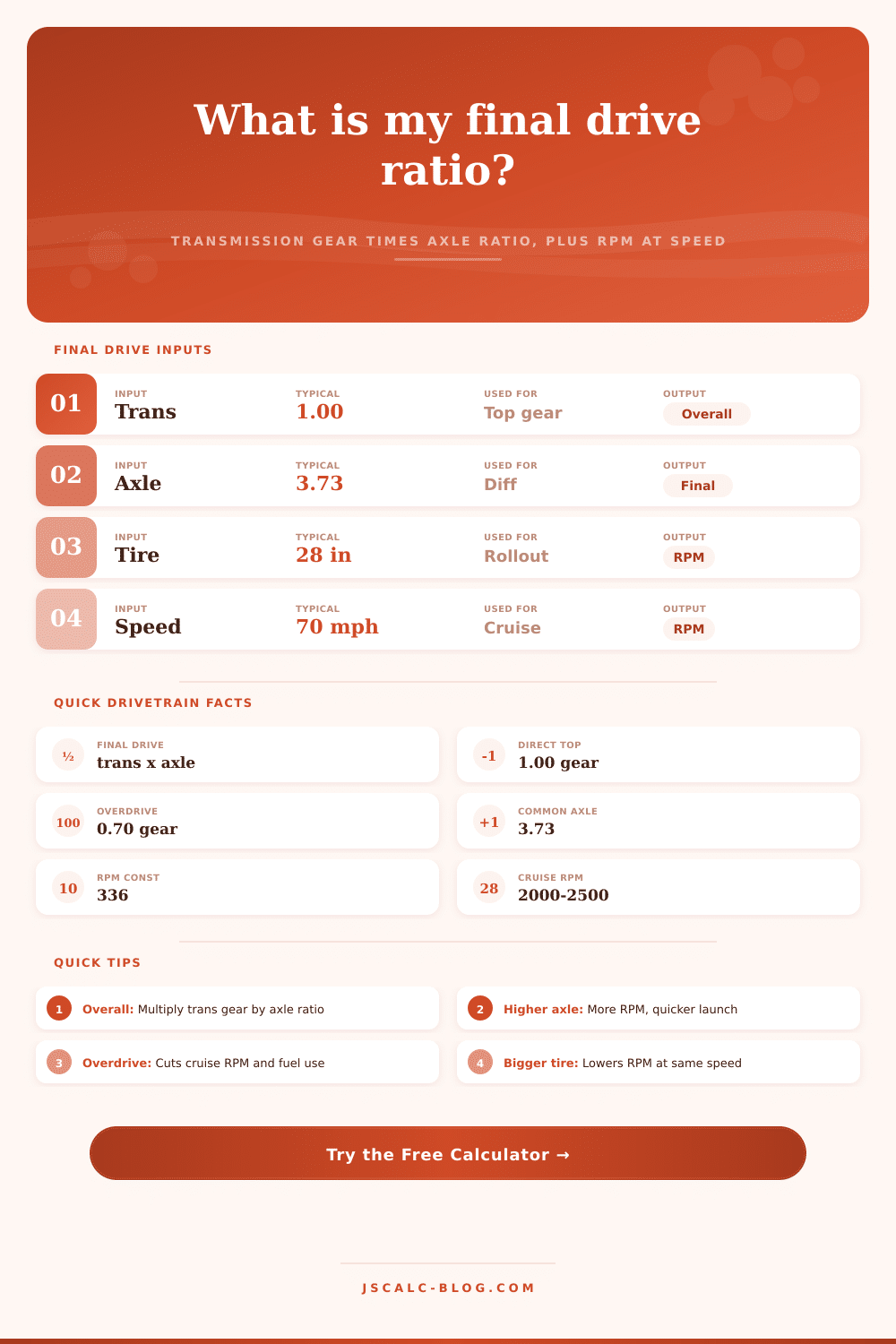
Simply multiply axle ratio (which is located in the rear differential) with the ratio of the specific gear you’ve chosen in your transmission. So if you have a 3.73 axle and you’re in a one-to-one direct drive, you have an overall final drive ratio of 3.73 to 1. That translates into the fact that for each single wheel rotation, engine has to crank three point seven three times. It’s a mathematical formula that produces mechanical leverage which amplifies torque, but also reduces speed. But the calculator above do it instantaneously so you don’t have to bother with trying to figure it out yourself in middle of some parts store aisle.
The mistake comes from confusing axle ratio for the overall system impact. It’s easy to see someone has a 3.73 rear end on their truck, but if they’re running 0.70 overdrive gearing, then their final drive is much lower than 3.73. That means engine spins down at 70 mph, which improves fuel economy and reduces engine noise. But it’ll feel like sludge when you need to merge onto highway or pull a steep hill. You can’t have both, maximum highway efficiency and maximum low-end grunt… In one package of gears.
Most folks forget about the next step in this train: Tire Size. Changing to big ol’ off-road rubber puts your tire diameter up and essentially increases the leverage, which means engine now has to spin slower to maintain same speed; in other words, the tire has covered a greater distance with each rotation. Sounds good on paper, as that’s a recipe for smooth cruising, but it’ll kill acceleration, because that bigger wheel require the engine to do more work to move itself forward. The result is heavy foot and light throttle; your car feels like a go-kart on a leash when coming off the line.
To regain some oomph, you should of try swapping out your axle ratio for one that’s a bit steeper, such as 4.10 or even 4.56. Of course, those parameters has to be weighed against what you actualy do behind the wheel. Do you frequently haul heavy trailers? Then a steeper axle ratio, which have a higher number, keeps engine RPMs in power band instead of lugging as you pull a load. Do you mostly drive long distances on the Interstate? A lower number will save gas while also reducing vibration at typical cruising speeds.
To get an idea for how various combinations behave at normal speeds, the reference table that goes with tool outlines common combos. I’ll add here, too, that moddern transmissions are designed with multiple gears for this very purpose. You might find automatic ten speed has a gear range of 4.70:1 in first gear and as low as 0.64:1 in tenth. That’s some spread. When you’re cruising along at a steady pace, the car can be a fuel-sipping sedan. Need it to tow? It’s got you covered.
Knowing what your particular transmission translate into on your axle ratio can help you expect driving experience before you purchase. So in the end, which is really all that matters, it’s a question of character. It is about personality of the car beneath the seat. Is it going to be eager and responsive? Or will it be lazy and sluggish? Will it get great mileage or be loud on highway?
There’s not one single gear ratio that works best for everyone; it simply comes down to what you’re using the car for most often. Knowing how those gears work together helps you make a better adjustment different than a wild stab in the dark. And knowing that makes you less of a person who goes out and buys a bunch of furnitures and more of someone who knows their ride.