ISO Week Number Calculator
Find the ISO 8601 week number and ISO week-year for any date, or reverse an ISO year and week back to its exact Monday-to-Sunday range. Includes the Thursday rule, day-of-year, and 53-week year checks.
🎯Real Date Presets
📝Date & Mode Inputs
Reverse mode uses the ISO year and week fields below.
Or use the year, month, and day boxes below.
Out-of-range days roll to the correct month.
1 to 52, or 53 in a long year.
ISO week math always anchors on Monday; this only labels the range.
🔢ISO 8601 Snapshot
📆This Month's ISO Weeks
| Date | Weekday | ISO Week | ISO Year | Day of Year |
|---|---|---|---|---|
| Enter a date above to list this month's dates with their ISO week numbers. | ||||
📊Quarter & Week Reference
| Quarter | Months | First ISO Week | Last ISO Week | Week Count |
|---|---|---|---|---|
| Quarter to ISO week mapping appears after calculation. | ||||
📘ISO Week Rules
| Rule | Meaning | Example |
|---|---|---|
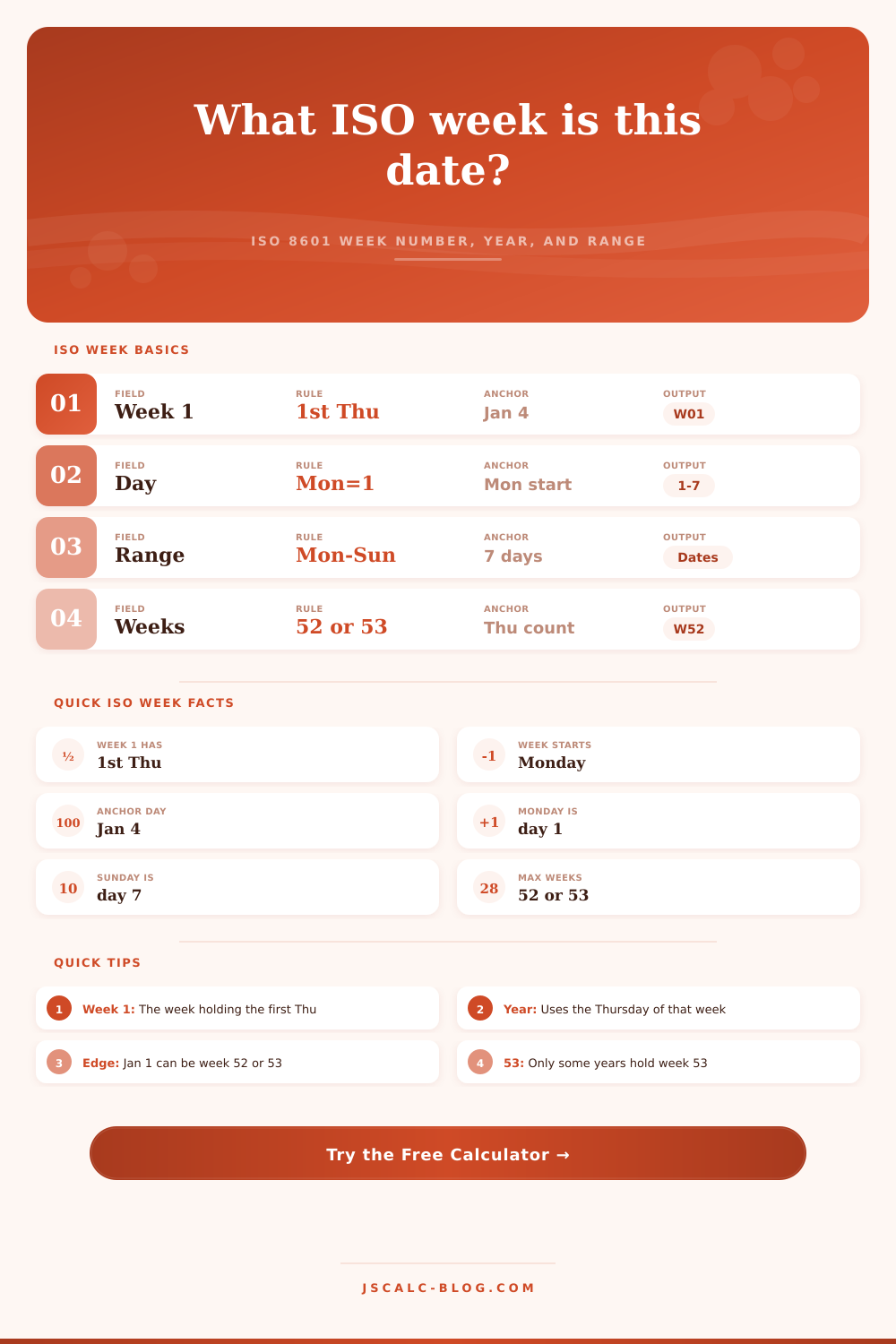
| Week 1 definition | The week that contains the first Thursday of January (equivalently, the week holding January 4). | Jan 4 is always in W01. |
| Week start | Every ISO week begins on Monday and ends on Sunday, so Monday is day 1 and Sunday is day 7. | Mon 2026-06-29 opens W27. |
| Week-year | The ISO year of a date is the year of the Thursday in that week, not always the calendar year. | 2027-01-01 sits in W53 of 2026. |
| Early January | Jan 1 to Jan 3 can belong to the last week of the previous ISO year. | 2022-01-01 was W52 2021. |
| Late December | Dec 29 to Dec 31 can belong to week 1 of the next ISO year. | 2024-12-30 was W01 2025. |
| Weeks per year | A year has 53 ISO weeks when Jan 1 is Thursday, or when it is a leap year starting on Wednesday; otherwise 52. | 2020 and 2026 hold week 53. |
🗂53-Week Year Comparison
| Year | Jan 1 Weekday | Leap Year | Weeks | Last Week Starts | W01 Monday |
|---|---|---|---|---|---|
| The 53-week reference grid appears after calculation. | |||||
⚙Full ISO 8601 Formula Breakdown
📋Reference Values
| Concept | ISO 8601 Value | Range | Notes |
|---|---|---|---|
| Week number | W01 to W52 or W53 | 1 to 53 | Printed as W plus two digits, e.g. W09. |
| Weekday number | Monday = 1 … Sunday = 7 | 1 to 7 | Thursday = 4 anchors week 1. |
| Combined format | 2026-W27 or 2026-W27-7 | Year-Week-Day | The optional last digit is the weekday. |
| Day of year | Ordinal 001 to 365 or 366 | 1 to 366 | 366 only in leap years. |
| Weeks per year | 52 in most years, 53 in some | 52 or 53 | Long years repeat on a 28-year cycle. |
💡Practical ISO Week Tips
If you think a week has seven days in a row then you’re going to run into trouble in logistics and business: payroll weeks can end up floating outside the calendar year; your inventory report won’t line up with regular dates; your international partner might have there own weekly cycle. To solve this mess, we have ISO 8601 standard, which arranges time into a strict grid. Now when you say “Week 1,” everyone know what day you mean… Whether they are in Boston or Berlin. It’s that kind of consistancy that lets you keep tabs on cross-border shipment and align quarterly goals.
At first glance, this seems like an arbitrary way to define week numbers. However, there’s a simple rule to follow: Week 1 does not begin on January 1st; instead, Week 1 begins on the first Thursday of the year. Because Thursday fall smack-dab in the middle of the week, this provide a fixed point for defining remainder of the calendar year. As a result, Week 1 will always include at least four days during new calendar year. That ensures no weeks is split between different years (which would disrupt reporting cycles).
Why ISO Weeks Help Your Business
The date arithmetic is handled by calculator above so you don’t need to count days yourself. That’s where the rule comes into play: when New Year’s Day lands on a Sunday, Saturday, or Friday, it’s actualy in the last week (Week 52 or Week 53) of the preceding year. Similarly, at the end of the year, Dec. 30th might actualy be in Week 1 of next year. This is why ISO week-year will frequently vary from calendar year. It’s not a problem with your spreadsheet, just how standard is defined.
And that’s what the tool above do. It figures out the difference for you right away so you can see which week and which correct ISO year to display. Some years has fifty-three complete weeks; others do not. Specifically, those which begin on either Wednesday (a leap year) or Thursday (a regular year) will having an extra week in the year. Payroll folks and retailers knows to plan for this. Your budget would of been out of sync with reality if you simply accept that each year have only fifty-two weeks. A simple check of whether any given year has fifty-three weeks will save you from having to correct difference during the fiscal period.
Over time, it’s easy to see value of this standard. By working on ISO weeks, you can compare against other timeframes directly, no more start-of-quarter issues or month-length headaches. We all just talk about Week 1 through Week 52 or 53, eliminating noise from seasonality and making your data analysis far more simpler.
Our interface clearly displays relationship between the calendar months and how they break into weeks (shown above). This lets you see exactly where things break off. There’s no need to remember the mathematical formula for figuring out which Thursday anchors a given week. Instead, here’s how logic works. Find closest Thursday to your desired date. See what year that Thursday lands on. Then, count number of weeks from January 4th until that Thursday (remember, computers is better at this than we are). Then look up your week number on this chart.
If your date is in Week 27, great! Plug it into your project timeline with certainty. Explain to your team what week number corresponds to their deliverable… You won’t be guessing. ISO weeks eliminate any confusion from your calendar, converting fuzzy time periods into clear points. Need to plan an international conference call? Audit your annual spending? Having a common way to express time avoids miscommunication.
So when you encounter a date at or around the start or end of a year, look up its week number. It could be in another year entirely. Which is what this standard’s for. Time never stops; we only measure it with hard lines.