Plant Spacing Calculator
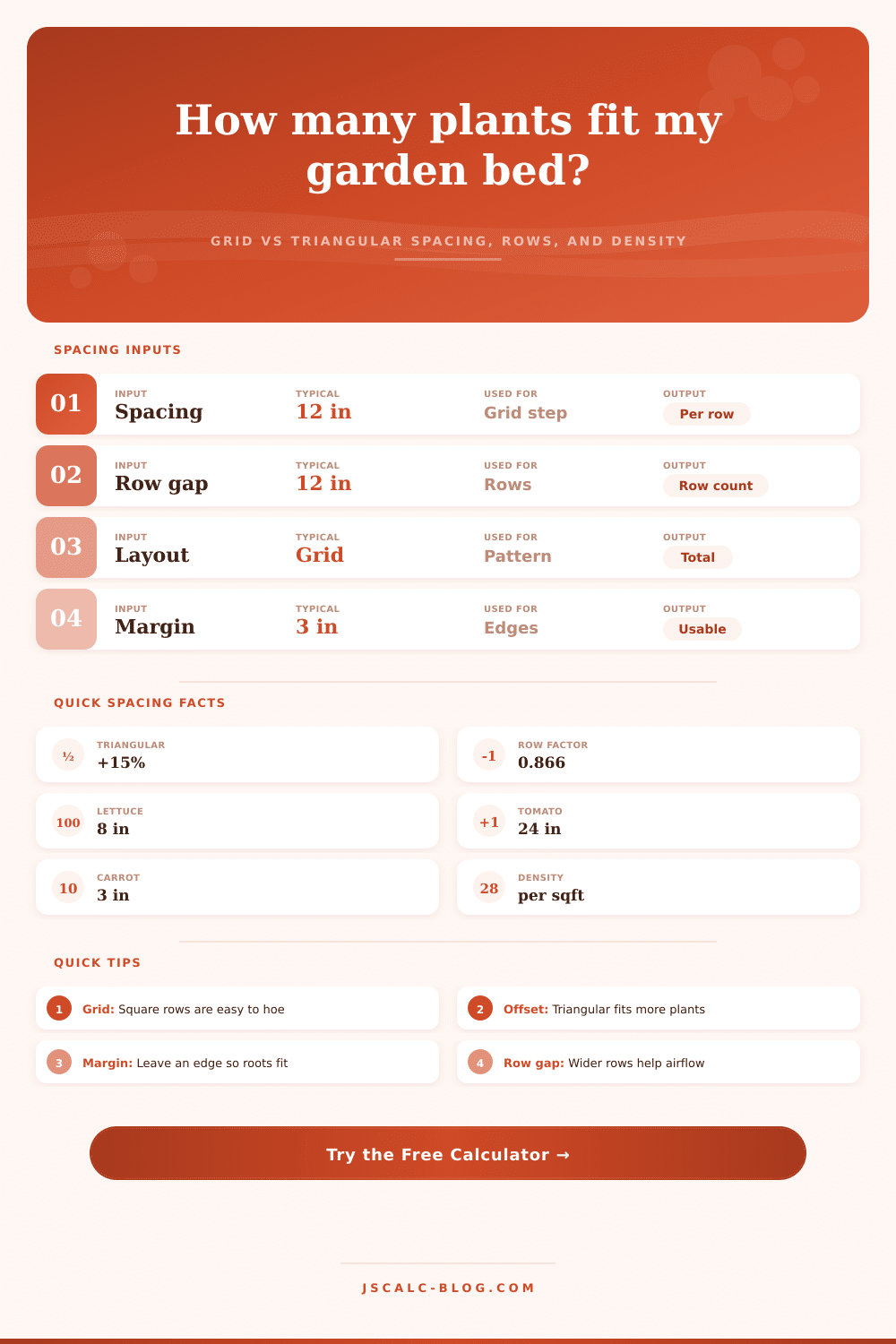
Find how many plants fit a garden bed from your spacing, row gap, and edge margin. Compare a square grid against a triangular offset layout and see plant density per square foot.
🌱Real Garden Presets
📝Bed and Spacing Inputs
All bed and spacing fields use this unit.
The long side of the bed, in the unit above.
The short side of the bed, in the unit above.
Center-to-center gap along a row.
Gap between one row and the next.
Spacing often differs in unit from the bed.
Uses the spacing unit. Kept off every edge.
Plus-one counts a plant at each edge of the run.
🔢Layout Snapshot
🥕Recommended Spacing by Plant
| Plant | In-Row Spacing | Row Spacing | Per Sq Ft | Notes |
|---|---|---|---|---|
| Carrot | 3 in | 3 in | 16 | Thin seedlings to final gap |
| Radish | 2 in | 3 in | 24 | Fast; succession every 2 weeks |
| Lettuce (leaf) | 8 in | 8 in | 2.25 | Loose-leaf tolerates tighter |
| Spinach | 4 in | 6 in | 6 | Cool-season, bolts in heat |
| Onion | 4 in | 6 in | 6 | Wider gap grows larger bulbs |
| Bush bean | 4 in | 18 in | 2 | Rows for easy picking |
| Beet | 3 in | 6 in | 8 | Each seed cluster gives several |
| Strawberry | 12 in | 18 in | 1 | Runners fill the gaps in year 2 |
| Pepper | 18 in | 18 in | 0.44 | Stagger for support and airflow |
| Broccoli | 18 in | 24 in | 0.44 | Big leaves need elbow room |
| Cabbage | 18 in | 24 in | 0.44 | Tighter gives smaller heads |
| Tomato (staked) | 24 in | 36 in | 0.25 | Wider prevents blight spread |
| Squash / zucchini | 24 in | 36 in | 0.25 | Vining types need much more |
| Sweet corn | 12 in | 30 in | 1 | Block of 4+ rows aids pollination |
🔺Square Grid vs Triangular Yield
| Spacing | Grid per 4×8 ft | Triangular per 4×8 ft | Extra Plants | Gain |
|---|---|---|---|---|
| 6 in | 153 | 176 | +23 | ~15% |
| 8 in | 91 | 105 | +14 | ~15% |
| 10 in | 60 | 69 | +9 | ~15% |
| 12 in | 45 | 52 | +7 | ~15% |
| 15 in | 28 | 33 | +5 | ~16% |
| 18 in | 20 | 24 | +4 | ~15% |
| 24 in | 12 | 14 | +2 | ~15% |
Values assume the plus-one edge model on a 48 in × 96 in bed with a 3 in margin. Triangular rows sit closer because each new row rises by spacing × 0.866.
📏Plants Per Square Foot Reference
| Spacing (equal) | Area Per Plant | Grid Per Sq Ft | Triangular Per Sq Ft | Square-Foot Grid Fit |
|---|---|---|---|---|
| 2 in | 4 in² | 36.0 | 41.6 | 36 per square |
| 3 in | 9 in² | 16.0 | 18.5 | 16 per square |
| 4 in | 16 in² | 9.0 | 10.4 | 9 per square |
| 6 in | 36 in² | 4.0 | 4.6 | 4 per square |
| 8 in | 64 in² | 2.25 | 2.6 | 2 to 3 per square |
| 12 in | 144 in² | 1.0 | 1.15 | 1 per square |
| 18 in | 324 in² | 0.44 | 0.51 | 1 per 2.25 squares |
| 24 in | 576 in² | 0.25 | 0.29 | 1 per 4 squares |
Density = 144 / (spacing × row spacing) in inches. Triangular multiplies grid density by about 1.155.
🗂Row-Spacing Comparison Grid
| Crop Style | In-Row | Row Gap | Layout | Per 10 ft Row | Rows Per 4 ft | Total 4×10 |
|---|---|---|---|---|---|---|
| Intensive greens | 6 in | 6 in | Triangular | 21 | 9 | ~217 |
| Salad block | 8 in | 8 in | Grid | 16 | 7 | 112 |
| Root rows | 3 in | 12 in | Rows | 41 | 5 | 205 |
| Bush beans | 4 in | 18 in | Grid | 31 | 3 | 93 |
| Peppers | 18 in | 18 in | Triangular | 7 | 3 | ~24 |
| Tomatoes | 24 in | 36 in | Grid | 6 | 2 | 12 |
| Sweet corn | 12 in | 30 in | Grid | 11 | 2 | 22 |
| Strawberries | 12 in | 18 in | Grid | 11 | 3 | 33 |
Rows-per-4-ft and per-row counts use the plus-one edge model with a small margin. Use the calculator above to match your exact bed.
⚙Full Formula Breakdown
💡Practical Spacing Tips
I started gardening with optimism. I dug in the dirt, amended it, and purchased seeds as if Mother Nature would do all the work of getting things growing.
And so you plant. And then…well, lots of folks pack everything in together, guessing what “close” means, or fearing that leaving any space will be wasteful. Guess what? No jungle-like growth ever results. More likely: plants competes for food, moisture and light, each losing. They yield less per square foot. Aesthetics aside: Spacing matter. Big time.
Why Plant Spacing Is Important
If you take out the anxiety, the math is obvious: How big will the bed be? What is its length and width? And how much room does each plant require when fully grown? That tiny tomato seedling won’t stay that way; it’s going to become a big, thirsty thing in three months. Are you planting your tomatoes only 18 inches apart? Sure, you’ll get more of them, but you’ll also have to contend with the fungus issues and reduced airflow, which mean lower yields of smaller fruit.
The arithmetic is all handled for you by the calculator, so you don’t have to stand in the middle of a garden center, trying to divide one diameter into another, and one dimension into another.
Planting success is also affected by geometry. The grid is the classic go-to design for beginners, but it has areas of bare soil in the triangles between neighboring diagonals. Offset or triangular designs shifts every other row 1/2 a unit of space. Each new row fits into the gaps left by the previous one. This means an offset plan fit about fifteen percent more plants in the same area. Orchardists and vineyard growers discovered this allow them to pack plants in at high densities while still giving each plant enough space. No trigonometry required. Just realize: Staggered rows fit more effective than straight ones.
Now, as many gardeners will tell you, margins count. They suffer from scraping leaves and rotting in contact with any structure (wood or metal frame). The roots smacks into such hard barriers, too, suffering damage and stress. A three-inch margin all around isn’t wasted; it’s protection against stress and damage to roots when things is being harvested, or weeded. The margin also defines where mulch stops. This is good because mulch holds moisture in and smothers weeds without tangling with crop stems.
You get to switch views (triangular offsets vs. Square grids) and see how different they are. Choose from presets: squash, which are heavy feeders; carrots, which is dense planters. Define your boundaries, and then get results: a density reading, and also total number of plants.
High-density means good, right? Nope, usually the opposite. Competition isn’t what the crops need. Too-low density? Then weeds take over the vacant spaces where no plant grew.
Right spacing refers to actual adult plants, not something from your starter tray. Bunch things tightly for multiple pickings. Go for it (lettuce). Use wide gaps to allow for airflow around foliage and avoid soil contact, which increases blight threat in tomatoes and peppers. The calculator allows for experimentation on those factors… Without wasting seeds. Want to know how changing row spacing affects your total yield? Check it out… And then put down the trowel.
There is A lesson in restraint in gardening. There’s the temptation: Fill it all in. Every inch of earth should of be alive! Leave some space. That’s an act of care. It allows air to circulate, roots to extend, and light to reach lower leaves. Those couple of inches of blank ground can make the difference between a good harvest and a struggling patch.
This isn’t just about sowing seed. It’s about creating a microclimate, where each creature has its place to thrive.