Differential Gear Ratio Calculator
Count the ring and pinion teeth to find your differential (axle) gear ratio, then see cruising RPM at road speed, the torque and fuel-economy trade-off, and the ratio needed to regear after a tire-size change.
🎯Real Ring & Pinion Presets
📝Differential Inputs
The large gear bolted to the differential case.
The small gear on the driveshaft input.
Used when ratio source is direct.
Overall loaded diameter of the driven tire.
Use 1.00 for direct top gear, or the overdrive ratio.
Tire the current ratio was chosen for.
Larger or smaller tire you are switching to.
🔢Formula Snapshot
📊Common Ring & Pinion Combinations
| Ring Teeth | Pinion Teeth | Axle Ratio | Common Fit | Best Use |
|---|---|---|---|---|
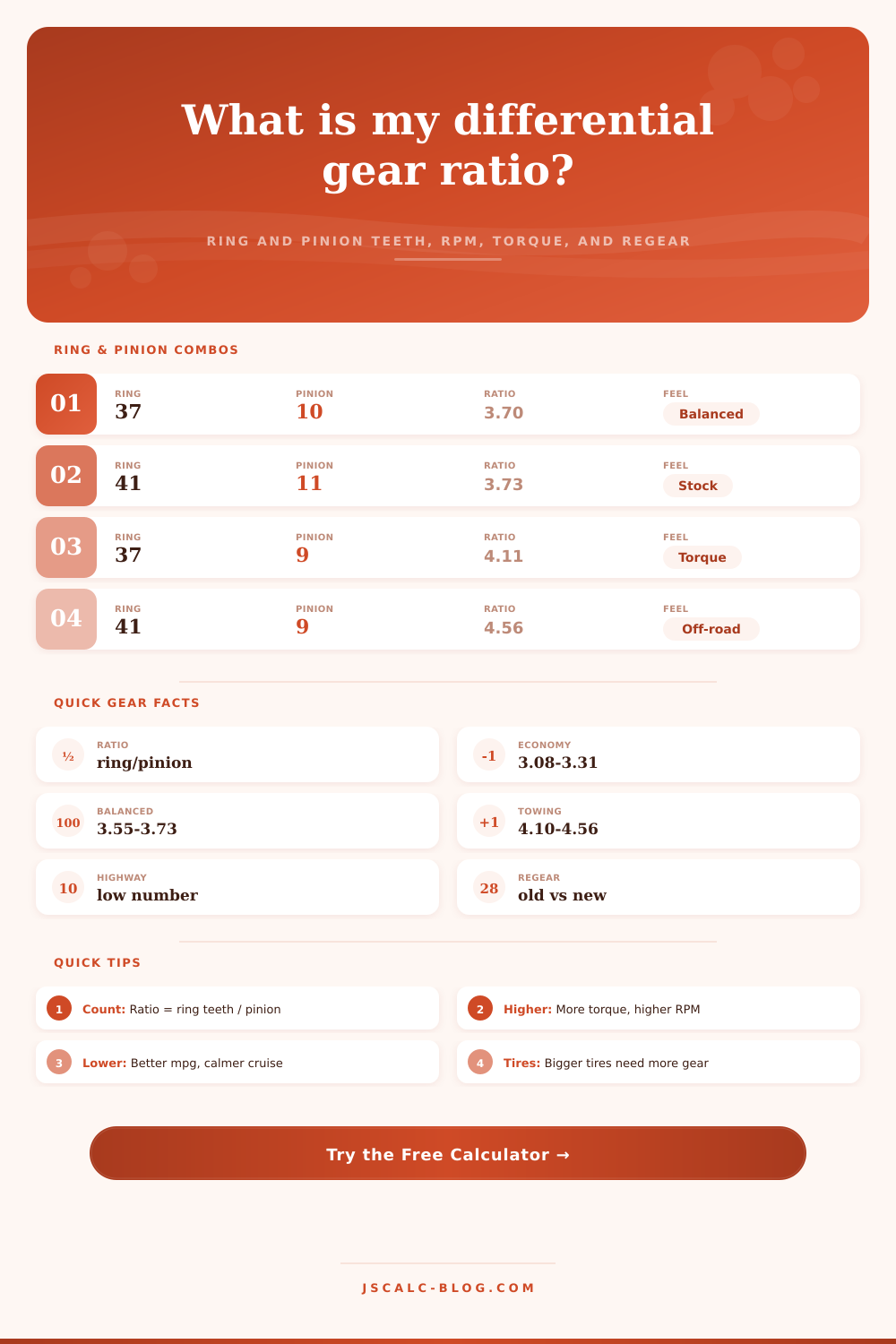
| 40 | 13 | 3.08:1 | Half-ton, sedans | Economy, calm highway cruise |
| 43 | 13 | 3.31:1 | Light trucks, SUVs | Highway with light loads |
| 39 | 11 | 3.55:1 | Trucks, muscle cars | Balanced daily driving |
| 37 | 10 | 3.70:1 | Trucks, Jeeps | All-around street and light tow |
| 41 | 11 | 3.73:1 | Trucks, 4x4 | Popular stock and mild upgrade |
| 37 | 9 | 4.11:1 | Off-road, towing | Torque, 33-35 in tires |
| 41 | 9 | 4.56:1 | Rock crawlers | 35-37 in tires, low-end grunt |
| 43 | 9 | 4.78:1 | Heavy off-road | 37+ in tires, steep trails |
| 46 | 9 | 5.13:1 | Extreme crawlers | 40 in tires, maximum torque |
🛣Cruise RPM at 65 mph by Ratio
| Axle Ratio | 28 in Tire | 31 in Tire | 33 in Tire | 35 in Tire | Cruise Feel |
|---|---|---|---|---|---|
| Enter values above to build the cruise RPM table. | |||||
RPM assumes 1:1 transmission top gear. Multiply by an overdrive ratio (for example 0.70) to model a real top-gear cruise.
⚖Ratio Effect: Economy vs Performance
| Ratio Band | Numeric | Cruise RPM | Fuel Economy | Torque / Acceleration |
|---|---|---|---|---|
| Tall / economy | 2.73 - 3.23 | Lowest | Best mpg | Softest launch, needs downshift to tow |
| Balanced | 3.42 - 3.73 | Moderate | Good compromise | Solid all-round street response |
| Performance | 3.91 - 4.30 | Higher | Slight mpg drop | Stronger acceleration and towing |
| Off-road / tow | 4.56 - 5.13 | Highest | Lowest mpg | Maximum low-end torque and crawl |
Lower numeric ratio = better economy and calmer RPM. Higher numeric ratio = more torque, quicker acceleration, higher cruise RPM.
🔄Tire-Size Regear Reference
| Old Tire | New Tire | Size Change | From 3.73 | From 4.10 | From 4.56 | Effect if Not Regeared |
|---|---|---|---|---|---|---|
| 31 in | 33 in | +6.5% | 3.97 | 4.37 | 4.86 | Slower launch, RPM drops at cruise |
| 31 in | 35 in | +12.9% | 4.21 | 4.63 | 5.15 | Noticeably sluggish off the line |
| 33 in | 35 in | +6.1% | 3.96 | 4.35 | 4.84 | Mild loss of low-end pull |
| 33 in | 37 in | +12.1% | 4.18 | 4.60 | 5.11 | Strong effective gearing loss |
| 35 in | 37 in | +5.7% | 3.94 | 4.33 | 4.82 | Small but real torque drop |
| 35 in | 40 in | +14.3% | 4.26 | 4.69 | 5.21 | Heavy loss, regear strongly advised |
New ratio to keep the same effective gearing = old ratio × new tire diameter / old tire diameter. Round to the nearest available ring and pinion set.
⚙Full Formula Breakdown
📋Reference Values
| Item | Common Entry | How It Is Used | Ratio Effect |
|---|---|---|---|
| Ring teeth | 37 to 46 | Top of the ratio fraction | More ring teeth raise the numeric ratio |
| Pinion teeth | 9 to 13 | Bottom of the ratio fraction | Fewer pinion teeth raise the ratio |
| Tire diameter | 28 to 40 in | Sets RPM per mile | Bigger tires lower effective gearing |
| Trans gear | 0.65 to 1.00 | Multiplies with axle ratio | Overdrive lowers cruise RPM |
| Speed | 55 to 75 mph | Drives the RPM formula | Higher speed raises RPM linearly |
💡Practical Gearing Tips
In most trucks, the final multiplier between road and engine is located in the rear axle, does it multiply fast, or does it multiply slow when you hit the gas? If your truck feel sluggish off the line or if you notice your tachometer climbing to high numbers at cruising speed, odds are that you’re confused about what’s happening under the hood. The math behind how gears affect performance is so abstract, it seems disconnected from how a car actualy drives.
The axle ratio is nothing more than a fraction. Simply take tooth count on the big ring gear and divide it by the tooth count of the small pinion gear spinning it. For example, let’s say there are eleven teeth on the pinion and forty-one teeth on the ring. That equals approximately three point seven three. That tells us that for each wheel revolution, the driveshaft will turn almost four times.
What Is Axle Ratio?
It is a basic math equation, but it also determines how your vehicle will tow, get gas mileage, etc. The drivetrain has a mechanical advantage based off this number. A torque multiplier‘s higher numerical ratio are better. When you’re crawling over rocks or towing a big ol’ trailer uphill, it means the wheels turn slower then the engine. It keeps you out of the bog and helps you stay in the powerband; not bad.
The downside is highway cruising. Sure, a four point five six ratio may get you further offroad but it’ll have your engine screaming at two-thousand RPMs at only sixty-five miles an hour. Not only is it annoying, but it kills your gas mileage, too. The reverse apply for long distance cruising. Low ratios such as 3.08 cause the engine to slow dramatically at high speeds. This reduces gas usage and also reduces wind chill in the cab.
The cost is acceleration. When you have to pass someone or merge onto a freeway, you’ll spend much of your time downshifting due to excessive gearing that doesn’t deliver instant power to the wheels. No single ratio are right. It’s all compromise based on how you drive.
It gets more complicated when you consider tire size. Adding bigger tires reduces your final drive ratio but doesn’t alter anything in your differential. Adding 3 inches of diameter changes effective gearing, which slows down acceleration and makes the vehicle feel lazy. This is what happens to many owners who just upgrade to tires and then regret it when they notice that their truck won’t pull like it used to anymore.
Regearing should of solves the problem by replacing your current ring and pinion with a numerically higher set to return your original powerband feel. Unfortunately, gear sets aren’t continuous products. You can’t call up and get one made to fit your specific tire size. There’s a list of options you can choose from and often times that means picking the nearest match instead of something mathematically exact.
When it comes to gearing, many people gets hung up on peak HP; that’s not the right number to look at. You want to know wheel torque in actual driving scenarios, not just numbers from a test machine. And you don’t want an engine revving at redline constantly while you shift gears just as quickly. It is better to have a moderate ratio that keeps your engine within its best power range as you accelerate.
The comparison tables provided with the tool help visualize those trade-offs by showing how different ratios affect speed and RPM. Compare your choices, then buy. In summary So how do you decide which gear ratio? Match your drivetrain to what you actualy use it for. Do you spend most of your time cruising down the freeway? Get the lower numbers for better fuel economy. Do you tow frequently or spend a lot of time off road? Go up a couple sizes and get more low-end torque. Plug in your transmission specs along with your tire size, and the math is pretty easy. Basically it comes down to preference; do you want quiet miles or quick starting power?