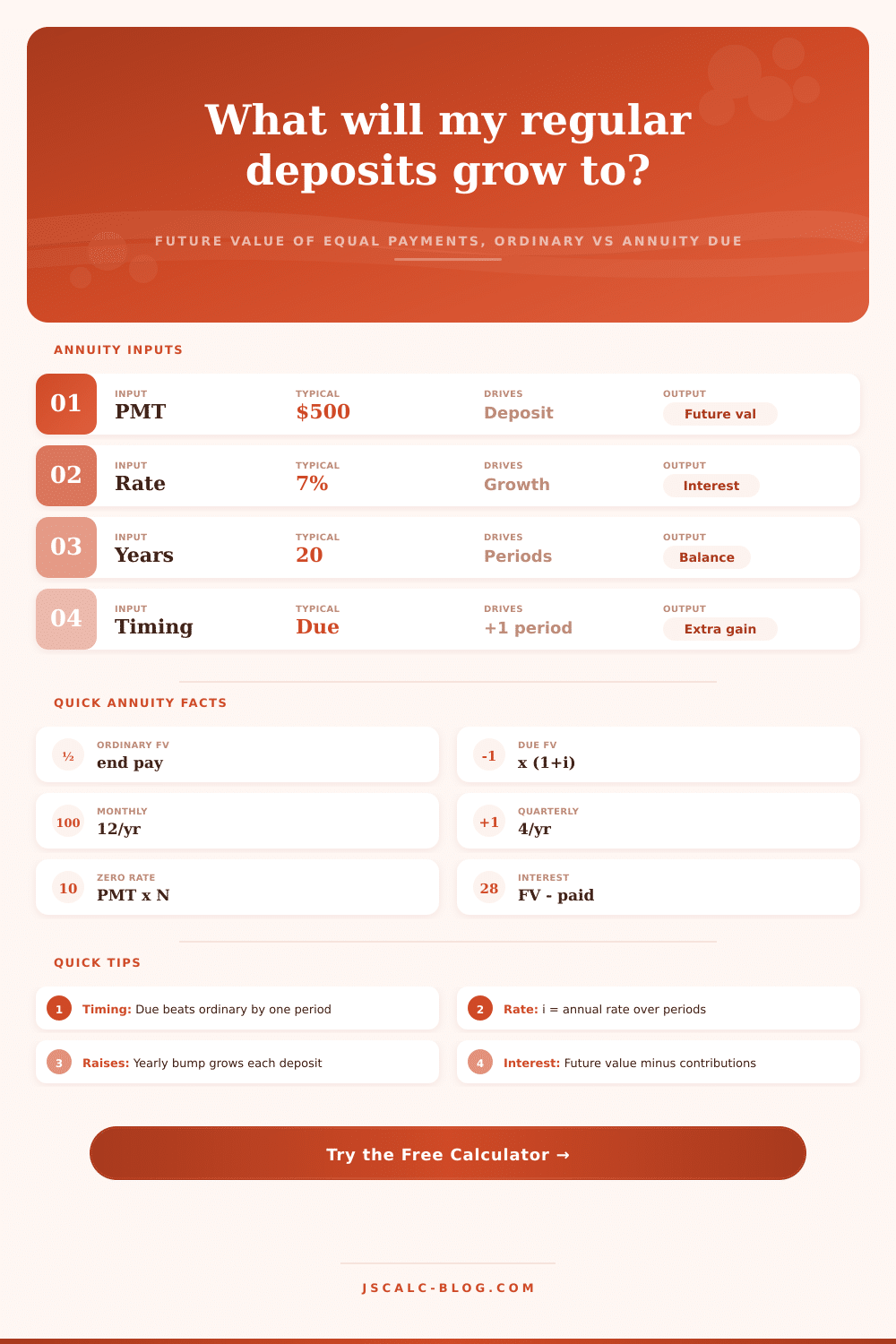
Future Value of Annuity Calculator
Project what a stream of equal deposits grows into over time. Compare ordinary end-of-period timing against annuity due, add an annual raise, and see contributions versus compound interest in a full year-by-year schedule.
🎯Real Annuity Presets
📝Annuity Inputs
The equal deposit you add each period.
Compounding matches this deposit frequency.
Raises each year's deposit. Leave 0 for a level annuity.
Set a target to check progress. 0 hides the goal line.
🔢Formula Snapshot
📊Year-by-Year Growth
| Year | Deposits This Year | Payments To Date | Interest To Date | End Balance |
|---|---|---|---|---|
| Enter values above to build the yearly growth schedule. | ||||
⚖Ordinary vs Annuity Due
| Measure | Ordinary (End) | Annuity Due (Start) | Difference |
|---|---|---|---|
| The timing comparison appears after calculation. | |||
📈Rate Impact At Your PMT
| Annual Rate | Periodic i | Contributions | Interest | Future Value |
|---|---|---|---|---|
| The rate sensitivity table appears after calculation. | ||||
🗂Annuity Factor Reference
| Periods N | 2% Factor | 4% Factor | 6% Factor | 8% Factor | 10% Factor |
|---|---|---|---|---|---|
| 5 | 5.2040 | 5.4163 | 5.6371 | 5.8666 | 6.1051 |
| 10 | 10.9497 | 12.0061 | 13.1808 | 14.4866 | 15.9374 |
| 15 | 17.2934 | 20.0236 | 23.2760 | 27.1521 | 31.7725 |
| 20 | 24.2974 | 29.7781 | 36.7856 | 45.7620 | 57.2750 |
| 25 | 32.0303 | 41.6459 | 54.8645 | 73.1059 | 98.3471 |
| 30 | 40.5681 | 56.0849 | 79.0582 | 113.2832 | 164.4940 |
| 40 | 60.4020 | 95.0255 | 154.7620 | 259.0565 | 442.5926 |
Ordinary annuity factor is ((1+i)^N – 1) / i using the per-period rate i. Multiply by PMT for future value; multiply again by (1+i) for annuity due.
⚙Full Formula Breakdown
📋Input Reference Values
| Input | Common Range | How It Is Used | Effect On Future Value |
|---|---|---|---|
| Payment (PMT) | $50 to $2,000 | Multiplies the annuity factor | Scales future value directly |
| Frequency | 1 to 52 per year | Sets periods and periodic rate | More periods smooths growth |
| Annual rate | 2% to 10% | Divided into per-period i | Compounds interest each period |
| Years | 3 to 40 | Multiplies periods per year | Longer terms boost interest share |
| Timing | Ordinary or due | Due multiplies FV by (1+i) | Due adds one period of growth |
| Annual increase | 0% to 6% | Steps up deposits each year | Raises both deposits and interest |
💡Practical Annuity Tips
How much time does your money spend in the market? When will you pull it out? Where your money lives determine financial freedom.
Making consistent deposits over time is called an “annuity.” But math is counterintuitive. Most people focus on how much they save each month while ignoring the invisible force of compound interest that multiplies those savings. People think: “I’ll save $X each month.” They ignore compounding interest, which multiplies those savings.
How to Make Your Money Grow with Annuities
The calculator above let you toggle between annuities due and ordinary annuities. That toggle adjusts whether you make your deposits just before interest compounds or right at the moment it compounds. This handles the tricky math, so you can see precisely where your balance originate without spreadsheeting.
The first variable which trips people up is timing. An ordinary annuity means you’re making your deposit at the end of each period (i.e., it’s a paycheck deposited on Friday). An annuity due means you’re paying at the start, so that money has an additional period to gain interest before the next cycle begin. That’s simply the ordinary future value times one plus the periodic rate and it appears small. But over a span of two decades, that extra period of growth add up to a meaningful difference in your eventual balance. In other words, you’re receiving a free month of compounding for every single contribution that would otherwise sit idle until the end of the month.
It’s an engine driven by the annual interest rate, which you must calculate properly: The calculator take your annual percentage and divides it by how many times a year it happens. If the annual rate is seven percent and you make monthly deposits, then you’re earning roughly half a percent of interest each month on a ten thousand dollar balance. But you aren’t earning it once a year; you’re earning it every month. So each subsequent month’s interest payment is based off a slightly higher principal amount than the last. That’s what “compounding” means, and that’s also why the earlier you start saving, the better, even if it’s only a small sum. Make a humble deposit two decades ago and you’ll often beat making a huge deposit five years from now, simply due to all the extra time you gave the compound-interest curve to rise.
But here’s another reason why we should include an annual increase: most of us don’t take inflation into account when we make our contributions! Over time, both your salary, and how much money you’re able to save, tends to increase in the real world. If you leave that blank at zero, it means you assume you’ll continue to save the same number of raw dollars throughout your life (which gets more excruciating as prices creep upward). By adding a tiny bit of a bump to your contribution every year, you’ll mimic a cost of living adjustment for your saving habit. This maintains your purchasing power and allows compound interest to do its magic on a steadily increasing principal base.
To get an idea of what this annuity factor means, take a look at the table of references in the calculator. This is how many times your one-time periodic payment will be multiplied across the whole term. With a conservative return of two percent, that figure rises gradualy. Push it up to ten percent and hold it there for four decades and the factor grows into the hundreds. It is not a misprint. This shows the power of time in the market (as opposed to timing the market).
The calculations are simple enough, though relationship between rate, duration and frequency produces counter-intuitive results. Your goal is to watch that line creep across the contribution line which is a milestone you should track. That’s when interest earned exceeds your total contributions. At that point, your account starts to feed itself (more) than you. It’s a change that typically occurs later in long term plans, which also reinforces why patience pays. Don’t confuse flat growth early on with lack of success. It resembles a hockey stick laying on the ice… Only it doesn’t start rising up off the ice until much later. Your task is to keep pushing the puck until it does.
But remember: the final dollar amount should never be taken as a sure-fire indicator that your golden years are covered. Over time, inflation will nibble away at its purchasing power. It’s a goal (not a pledge). Use the calculator for your current life and pull out a figure that feels right to you, and then pad it a bit just in case.
That’s where annuities shine. They’re reliable; they force you to get disciplined. And once you get into this routine of savings, the math kicks in and produces exponential results. Nail down your pace, trust in the system and let time take care of the rest. Watch your savings grow… Because all those compound interest gains you earned early on pay off big when you no longer think twice about it.