Second Mortgage Payment Calculator
Price out a purchase-time piggyback second mortgage such as an 80/10/10 or 80/15/5. Split the home price into a first lien, a second lien, and a down payment, add both monthly payments, see your combined loan-to-value, and compare against a single loan carrying PMI.
🏠Real Piggyback Scenario Presets
📝Loan Inputs
Contract price or appraised value of the home.
Sets first, second and down percents automatically.
Primary mortgage, usually 80% to avoid PMI.
Purchase-money second mortgage percent.
Annual interest rate on the first mortgage.
Amortization length of the first lien.
Second liens usually run 1-3% higher.
Often shorter, such as 15 or 20 years.
Annual PMI on one loan at the same total LTV.
Controls how the dollar results display.
🧮Formula Snapshot
📊Piggyback Structure Split (on this price)
| Structure | First Lien | Second Lien | Down Payment | Avoids PMI? |
|---|---|---|---|---|
| 80/10/10 | 80% | 10% | 10% | Yes |
💵Payment per $1,000 Borrowed
| Rate | 15-Year | 20-Year | 30-Year | Typical Use |
|---|---|---|---|---|
| 5.0% | $7.91 | $6.60 | $5.37 | Low first lien |
| 6.0% | $8.44 | $7.16 | $6.00 | First lien |
| 6.5% | $8.71 | $7.46 | $6.32 | First lien |
| 7.5% | $9.27 | $8.06 | $6.99 | Second lien |
| 8.5% | $9.85 | $8.68 | $7.69 | Second lien |
| 9.5% | $10.44 | $9.32 | $8.41 | Higher second |
| 10.5% | $11.05 | $9.98 | $9.15 | Risk-based second |
🗃Piggyback vs Single-Loan Comparison Grid
| Structure | Down | First P&I | Second/PMI | Monthly Total | CLTV | Notes |
|---|---|---|---|---|---|---|
| 80/10/10 | 10% | - | - | - | - | - |
⚙Formula Breakdown
💡Piggyback Planning Tips
Buying a house often feels like solving a puzzle where the pieces never quite fit. You’d love to have this house, but you lack the full twenty percent down payment, and no one wants to pay private mortgage insurance! Enter the piggyback loan: It divides your finance package into two parts. By keeping the first mortgage below the eighty percent mark, lender waives the insurance policy. To make up the difference, you contribute less out-of-pocket cash; that balance becomes part of second mortgage.
On paper, this seems easy enough. But then you realize you’re juggling two distinct amortization schedules, and two sets of interest rates. The math quickly grows complicated.
Is a Piggyback Loan Right for You?
But the thing I like best is it gets rid of PMI. Yes, private mortgage insurance. PMI is basically an insurance policy protecting the bank, not you. And on a big loan amount, those payments adds up to hundreds of dollars per month… And don’t create any equity. A second lien simply replaces that with interest payments. Those interest payment contribute to repaying a genuine debt.
The catch: Second mortgages has higher rates, typically a point or two (or even three) more than your first-lien rate. You’re trading an insurance premium that doesn’t pay down your debt for an interest payment that does, but at a higher cost for every dollar you borrow. It makes sense … if you get the math right before the ink dries.
Just because the rate is higher doesn’t mean combined payment will be higher. This isn’t about the rate differential. It’s about looking at the big picture: the combined payment. Enter your split structure and your purchase price into the calculator above and let it do the math for you. This is easier than trying to guess what the higher rates will do to your bottom line. An eight point five percent second lien that’s ten percent looks reasonable, until you tack it onto a first lien with a six and a half percent rate. Even though the piggyback will save you money over time (think five or seven years), total monthly amount may be more than taking one loan with PMI. This detail is important because most buyers only think about the rate and don’t realize the effect of having two separate payments build on each other.
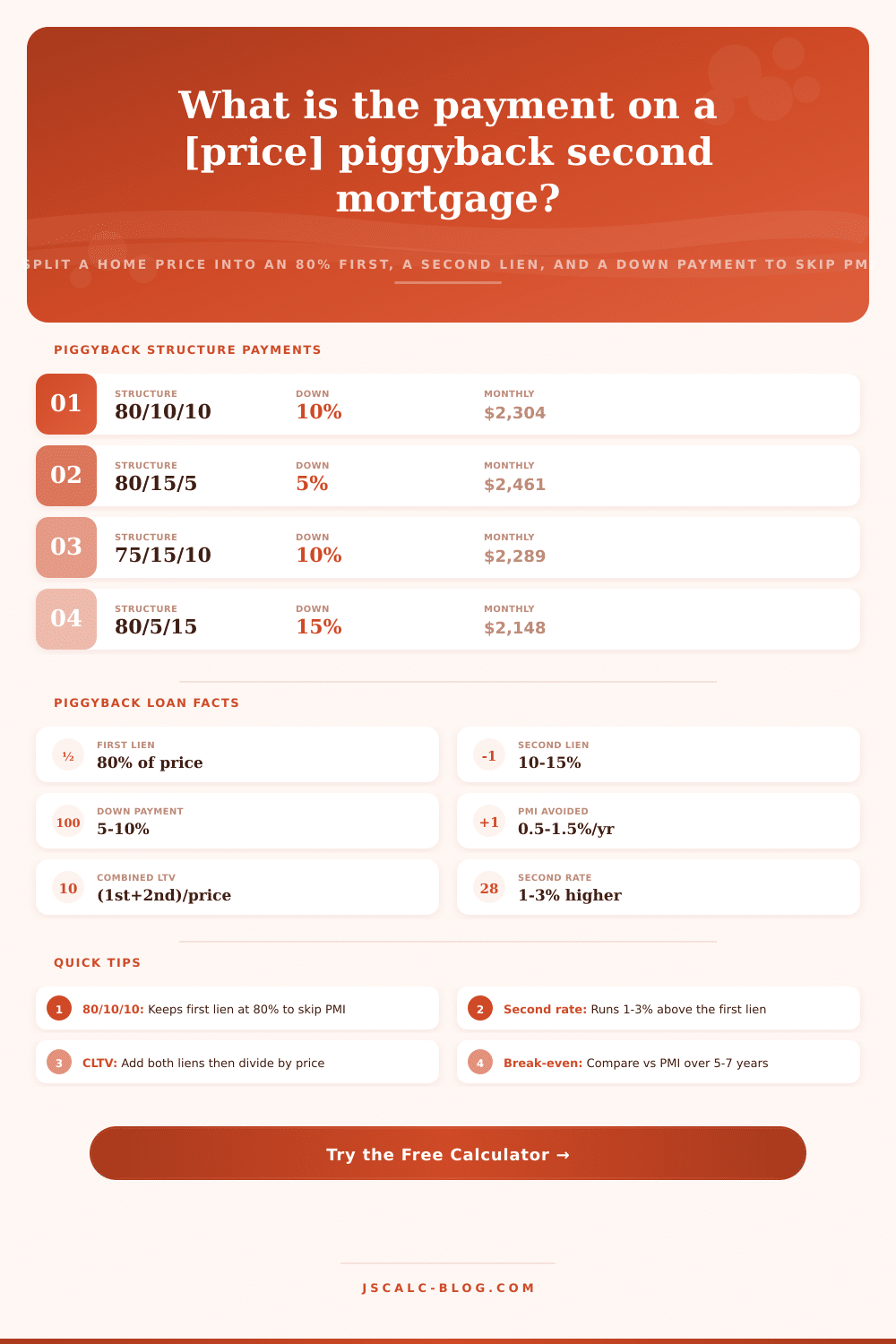
And then there’s the way the split affects things. If it’s an eighty-ten-ten, you get a lower rate on the first loan because the primary loan stay clean. You drop ten percent down, borrow eighty percent on the first loan, and ten percent on the second. But what happens if cash is tight? An eighty-fifteen-five structure will drop your down payment to five percent, which raises the size of second lien. And because the second lien has a bigger balance AND a higher rate, you pay much more in interest overall. So now you’re not just borrowing more; you’re doing so at a worse price. It’s a small thing, but remember: Every percentage point shift in the split alters the break-even point with PMI.
People also get tripped up on concept of combined loan-to-value. It’s another measure: essentially, what percent of the house are you borrowing? Lenders looks at both loans together to assess risk. Some lenders will balk if you borrow more than ninety-five percent of the value of the house combined, in either case. The tool does that for you, it won’t let you structure a deal it thinks no bank would ever agree to. It also has a side-by-side comparison grid of how much you’d save vs. What you’d pay if you just had one loan instead, so you can see precisely when the PMI savings run out and high-interest second-lien kicks in. This makes the decision a lot less emotional, it forces you to ask “which costs me less?” rather than “which do I feel better about?
The second mortgage’s term length also gets ignored by most folks. To follow underwriting guidelines, seconds is typically 15-20 year loans; firsts are nearly always a 30 year loan. This results in bigger monthly payments for a lower balance (higher “rate” = higher payment). Set them both to 30 years in your head and you’ll underestimate your first-year cash flow requirements. In reality, since the second lien has less time to amortize down the principal, the bite is worse every month. Match the inputs to the offer’s term and see if the payment shock is prohibitive or manageable.
In conclusion, a piggyback is a bridge. It is a bridge that allows you to get into the house with no huge downpayment and no PMI drain. And as we all know, bridges cost money. The extra interest on the second lien is the price of the bridge. You pay for avoiding the insurance.
Is it worth it? That’s totally up to your timeline (how long will you be there?) and current rates at closing. The numbers don’t lie; but they require some attention. You should of checked the math.