Equity Growth Over Time Calculator
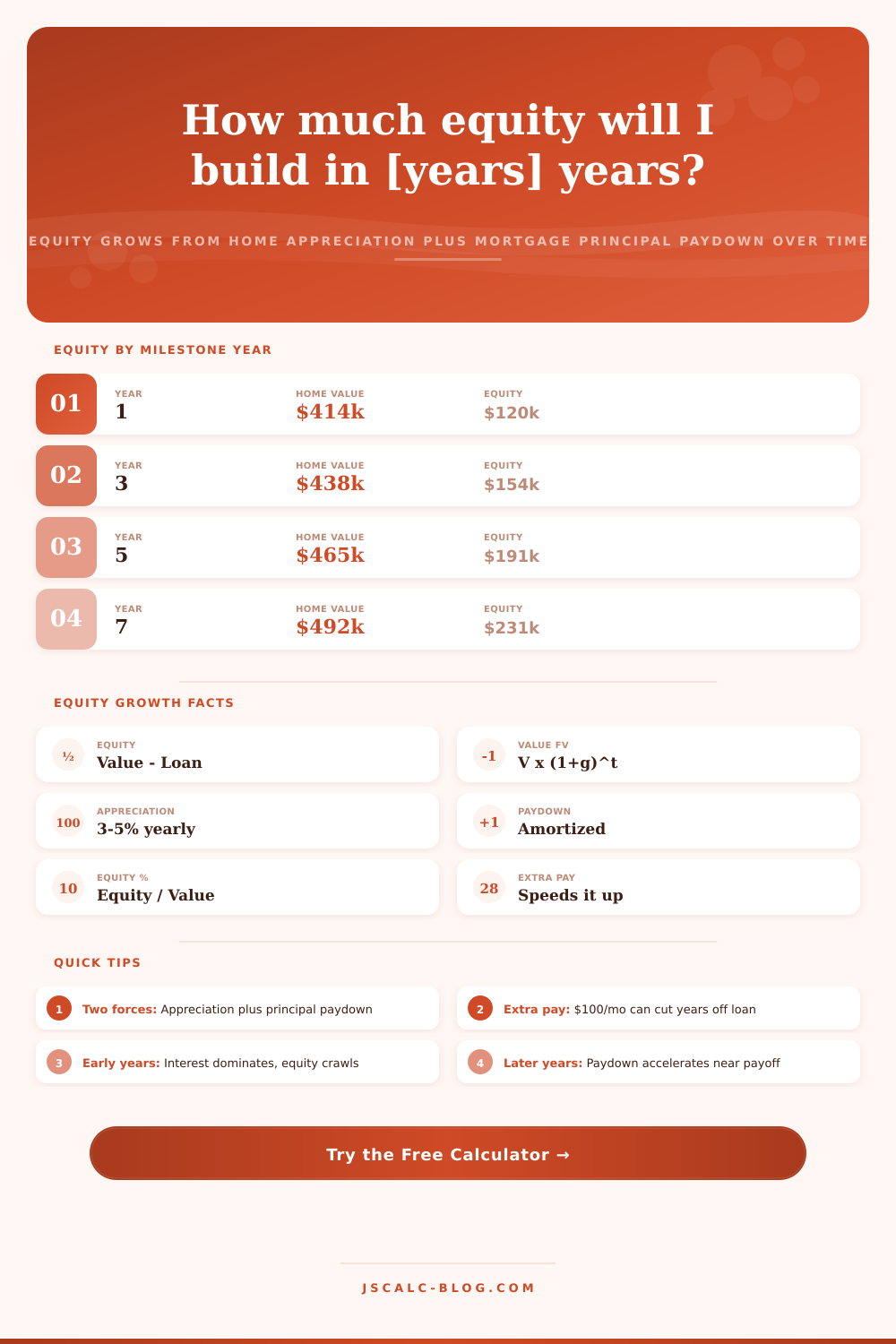
Project how your home equity grows year by year from two forces working together: home price appreciation and amortized mortgage principal paydown. See projected value, remaining balance, and equity at milestone years 1, 3, 5, 7, 10, 15, 20, and 30.
🎯Real Homeowner Scenarios
📝Your Home and Mortgage
Today's market value or recent appraisal.
Outstanding loan principal you still owe.
Annual mortgage rate; used monthly for amortization.
Years left on the loan schedule.
Expected yearly home price growth rate.
Optional extra paid toward principal each month.
Optional. Leave 0 to use value minus balance.
Result cards summarize this target year.
🔢Equity Formula Snapshot
📊Equity Milestone Projection
| Year | Projected Value | Remaining Balance | Equity $ | Equity % |
|---|---|---|---|---|
| 1 | - | - | - | - |
🧩What Builds Your Equity
| Equity Source | Where It Comes From | Speed | Control |
|---|---|---|---|
| Starting equity | Down payment already made | Instant | At purchase |
| Principal paydown | Loan portion of each payment | Slow then fast | Extra payments |
| Appreciation gain | Rising market home value | Compounds yearly | Market driven |
| Extra principal | Payments above the minimum | Accelerates payoff | Fully yours |
| Home improvements | Value-adding renovations | One-time boost | Your choice |
📈Appreciation Multiplier Reference
| Years Held | 2% / Year | 3% / Year | 4% / Year | 5% / Year |
|---|---|---|---|---|
| 1 year | 1.020x | 1.030x | 1.040x | 1.050x |
| 3 years | 1.061x | 1.093x | 1.125x | 1.158x |
| 5 years | 1.104x | 1.159x | 1.217x | 1.276x |
| 7 years | 1.149x | 1.230x | 1.316x | 1.407x |
| 10 years | 1.219x | 1.344x | 1.480x | 1.629x |
| 15 years | 1.346x | 1.558x | 1.801x | 2.079x |
| 20 years | 1.486x | 1.806x | 2.191x | 2.653x |
| 30 years | 1.811x | 2.427x | 3.243x | 4.322x |
🗃Equity Growth Comparison Grid
| Scenario | Home Value | Loan Balance | Appreciation | Equity Yr 5 | Equity Yr 10 |
|---|---|---|---|---|---|
| Starter home | $400,000 | $320,000 | 4% | $191,000 | $296,000 |
| Mid market | $550,000 | $440,000 | 4% | $262,000 | $407,000 |
| New buyer 3% down | $400,000 | $388,000 | 4% | $123,000 | $228,000 |
| Luxury coastal | $1,200,000 | $900,000 | 4% | $620,000 | $942,000 |
| Hot market 7% | $400,000 | $320,000 | 7% | $248,000 | $418,000 |
| Flat market 2% | $400,000 | $320,000 | 2% | $135,000 | $186,000 |
| Extra $300/mo | $400,000 | $320,000 | 4% | $211,000 | $339,000 |
| 15-year refi | $400,000 | $320,000 | 4% | $254,000 | $418,000 |
⚙Formula Breakdown
💡Equity Building Tips
But home equity isn’t just a static amount. Home equity is defined by two competing factors: The value of your house rising (which increase your net worth) vs. Paying off your mortgage (which also increases your net worth). Paying off your mortgage reduces your net worth. The connection between these two factors, debt repayment and market gains. Alters your perception of being a homeowner. Instead of seeing a fixed figure on your bank statement, you now see yourself as someone on a journey, one that hinges on the pace of your payments and the market’s mood.
Everyone obsesses about property value, and under-obsess about loan mechanics. Everyone frets that his or her area isn’t growing in value fast enough. That is just one side of the equation. There is also amortization, which benefit you but looks slow at the start. In the early years of a thirty-year mortgage, almost all your monthly payment go toward interest. Your principal balance won’t budge very far. When homeowners forget about the time horizon, they’ll think their equity isn’t growing, that they’re paying “rent” to the bank!
Two Ways to Build Home Equity
Enter your starting data into the calculator above, including your current home value, outstanding loan balance, and approximate appreciation rate. The calculator will run the math to see how those two forces intersect over time, typically for a decade or longer. The tool show your estimated equity during important years. What do you tend to observe? It starts gradually and then rises sharply. Why? Because as your loan principal decreases, so does interest charge. More of every payment gets applied toward reducing your real loan balance.
Finally, there’s the psychological trick our markets play on us. Your mortgage balance decreases with every payment you make; it doesn’t care about market conditions. The market rises and falls, up and down and up again. Paydown is silent and under your control. Appreciation is loud and outside of you control. When a homeowner panics over a temporary market downturn, they tend to forget: their principal will continue paying down, regardless of what happens in the surrounding housing market. They’ll build equity for life, even if market value fluctuate in the short term.
The best way to speed up that curve is through extra principal payments (AKA prepaying). Every dollar you pay toward the principal knocks out interest you’ll owe for that dollar in the future, so each additional dollar you pay on your mortgage shaves years off the loan term and saves tens of thousands in interest. You should of known this. Simply adjust “extra principal” input on the calculator, and you’ll notice your equity line grow more than it would with just standard payments. This is compound appreciation.
Here’s a good explanation from the page with this table (which illustrates the impact of compounding over longer periods): In year one, a four percent annual return seems modest, but small percentages makes an enormous difference when compounded onto a growing base over many decades. While markets with a five percent return and a three percent return may appear alike initially, they diverge greatly more than time passes. And that’s the magic of having compounding work for you, if you’re able to stay in house long enough to benefit.
Amassing wealth in real estate isn’t about time, it’s about duration. It’s about outlasting the loan rather than trying to time the market. It’s about believing that the slow start today will be compensated by compound growth and gradual payoff down the road. It’s about owning something which holds its value, and systematically paying off debt, rather than trying to get rich quickly from a price spike.
You’re balancing the market with your payments until the keys are yours. The market controls the price. You control the payments.