HELOC Draw and Repayment Calculator
Project the full life of a home equity line of credit across both phases. See your interest-only payment during the draw period, the higher amortized payment once repayment begins, the payoff date, and the total interest a HELOC really costs from first draw to final payment.
🏦Real HELOC Scenarios
📝HELOC Terms
Balance you borrow at the very start of the draw period.
Extra amount pulled each month during the draw period.
Yearly interest rate; most HELOCs are variable.
Interest-only window when you can borrow, often 5 to 10 years.
Amortization window after the draw ends, often 10 to 20 years.
Maximum line size; balance is capped here during draws.
Optional principal you pay above interest during the draw.
Controls how currency results are displayed.
🔢Payment Snapshot
🗓Year-by-Year Lifetime Timeline
| Milestone Year | Phase | Balance | Monthly Payment | Cumulative Interest |
|---|---|---|---|---|
| - | - | - | - | - |
📊Draw vs Repayment Comparison
| Feature | Draw Period | Repayment Period | Why It Matters |
|---|---|---|---|
| Can you borrow | Yes, up to limit | No, line closed | Access ends at the switch |
| Payment type | Interest only | Principal plus interest | Payment jumps sharply |
| Balance trend | Flat or rising | Falls to zero | No principal cut early |
| Typical length | 5 to 10 years | 10 to 20 years | Sets amortization pace |
| Rate style | Usually variable | Variable or fixed | Adjusts monthly on many lines |
| Minimum payment | Small, tempting | Large, mandatory | Budget shock risk |
| Payoff progress | None by default | Steady each month | Debt lingers if only IO paid |
📈Interest-Only Payment by Balance and Rate
| Balance | 6% APR | 8% APR | 10% APR | 12% APR |
|---|---|---|---|---|
| $25,000 | $125 | $167 | $208 | $250 |
| $50,000 | $250 | $333 | $417 | $500 |
| $75,000 | $375 | $500 | $625 | $750 |
| $100,000 | $500 | $667 | $833 | $1,000 |
| $125,000 | $625 | $833 | $1,042 | $1,250 |
| $150,000 | $750 | $1,000 | $1,250 | $1,500 |
📐Repayment Payment per $10k Borrowed
| Repay Term | 6% APR | 8% APR | 10% APR | 12% APR |
|---|---|---|---|---|
| 10 years | $111.02 | $121.33 | $132.15 | $143.47 |
| 15 years | $84.39 | $95.57 | $107.46 | $120.02 |
| 20 years | $71.64 | $83.64 | $96.50 | $110.11 |
| 25 years | $64.43 | $77.18 | $90.87 | $105.32 |
⚙Formula Breakdown
💡HELOC Cost-Cutting Tips
Maybe you used a HELOC (“home equity line of credit”) to consolidate your debts or fund a renovation project, which is fine, since at first glance this debt seem affordable: those early payments seems low! In reality, there’s two parts to every HELOC; most people only know about the “draw period,” when the principal balance doesn’t change and the payments is low. But then comes the “repayment period“, when the math gets weird and your monthly payment skyrockets.
This means running all phases together in real time. The calculator above does just that, instead of showing what you can afford at only one specific moment. It follows the funds through from the initial pullout to the last payment. It displays the total interest paid over the lifetime of loan and shows the exact date it is fully repaid. In doing so, it addresses the usual error people makes when they only think about short-term cash flow … without considering long-term financial impact of their choice.
How HELOCs Work and How to Save Money
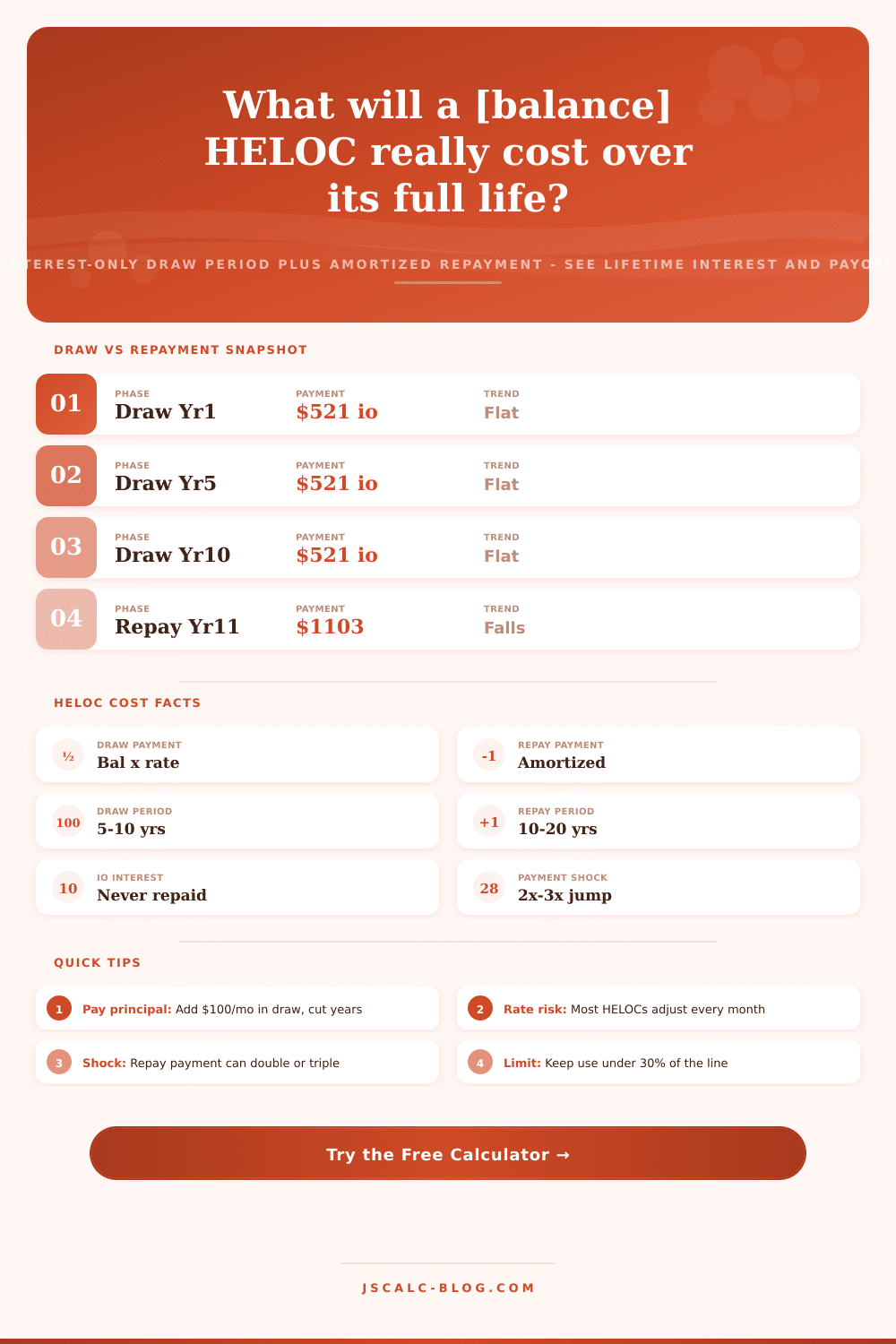
While you’re within the draw period (typically five to ten years), you’ll be able to borrow up to the limit on your line of credit. Typically, you’ll just need to make interest-only payments while in the draw period. How much is that? It’s whatever you owe multiplied by the monthly rate. For instance, if your APR is 8.5 percent and you have a $50,000 balance, you’d pay about $350/month. That sounds like chump change, especially since it won’t touch your principal unless you include additional funds. If you only pay the minimum, you will still owe everything you borrowed by the end of draw period.
And then comes the closing line, at which point it’s time to repay, typically over a ten- to-twenty-year term. At this point, your remaining debt are paid off through a traditional loan formula, so you’re on the hook for interest plus principal. In some cases, that amount jump up by two- or even three-times right from the get-go. If that three-hundred-fifty-dollar monthly payment was manageable before, it might fly into the thousands once you start paying back. This is called payment shock. If you don’t prepare for it, payment shock is one of the biggest sources of budget stress with HELOCs.
Neither side alone tell the story. Interest-only payments omit the unpaid principal, which understates the cost. Repayment payments omit the interest that’s been paid out in the draw. Combined, lifetime interest presents the complete bill. By the time a fifty-thousand-dollar HELOC has been open for a decade under interest-only payments, it can have cost tens of thousands of dollars… All without having touched the principal. It’ll help you see total cost so you know how much to borrow or if you should of repay it early.
Instead of the minimum (which is only interest), pay the principal while in the draw period, even an extra hundred or two hundred dollar a month shrinks the balance that gets amortized later. If you add an extra hundred bucks or two hundred bucks per month now, you’ll shrink the balance that gets amortized after you exit draw. That lowers not only the eventual payment but also the total interest owed.
To maintain low use, borrow far below your limit, so that there won’t be much balance to manage. Most HELOCs is variable-rate, with the potential to change every month; before signing up, it’s good practice to stress-test at a slightly higher rate. The table on the page demonstrates how various rates affects the payment, no math needed!
Last but not least: Budget according to the higher payment (i.e., repayment), not the lower payment (i.e., draw). Use your own calculations to determine what happens if you pay extra principal, how much earlier will this HELOC be paid off? How much less in interest will you repay?
If you think of a HELOC as one big loan with two phases, it’s a mighty weapon. But if you’re stuck thinking about the initial years, then you’ll overspend. Before you sign anything, make sure you have a solid understanding of how a HELOC works from start to finish. So you can enter into the deal with eyes wide open.