Reverse Mortgage Proceeds Calculator
Estimate the HECM principal limit and the net cash a homeowner age 62 or older could receive. Enter home value, the youngest borrower age, the expected rate and any existing mortgage, and see the principal limit, mandatory obligations, and how the money splits across a lump sum, a growing line of credit, and a tenure payment for life.
🏠Real Borrower Scenarios
📝Home and Borrower Details
HECM requires the youngest borrower to be at least 62.
Current market appraisal of the property.
2025 FHA national limit is 1,209,750. Adjust if it changes.
Lower expected rates raise the principal limit factor.
Leave at 0 to use the built-in age and rate lookup.
Any current loan must be paid from proceeds first.
Origination, title, appraisal and third-party fees.
FHA upfront mortgage insurance premium, typically 2%.
🔢Formula Snapshot
📊Principal Limit Factor by Age
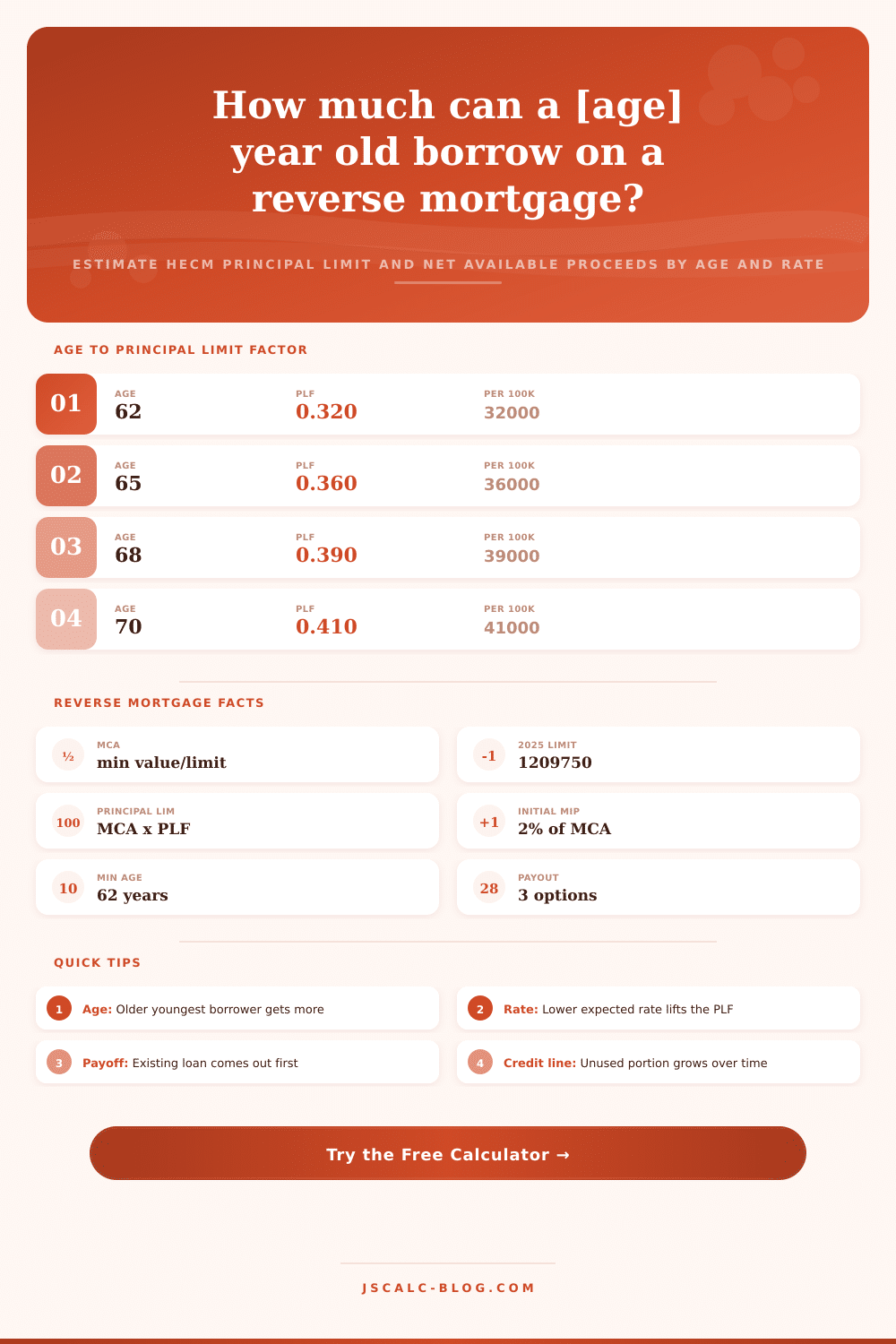
| Youngest Age | Typical PLF | PL per 100k MCA | Relative Access |
|---|---|---|---|
| 62 | 0.320 | $32,000 | Lowest, longest horizon |
| 65 | 0.360 | $36,000 | Low |
| 68 | 0.390 | $39,000 | Below average |
| 70 | 0.410 | $41,000 | Moderate |
| 72 | 0.430 | $43,000 | Moderate |
| 75 | 0.460 | $46,000 | Above average |
| 80 | 0.520 | $52,000 | High |
| 85 | 0.560 | $56,000 | Higher |
| 90 | 0.610 | $61,000 | Highest |
📈How Expected Rate Shifts the PLF
| Expected Rate | Rate Adjustment | PLF at Age 70 | Direction |
|---|---|---|---|
| 3.0% | +0.060 | 0.470 | Most proceeds |
| 4.0% | +0.040 | 0.450 | More proceeds |
| 5.0% | +0.020 | 0.430 | Above baseline |
| 6.0% | +0.005 | 0.415 | Near baseline |
| 6.5% | 0.000 | 0.410 | Baseline |
| 7.5% | -0.030 | 0.380 | Fewer proceeds |
| 8.5% | -0.060 | 0.350 | Least proceeds |
🗃Principal Limit and Proceeds Comparison Grid
| Age | PLF | MCA | Principal Limit | Obligations | Net Available |
|---|---|---|---|---|---|
| 62 | 0.320 | $450,000 | $144,000 | $81,000 | $63,000 |
| 65 | 0.360 | $450,000 | $162,000 | $81,000 | $81,000 |
| 68 | 0.390 | $450,000 | $175,500 | $81,000 | $94,500 |
| 70 | 0.410 | $450,000 | $184,500 | $81,000 | $103,500 |
| 72 | 0.430 | $450,000 | $193,500 | $81,000 | $112,500 |
| 75 | 0.460 | $450,000 | $207,000 | $81,000 | $126,000 |
| 80 | 0.520 | $450,000 | $234,000 | $81,000 | $153,000 |
| 85 | 0.560 | $450,000 | $252,000 | $81,000 | $171,000 |
| 90 | 0.610 | $450,000 | $274,500 | $81,000 | $193,500 |
💰Payout Option Comparison
| Payout Option | How It Pays | Best For | Note |
|---|---|---|---|
| Lump Sum | All net cash at close | Large one-time need | Fixed rate loans only |
| Line of Credit | Draw as needed | Flexible reserve | Unused portion grows |
| Tenure | Equal monthly for life | Steady income | Continues while in home |
| Term | Equal monthly, set years | Bridge to a date | Higher monthly amount |
| Modified | Line plus monthly | Income and reserve | Split the principal limit |
⚙Formula Breakdown
💡Reverse Mortgage Planning Tips
A reverse mortgage isn’t paid back in monthly payments (no payment to make), so don’t think of it that way. The key number to focus on is the amount of money you will be able to access via your house’s equity, also known in the industry as the principal limit. All other considerations hinges on this number, which answers both “how much will I be able to spend today?” and “what will I have left over for future expenses?”
It’s more complicated than a loan based off property value, because it takes into account age, interest rate, and federal insurance requirements… Things few homeowners know about until sitting down with an expert familiar with the HUD tables. The first number is the Maximum Claim Amount; also known as MCA. It’s either your home’s appraised value OR the current FHA lending limit (which is $1,209,750 in 2025). Say your house appraises for four hundred fifty thousand bucks. That’s your MCA. But say it appraise for two million. The MCA will hit its limit at that federal cap, meaning any remaining equity is off-limits to this type of loan. The calculator figure it all out automatically when you plug in your appraised value.
How Reverse Mortgage Calculators Work
This brings us to the Principal Limit Factor, a decimal number found in government tables that’s very dependent on youngest borrower’s age. Why? Because the program loans based off your life expectancy. For example, a younger borrower is assumed to carry the debt further into their future, so the factor should of be lower (to prevent the increasing balance from exceeding house value). You can expect something around 0.32 for a sixtysomething, or perhaps 0.61 for a nonagenarian. In between these age lines the tool do an elegant interpolation; instead of shoehorning you into a strict bracket, you get a reasonable number for your precise age. That level of detail make all the difference to the bottom line.
This one gets really moved around by the expected change in interest rates. The lower the rate, the bigger the factor because as the principal grows slower it will have more room underneath the house value (over time). The higher the rate, the smaller the principal limit become. So if you enter in your inputs, the calculator updates the base factor accordingly… Either increasing or decreasing relative to what’s on the government’s HUD table. So that means two otherwise identical borrowers (in terms of income/credit score) could qualify for very different amounts depending on where we are in the rate cycle when they close. This isn’t purely an income-or-credit-score situation, actuary math applies here too.
But then what? The main limit is gross. It’s not how much cash you get to keep. First up are mandatory obligations. The reverse mortgage must be in first lien position, so if you owe money on a house, you has to repay that mortgage. Next are the closing costs plus the upfront mortgage insurance premium (usually two percent of the MCA). At four hundred fifty thousand dollars, the upfront premium will cost you nine thousand all by itself. Combine that with a twelve thousand in fees, add a payoff of sixty thousand, and before you’ve seen a single dollar, about eighty-one thousand of your principal limit has been allocated. This way the tool lists those deductions, ensuring no one will be surpised.
The rest is what’s left: Your net available proceeds. This can be taken as a lump sum, which suits large one-time needs but usually locks in a fixed rate. It can also be opened as a line of credit, growing over time at the loan rate plus insurance if you don’t use any of it; then you’ve got a standby reserve that expands (even when not touched). And it can be converted to a tenure payment, turning the proceeds into equal payments for life. As long as you remain in the home, this’s a form of lifetime income.
On the page there are the reference tables, explaining how all these options work through various rates and ages. Run some scenarios with it. Try the pre-sets to see what happens if you wait longer (say 62-70). This will help you get more on your limit, otherwise you’ll hit the lending ceiling sooner with a high-value home. It makes the intimidating product concrete: something you can reason about in terms of numbers.
These are educated estimates; they’re not a loan approval. You need counseling and exact fee quotes for those. But understanding how it works before talking to a lender helps you know what’s important.