Property Tax From Millage Rate Calculator
Convert a millage (mill) rate into a real tax bill. Enter your assessed value and exemptions, then stack county, city, school, and special district mills to see the annual tax, monthly escrow, effective rate, and how much each levy contributes to your bill.
🎯Real Scenario Presets
📝Property and Millage Inputs
Taxable assessed value set by the assessor, before exemptions.
Total dollar value of homestead, senior, or veteran exemptions.
County general fund levy in mills (1 mill = $1 per $1,000).
City or township levy for roads, police, and fire.
Usually the largest levy on the bill.
Fire, library, water, or bond levies combined.
🔢Formula Snapshot
📊Per-Levy Contribution
| Jurisdiction | Mills | Rate % | Annual Tax | % of Bill |
|---|---|---|---|---|
| County | - | - | - | - |
📋Mills to Tax Reference ($100,000 taxable)
| Total Mills | As Percent | Tax per $100k | Reads As |
|---|---|---|---|
| 10 mills | 1.00% | $1,000 | Very low |
| 15 mills | 1.50% | $1,500 | Low |
| 20 mills | 2.00% | $2,000 | Below average |
| 25 mills | 2.50% | $2,500 | Typical |
| 30 mills | 3.00% | $3,000 | Average |
| 36 mills | 3.60% | $3,600 | Above average |
| 45 mills | 4.50% | $4,500 | High |
| 60 mills | 6.00% | $6,000 | Very high |
🗃Tax Across Assessed Values (36 total mills)
| Assessed Value | Homestead | Taxable Value | Annual Tax | Monthly | Effective % |
|---|---|---|---|---|---|
| $100,000 | $25,000 | $75,000 | $2,700 | $225 | 2.70% |
| $150,000 | $25,000 | $125,000 | $4,500 | $375 | 3.00% |
| $200,000 | $40,000 | $160,000 | $5,760 | $480 | 2.88% |
| $250,000 | $40,000 | $210,000 | $7,560 | $630 | 3.02% |
| $300,000 | $40,000 | $260,000 | $9,360 | $780 | 3.12% |
| $400,000 | $50,000 | $350,000 | $12,600 | $1,050 | 3.15% |
| $500,000 | $50,000 | $450,000 | $16,200 | $1,350 | 3.24% |
| $750,000 | $50,000 | $700,000 | $25,200 | $2,100 | 3.36% |
📏Millage and Rate Conversions
| Unit | Equals | Per $100,000 | Note |
|---|---|---|---|
| 1 mill | 0.1% | $100 | $1 per $1,000 |
| 10 mills | 1.0% | $1,000 | One percent |
| 0.5 mill | 0.05% | $50 | Half mill |
| 1 percent | 10 mills | $1,000 | Rate to mills |
| 2.5% | 25 mills | $2,500 | Typical bill |
| $1,000 tax | 10 mills | per $100k | Reverse check |
⚙Formula Breakdown
💡Property Tax Planning Tips
Your property tax statement look like a wall of numbers straight out of an accounting textbook. It includes a city millage, a county levy, a school district charge, and some special districts. Until you look at them closely, these appear to be arbitrary. But in fact they’re all different versions of the same type of math.
One math: the math that links the rate and value. That’s what the calculator does. It take this jumble of rates… Or levies… And adds it to the number on your house. And then it shows you how much each dollar will cost you, year after year.
How to Understand Your Property Tax Bill
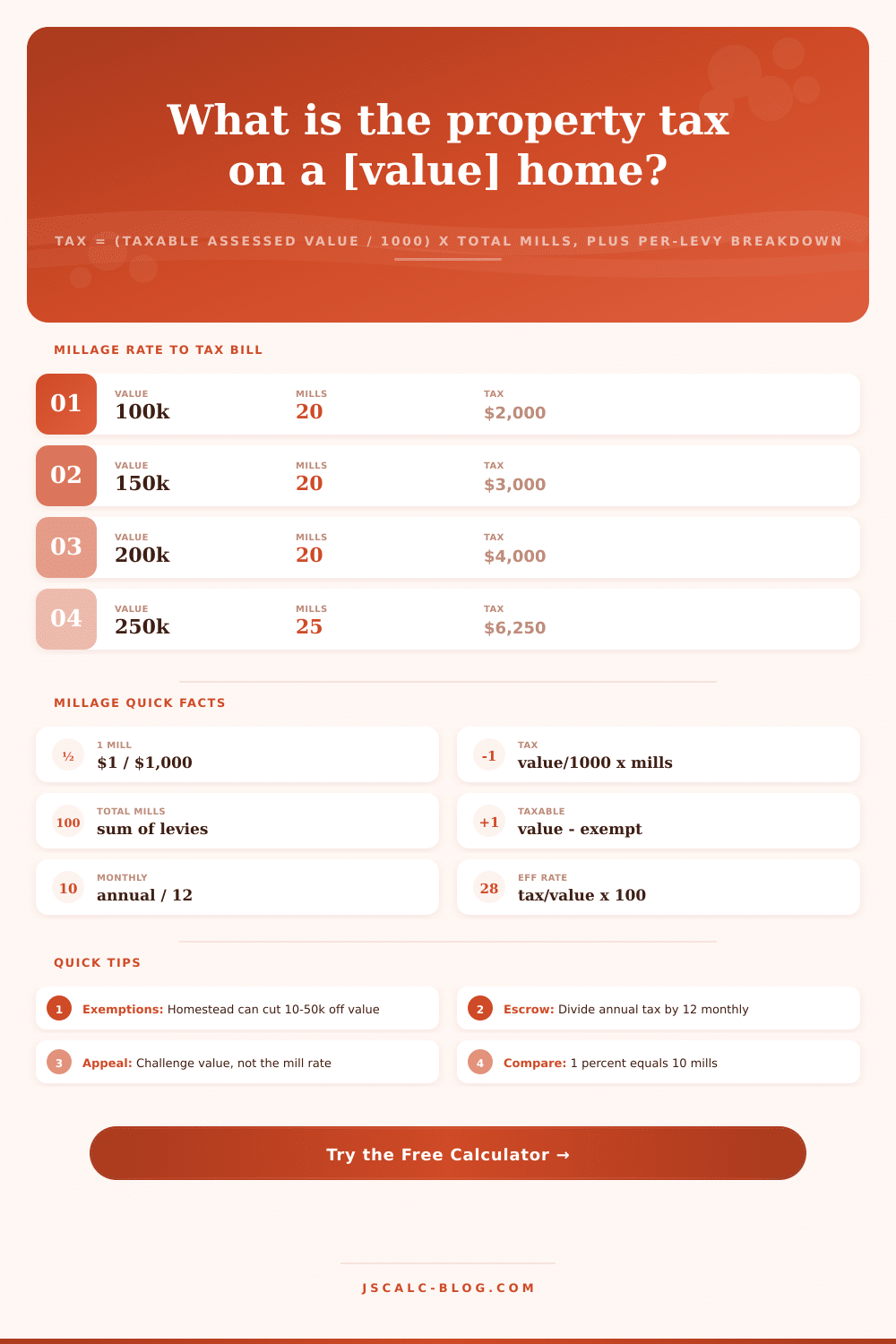
There are two terms to define: One tenth of a percent is called a mill. For every thousand dollars of taxable value, it’s one dollar. For example, ten mills would be one percent. Thirty-six mills would be three point six percent.
Why do local governments use mills? They want something precise, something more detailed than whole percentages. They have an itemized list, which might include taxes of eighteen point seven five mills. The mill makes sense because it lets you catch mistakes on budget proposals. Understanding the unit helps you spot absurdity in local budget proposal when you hear about proposed millage increases at town meetings.
The way most homeowners do the math, they take the mill rate, multiply it by full assessed value of their house. That’s incorrect. You need to subtract out the exemption amount before multiplying by the mill rate. So if your house is worth three hundred grand, but you get a forty thousand dollar homestead exemption, then the actual taxable value is two hundred sixty grand. Then you multiply by the mills.
Why? Because not all houses on the same block will be taxed the same. One guy forget to renew his paperwork. Another guy claims everything he can possibly claim. Each tax increases the savings from reducing the taxable value. Your biggest tool are exemptions. And then there’s stacking levies. Levies don’t care about your equity or income. They pile on. Administration and roads is set by the county. City adds their piece, typically fire and police. School district adds theirs (that’s normally the biggest chunk). Special districts add theirs for water, library or a bond issue.
You enter every levy into the tool. You know what percentage goes to each jurisdiction. Five percent might be municipal service. Half could be for schools. Now you know where to attend board meetings.
So how do you look at it? Here are three options. And the answer gives you all three. If you’re making payments directly, that’s the annual bill. If you have an escrow account (and most of us do), the lender spreads that annual bill over the year so you get one-twelfth of it each month. That’s the amount deducted from your paycheck every single time and it hits your cash flow.
The effective tax rate is expressed as a percentage of the initial assessed value. That makes it easy to compare rates between states or even different than parts of town. If property values are low but the millage is high, it won’t be so bad. Even if property values rise dramatically, a moderate millage could still kill you.
Don’t wait until annual statement time. Your property might have been assessed incorrectly. Too many times it’s biased in favor of the collector rather than the owner. When you appeal an overinflated number you should of saved money, no matter what the mill rate happens to be.
Use the calculator as a sandbox to play with scenarios. Nudge the assessed value up (or down). Adjust the exemption. See the tax amount fall in real-time. It turns abstract local governance into concrete monthly costs. This provides clarity so that you can challenge an unfair assessment (or at least budget correcty).