Assessed Value Calculator
Convert a home market or appraised value into its assessed value using your state or county assessment ratio, subtract homestead and other exemptions to find taxable value, and optionally estimate the yearly property tax from a mill rate or a simple tax percentage.
🏠Real Assessment Scenarios
📝Property and Assessment Inputs
The assessor's estimated fair market value of the property.
Pick a common ratio or choose Custom to type your own.
Percent of market value that is assessed. Editable any time.
Value removed from the assessed value for a primary residence.
Senior, veteran, disability, or agricultural exemptions combined.
Choose how to estimate the annual property tax bill.
Total millage. 1 mill equals $1 tax per $1,000 taxable value.
Used only when tax method is set to Simple tax rate.
🔢Formula Snapshot
📋Assessment Ratios by State
| State / Type | Assessment Ratio | $200,000 Market | Assessed Value |
|---|---|---|---|
| California (Prop 13) | 100% | $200,000 | $200,000 |
| Michigan (SEV) | 50% | $200,000 | $100,000 |
| Georgia | 40% | $200,000 | $80,000 |
| Ohio (approx) | 35% | $200,000 | $70,000 |
| Missouri residential | 19% | $200,000 | $38,000 |
| Louisiana | 10% | $200,000 | $20,000 |
| South Carolina primary | 4% | $200,000 | $8,000 |
| Full-value states | 100% | $200,000 | $200,000 |
📊Common Homeowner Exemptions
| Exemption | Who Qualifies | Typical Amount | Applied To |
|---|---|---|---|
| Homestead | Primary residence owner | $15,000 to $50,000 | Assessed value |
| Senior citizen | Age 65 and older | $5,000 to $40,000 | Assessed value |
| Disabled veteran | Service-connected rating | Partial to 100% | Assessed value |
| Disability | Certified disabled owner | $5,000 to $25,000 | Assessed value |
| Widow / widower | Surviving spouse | $500 to $5,000 | Assessed value |
| Agricultural | Working farmland | Use-value basis | Market value |
| Circuit breaker | Low-income owner | Income based | Tax bill |
📏Mill Rate to Tax Rate Reference
| Mill Rate | As Percent | Per $1,000 | Tax on $100,000 Taxable |
|---|---|---|---|
| 10 mills | 1.0% | $10 | $1,000 |
| 15 mills | 1.5% | $15 | $1,500 |
| 20 mills | 2.0% | $20 | $2,000 |
| 25 mills | 2.5% | $25 | $2,500 |
| 30 mills | 3.0% | $30 | $3,000 |
| 40 mills | 4.0% | $40 | $4,000 |
🗃Assessment Ratio Comparison Grid
| Assessment Ratio | Market Value | Assessed Value | Taxable Value | Mill Rate | Est. Annual Tax |
|---|---|---|---|---|---|
| 10% | - | - | - | - | - |
⚙Formula Breakdown
💡Assessment and Exemption Tips
When you buy a home, you’re not just getting a building on some land. You’re also getting an entry into a cost-of-living. A collection of numbers that determine how much you pay for everything. No two people will ever agree on what their house is worth (the most confusing disparity is between “market value” and “taxable value,” neither of which are equal to the other). To see exactly where each dollar of your assessment are derived from, this tool break down the number in 3 phases and takes away all jargon surrounding property taxes.
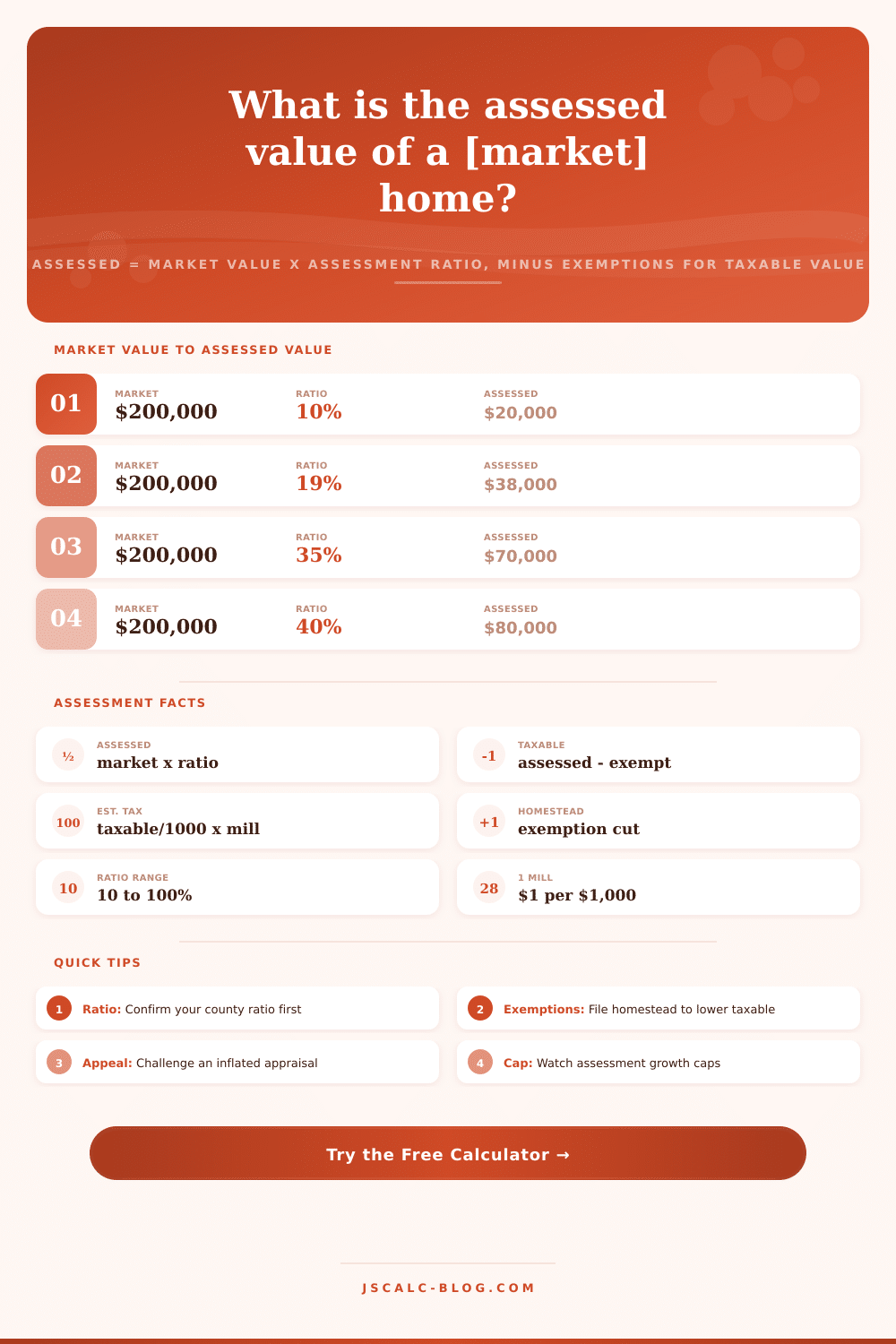
So here’s why they get it all wrong: Assessed value is a legally determined portion of market value (aka what your house could sells for right now). Different states have wildly different rates; for example, California assesses at 100 percent, Georgia does 40 percent and Louisiana just 10 percent. That means you can have two houses with the same market value; say $250,000, and one has $250,000 assessed value and the other has $25,000 assessed value.
How Property Taxes Are Calculated
Most homeowners is eligible for an exemption that lowers their taxable value below their assessed value. This is called taxable value, and it’s subject to the tax rate. The typical exemption are a homestead exemption, i.e., if your home is your primary residence. Additional discounts are available for senior citizens, veterans, and disabled owners.
For example: If you live in a state with an assessed value of $100,000 but get a $25,000 homestead exemption, the amount you’ll pay taxes on go down to $75,000. That means your home will be taxed at a lower rate… which means cash savings. The calculator crunches the numbers for you when you input your local rules. You don’t have to guess what portion of that reduction save you money.
The tax estimate takes into account your jurisdiction’s rate (some are expressed as a percentage; others as a mill rate). A mill is defined as a dollar of tax for every thousand dollars of taxable value. With a taxable value of $75,000 and a rate of 25 mills, the annual bill are $1,875. It helps to know whether your jurisdiction uses mills or percentages since this affects how sensitive your bill will be to any reassessment.
The tool lets you switch between the two and see the effect in real time. On the page, it provides a reference table which outlines all of those ratios in parallel: How will the same dollar amount change into a different number in each state? It is a painful reminder that your taxes depend nearly as much on where you live as they do on your income.
The grid can help you get your head around the ratio without seeing interest rates first… And use it to compare counties or when deciding whether to move. Unclaimed exemptions are among the most popular forms of overpayment. Many homeowners leave money in the hands of the government without ever filing for all the exemptions they’re entitled to. This can add up over time; a $25,000 exemption at 25 mills saves you $625 per year, which amounts to $7,500 saved over a decade.
Understanding how this works and making sure your paperwork reflects your life is the name of the game. Most counties gives you an official opportunity to appeal if the appraisal seems inflated to you (this timeframe varies). A lower market value leads directly to lower taxable and assessed values.
The presets within the tool will allow you to model things that may not have occured to you. You can compare how much a heavily exempted senior home would be assessed versus fully assessed. It puts numbers on an otherwise abstract policy. You can get to that concrete dollar amount so you understand precisly where it comes from.
This is about more than paying your taxes, it’s about knowing exactly why you’re paying them and how it all works together. To verify a tax bill, to budget for a purchase, to compare houses between states. All of these benefit from understanding this three step process. It is no longer guesswork. You should of used this tool sooner.