Homestead Exemption Savings Calculator
Estimate how much a homestead exemption, plus senior, veteran, and disability exemptions, cuts your yearly property tax bill. Enter your assessed value and tax rate in mills or percent, and see the taxable value, annual dollars saved, the percent your bill drops, and the cumulative savings over 5, 10, and 30 years.
🏡Real Homestead Scenarios
📝Property and Exemption Inputs
The taxable assessed value on your notice, before exemptions.
Mills convert as tax = value / 1000 x mills. 1% equals 10 mills.
Enter 1.2 for 1.2 percent, or 12 if the rate mode is mills.
Some states exempt a fixed dollar sum, others a percent up to a cap.
Dollar amount, or percent value like 50 when percent mode is on.
Maximum dollars a percent homestead can exempt. Used in percent mode.
Extra exemption for owners aged 65 and older, if you qualify.
Exemption for eligible veterans; disabled veterans often get more.
Additional exemption for a qualifying disability status.
Cumulative savings assume the same rate each year you own.
🔢Savings Snapshot
🗄Exemption Savings Comparison Grid
| Exemption Type | Exempt Amount | Tax Saved / Yr | Percent of Bill | 5 Year Saved | 30 Year Saved |
|---|---|---|---|---|---|
| Homestead | $0 | $0 | 0% | $0 | $0 |
📊Homestead Savings by Home Value
| Assessed Value | Homestead Exempt | Tax Rate | Annual Saved |
|---|---|---|---|
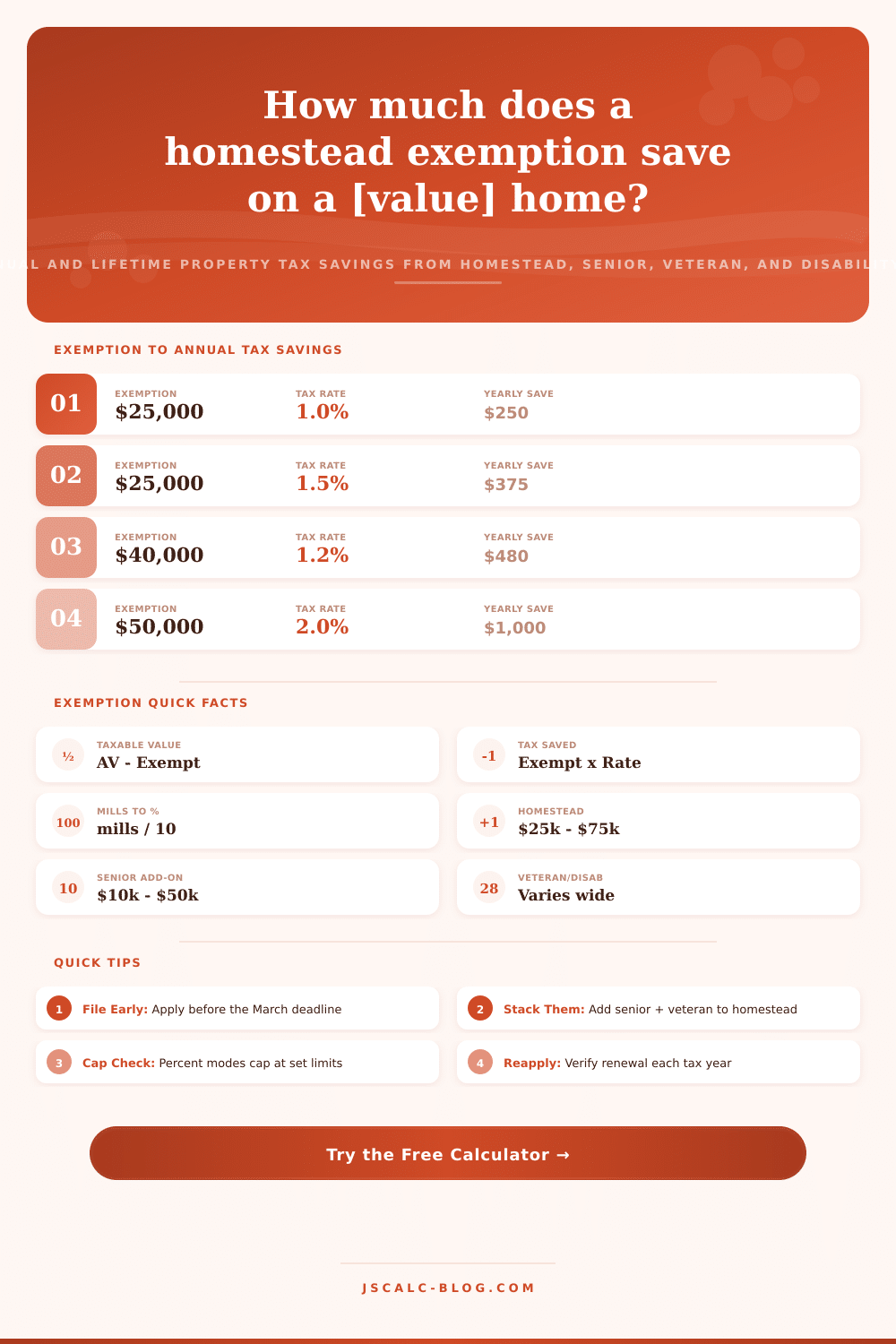
| $150,000 | $25,000 | 1.0% | $250 |
| $200,000 | $25,000 | 1.2% | $300 |
| $250,000 | $40,000 | 1.2% | $480 |
| $300,000 | $50,000 | 1.5% | $750 |
| $350,000 | $50,000 | 2.0% | $1,000 |
| $400,000 | $75,000 | 1.1% | $825 |
| $500,000 | $50,000 | 1.8% | $900 |
| $600,000 | $100,000 | 1.0% | $1,000 |
📋Common Exemption Types and Ranges
| Exemption | Who Qualifies | Typical Range | Notes |
|---|---|---|---|
| Homestead | Primary residence owner | $25,000 - $75,000 | Must be your main home |
| Senior 65+ | Owners aged 65 and up | $10,000 - $50,000 | Often income limited |
| Veteran | Honorable service veterans | $5,000 - $24,000 | Proof of service needed |
| Disabled Veteran | Service-connected disability | $12,000 - full value | 100% may be tax free |
| Disability | Qualifying disability status | $10,000 - $25,000 | Medical proof required |
| Surviving Spouse | Widow or widower | $5,000 - $25,000 | Varies by county |
| Percent Homestead | Primary residence owner | 20% - 50% of value | Capped in dollars |
⚙Formula Breakdown
💡Homestead Filing Tips
It is property tax. Unless you’re familiar with it, you probably assume that it’s one of those bills you write and just pay. Here it comes; here’s the number. Write the check. Cross fingers next year doesn’t get any stinkin’ higher. Every time you do this, you leave money on the table.
The homestead exemption is not some unknown perk reserved for lawyers. It’s simply a reduction in your taxable home value. Dollar-for-dollar, meaning a direct reduction in your taxes. Odds are, if you own your house, you qualify. The trick is knowing how much you save over a long time by doing so, not just this year.
How to Save Money on Property Tax
The math is simple enough to explain at the kitchen table, though it’s easy to ignore when reviewing a dense tax notice. The homestead exemption reduces the value your house are taxed on, prior to applying the tax rate. It has no effect on its market value whatsoever. All it does do is reduce the amount the county applies its rate to, to come up with your total liability.
Let’s say your house is appraised at two hundred fifty thousand dollars and your homestead exemption is for twenty-five thousand dollars: the government will treat you like you live in a house that’s worth two hundred twenty-five thousand. Since property tax = taxable value x rate, lowering that taxable base lowers your bill by an equal amount. This is a tiny lever with a giant mechanical advantage.
The problem is, every jurisdiction have a unique set of rules and rates. For example, some counties express theirs in dollars per thousand (also called mills), and others use percentages. Since it’s 2am, you don’t want to be doing math in your head. Fortunately, the calculator accepts either input: ten mills is one percent, so plugging in the former won’t result in a three times higher estimate different than using the latter. Pick the correct mode and everything will work out.
Furthermore, some states provide homestead relief as a percentage off of your home’s value (and there is typically a cap on how high up that goes in dollars). If you’re in a hot housing market, then this makes a huge difference. A 50% exemption on a $400K house might sound like a $200K windfall. But if the law limits that relief to say, $50K, you’ll only get a benefit equal to that cap. The calculator does this for you automatically, so you know how much the exemption will actualy save you… Not what the headline says, which may be misleading.
You should of also consider stacking exemptions if you qualify. If so, stack them. If you qualify for a homestead, that’s typically only the beginning. Many states offer another layer of relief for senior citizens over age 65. In some cases, veterans may qualifies for even more exemptions, especially those with service-related disabilities. These could wipe out their tax bill altogether. The points add up.
You don’t forfeit your homestead by adding, say, a veteran exemption above your senior exemption. The lower you drop your taxable value, the bigger the annual savings will climb.
Tax bills are so far away that we don’t realize how much this saves us. It’s easy for folks to discount these savings: “Oh, it’s just a few hundred dollars a year.” But the vast majority of us live in our main home for decades at a time. If you save three hundred bucks every year, that compounds into tens of thousands over three decades, or thousands over a decade. When viewed as an “annual line item” on your tax return, the exemption is easily overlooked. The calculator shows the long-term growth. It illustrates how small cuts each year add up to huge amounts of money staying in your home instead of being sent to the county treasury.
It’s easy to file, most of the time you just fill out a form (either online or on paper sent through the mail) before some early-spring deadline. If you file a day late, you lose a whole year of saving money. After filing, it lasts for as long as you occupy and/or own the house (with occasional renewal requirements if you’re disabled or a veteran). It requires minimal effort for a huge payoff.
Understanding this and checking your eligibility is one of the single highest-return things a homeowner can do all year. This takes something static and makes it manageable, it puts it within your control.