Property Tax Proration Calculator
Split the annual property tax fairly between buyer and seller at closing based on the exact days each party owns the home during the tax period. Handle taxes paid in arrears or in advance, choose a 365 or 360 day-count basis, and see the precise closing credit and which party owes it.
🏠Real Closing Scenarios
📝Proration Inputs
Full-year tax bill for the property.
First day of the local tax year (often Jan 1 or Jul 1).
Day ownership transfers to the buyer.
How the daily tax rate is derived.
Arrears: seller credits buyer. Advance: buyer repays seller.
Local custom on who is charged for closing day.
Precision used on every result card.
Optional: other tax credits netted at the table.
🔢Formula Snapshot
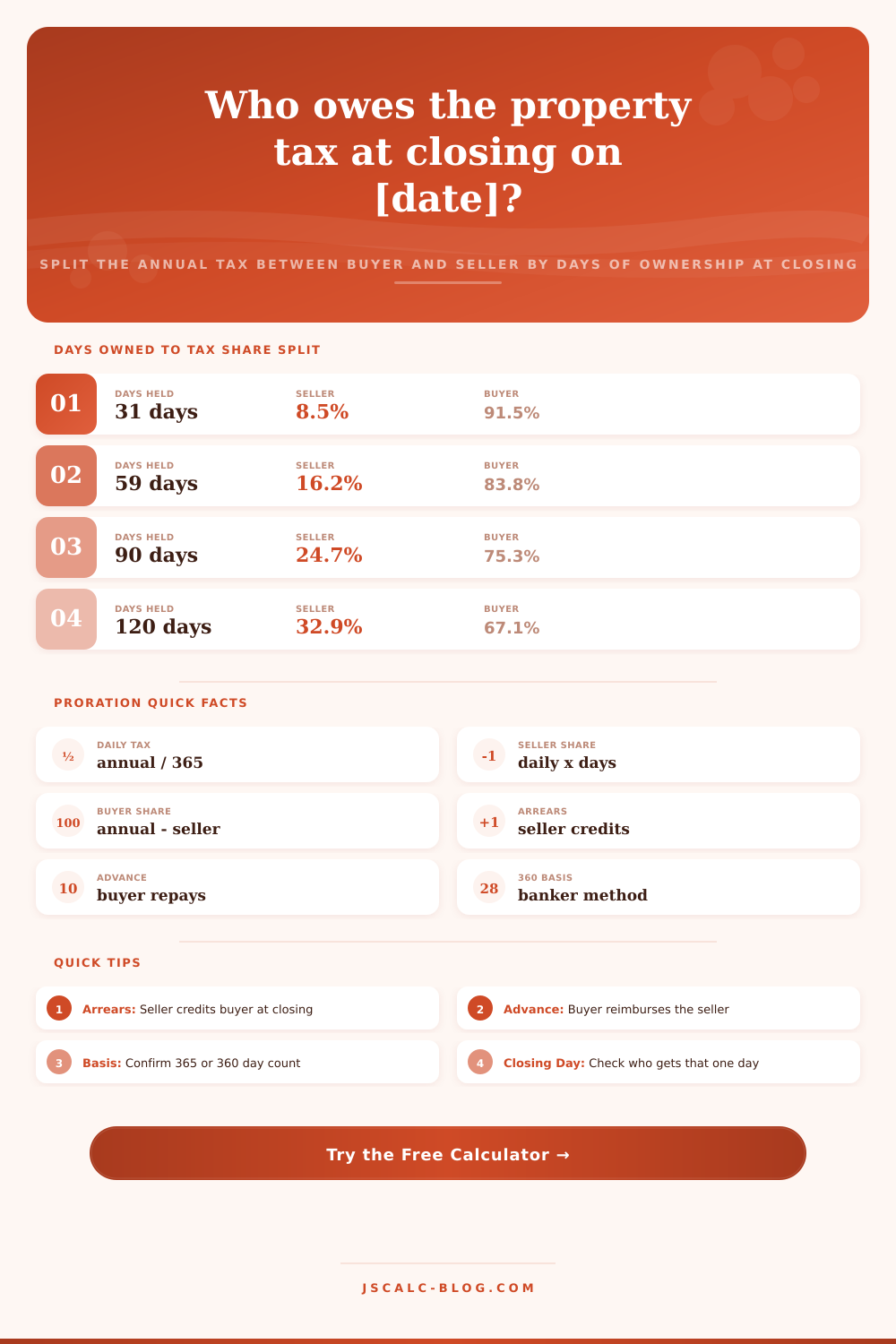
📋Days Held to Tax Share (on $4,380 / 365)
| Closing Point | Days Seller Held | Seller Share | Buyer Share |
|---|---|---|---|
| End of January | 31 days | $371.84 | $4,008.16 |
| End of February | 59 days | $707.75 | $3,672.25 |
| End of March | 90 days | $1,079.59 | $3,300.41 |
| End of April | 120 days | $1,439.45 | $2,940.55 |
| End of May | 151 days | $1,811.30 | $2,568.70 |
| End of June | 181 days | $2,171.18 | $2,208.82 |
| End of August | 243 days | $2,915.01 | $1,464.99 |
| End of October | 304 days | $3,646.85 | $733.15 |
| End of November | 334 days | $4,006.73 | $373.27 |
| End of December | 365 days | $4,380.00 | $0.00 |
📊Arrears vs Advance Credit Direction
| Payment Timing | Who Has Paid | What Is Owed | Credit Direction | Line on Statement |
|---|---|---|---|---|
| Arrears | No one yet | Seller owes elapsed days | Seller to buyer | Buyer credit |
| Advance | Seller prepaid | Buyer owes future days | Buyer to seller | Seller credit |
| Arrears, early close | No one yet | Few elapsed days | Seller to buyer | Small buyer credit |
| Arrears, late close | No one yet | Most days elapsed | Seller to buyer | Large buyer credit |
| Advance, early close | Seller prepaid | Most future days | Buyer to seller | Large seller credit |
| Advance, late close | Seller prepaid | Few future days | Buyer to seller | Small seller credit |
📏Day-Count Basis Comparison
| Basis | Days Per Year | Daily on $4,380 | Month Length | Common Use |
|---|---|---|---|---|
| 365 actual | 365 | $12.0000 | 28 to 31 days | Most title companies |
| 360 banker | 360 | $12.1667 | 30 days flat | Some escrow custom |
| 366 leap | 366 | $11.9672 | 29 in February | Leap-year closings |
| 365 semiannual | 182.5 per half | $12.0000 | Varies | Two-installment areas |
🗃Full Proration Comparison Grid (365 Basis, Jan 1 Start)
| Closing Month | Days Elapsed | Seller Share | Buyer Share | Arrears Credit | Advance Credit |
|---|---|---|---|---|---|
| January 15 | 15 days | $179.18 | $4,200.82 | Buyer +$179.18 | Seller +$4,200.82 |
| February 15 | 46 days | $549.53 | $3,830.47 | Buyer +$549.53 | Seller +$3,830.47 |
| March 15 | 74 days | $884.05 | $3,495.95 | Buyer +$884.05 | Seller +$3,495.95 |
| April 15 | 105 days | $1,259.59 | $3,120.41 | Buyer +$1,259.59 | Seller +$3,120.41 |
| June 15 | 166 days | $1,991.51 | $2,388.49 | Buyer +$1,991.51 | Seller +$2,388.49 |
| July 15 | 196 days | $2,351.34 | $2,028.66 | Buyer +$2,351.34 | Seller +$2,028.66 |
| September 15 | 258 days | $3,095.18 | $1,284.82 | Buyer +$3,095.18 | Seller +$1,284.82 |
| October 15 | 288 days | $3,455.01 | $924.99 | Buyer +$3,455.01 | Seller +$924.99 |
| November 15 | 319 days | $3,827.75 | $552.25 | Buyer +$3,827.75 | Seller +$552.25 |
| December 15 | 349 days | $4,187.59 | $192.41 | Buyer +$4,187.59 | Seller +$192.41 |
⚙Formula Breakdown
💡Proration Tips at Closing
Property tax proration: Dividing an annual property tax bill based on days of ownership often confuses buyers and sellers. This happens when a single cost are split down to the penny. But it serves an important purpose: fairness. Local services such as roads and schools is paid for by property taxes, which benefit whoever is living in house when the service is provided. When you’re selling in April, you get billed for the three months in January, February, March; the buyer gets billed for the next nine months. It’s fair, nobody ends up subsidizing anybody else so everyone pays only for the time they got to enjoy these publicly-funded services.
With the legalese removed, math is easy. Divide the total annual taxes by number of days in the year to find the daily rate. Multiply that daily rate by the number of days each party lived in the house to find the total amount owed. For the math, there’s no need to use a spreadsheet or do calculations in your head; simply plug in the figures into a calculator and let it do the work for you. It will break down the raw annual dollar amount into per-day cost. Then, you can check off each passing day to see exactly how much tax builds up as time goes by. That transparency helps because it puts those abstract lines from the settlement document into some hard numbers that you can check off against your own calendar.
How Property Tax Proration Works
And then there’s the issue of timing with payments. Property taxes can be billed either in advance or in arrears (after the fact). When billed in arrears, seller will get the bill after he has enjoyed use of house but without having paid the tax for that time period yet. He’ll have to credit the buyer at close. This ensures the buyer doesn’t pay for a period before they owned the house when the bill comes due months later. Alternatively, taxes could be billed in advance, meaning seller prepaid for the whole year. Now the buyer owes the seller money to compensate him for the portion of the year during which he will be occupying the house. That flips the money flow completely around. Small detail, big difference if you want to know who is writing and who is receiving a check at the table.
Another source of confusion with taxes are the day-count basis. A year contains three hundred sixty-five days (though some use a banker’s year of three hundred sixty), right? If only! Most people assume a year has 365 days, which is true for most title companies using an actual calendar count. But some lenders and old-school escrow conventions still operate under a banker’s year of three hundred sixty days where every month is exactly thirty days long. This technicality results in a slight increase in daily tax rate (you’re dividing the same total bill by a smaller number). That can swing the credit amount by a few bucks on a mid-year closing. Does it affect the fairness of the deal? No. It just means that you’ll see a different number on the screen than expected. If you know what convention is being used in your local market, then you will be able to guess the final figure prior to sitting down at signing table.
It’s not just about what day you close, either. Depending on local custom, there will be an understanding that either the seller or buyer is responsible for paying for the day-of-ownership transfer. In some areas, the day goes to the buyer; in other places, it goes to the seller. Sounds like a quibble over one measly day, but when that day is part of a big-ticket deal and the tax bite is significant, those 24 hours mean actual cash. Breaking that rule can create last-minute problems as each party believe they have ownership starting on a different day. Make sure everyone agrees about which days get counted beforehand so neither side has any illusions once it comes time to write out the checks.
Don’t worry about remembering these formulas; or bringing your own calculator to the closing table. Instead, use this tool to automate all of it: It will calculate your daily interest rate based off the terms you enter; then apply that daily rate according to the right day-count basis and timing logic (i.e., whether you’re paying for an additional day/week/month after the close). And most importantly, you can play around with various scenarios. Adjust the closing date by a few days in either direction, for instance; to see how shifting dates impacts the size of your credit.
You should of seen this coming. Property tax proration matches expenses to benefits. The person receiving the service should be the one paying the bill. It’s fair to both sides: breaking the yearly cost down into daily rates based on actual occupancy ensures everyone benefits. If it’s your first time purchasing a house (or selling a vacation house), splitting up the bill will make you feel confident that the closing statement accurately depicts reality. You just want to walk away knowing exactly what you’re paying for and why. Actualy, it is simple once you understand the rules. The furnitures in the house don’t matter here.