Solar Day vs Sidereal Day Calculator
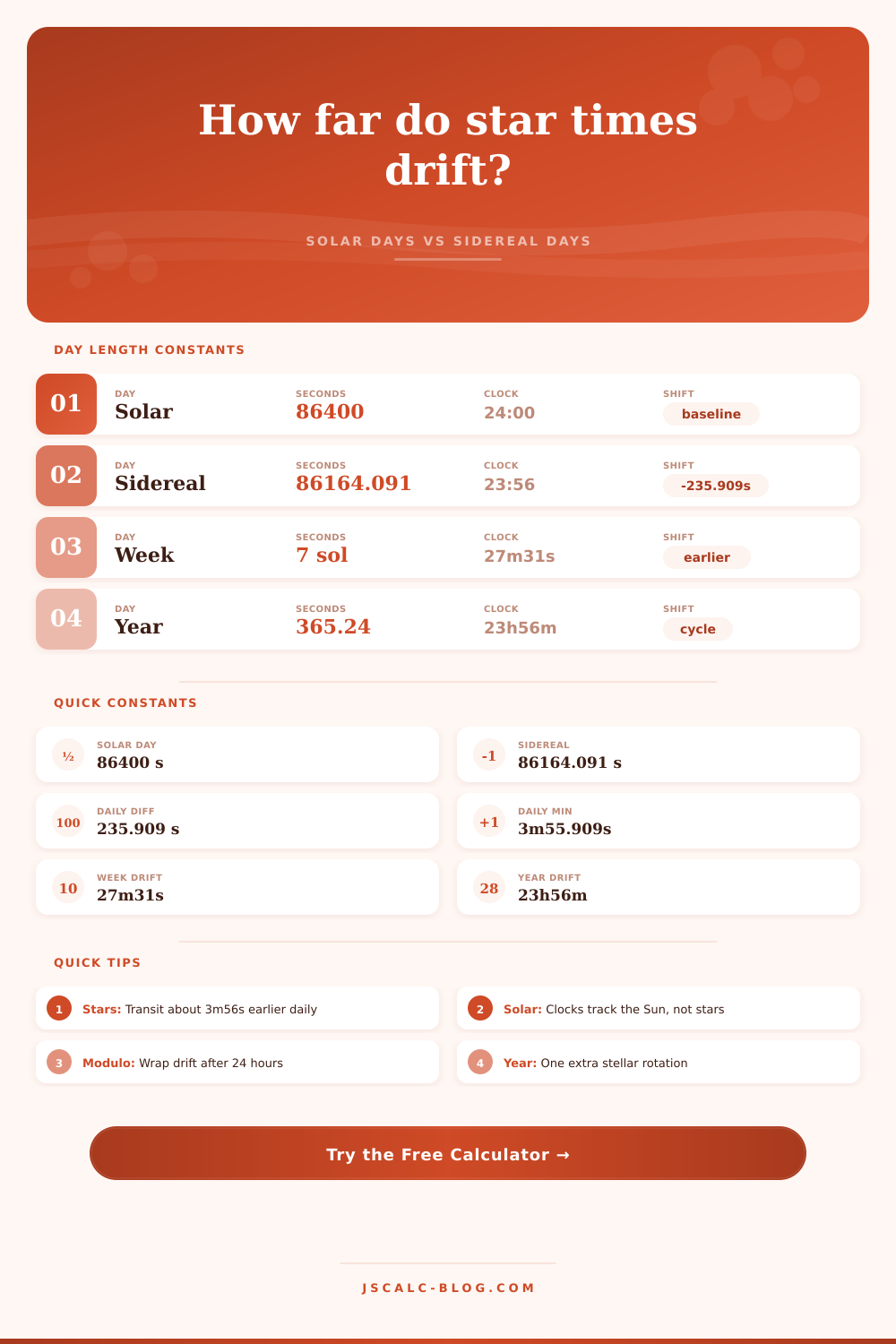
Compare mean solar days with sidereal days using the fixed astronomy constants: 86400 seconds, 86164.091 seconds, and 235.909 seconds of daily accumulated drift.
| Quantity | Value | Clock form | Use in calculator |
|---|---|---|---|
| Mean solar day | 86400 seconds | 24h 00m 00s | Civil-clock day basis |
| Sidereal day | 86164.091 seconds | 23h 56m 4.091s | Earth rotation relative to stars |
| Daily difference | 235.909 seconds | 3m 55.909s | Star-transit advance per solar day |
| Solar to sidereal ratio | 1.00273791 | rotations/day | Sidereal rotations per solar day |
| Sidereal to solar ratio | 0.99726957 | solar days | Solar days per sidereal day |
| Longitude conversion | 15 degrees | 1 sidereal hour | Local sidereal offset estimate |
| Preset | Entered interval | Solar days | Approx accumulated drift | Why it is useful |
|---|---|---|---|---|
| One Mean Solar Day | 1 solar day | 1.0000 | 3m 55.909s | Basic daily star advance |
| One Sidereal Day | 1 sidereal day | 0.9973 | 3m 55.265s | One stellar rotation |
| Observing Week | 7 solar days | 7.0000 | 27m 31.363s | Weekly night-sky planning |
| Synodic Month | 29.5306 solar days | 29.5306 | 1h 56m 7s | Moon phase cycle interval |
| Quarter Year | 91.3105 solar days | 91.3105 | 5h 59m 1s | Season-scale sky change |
| Half Year | 182.6211 solar days | 182.6211 | 11h 58m 2s | Opposite season comparison |
| Tropical Year | 365.2422 solar days | 365.2422 | 23h 56m 4s | One extra stellar rotation |
| 90-Day Term | 90 solar days | 90.0000 | 5h 53m 52s | Course or observing log span |
| Two Tropical Years | 730.4844 solar days | 730.4844 | 47h 52m 8s | Two-year accumulated drift |
| Solar interval | Total drift | Modulo 24h drift | Sidereal rotations | Star transit note |
|---|---|---|---|---|
| Calculate to fill this table. | ||||
Rows scale around your entered interval while keeping the same mean solar day and sidereal day constants.
| Step | Formula | Meaning | Output used |
|---|---|---|---|
| 1 | seconds = solar days x 86400 | Convert civil-clock interval to seconds | Total elapsed seconds |
| 2 | sidereal days = seconds / 86164.091 | Earth rotations relative to stars | Sidereal rotation count |
| 3 | drift = solar days x 235.909 | Accumulated earlier star transit | Total clock advance |
| 4 | wrapped drift = drift mod 86400 | Same shift within one clock day | Planning clock offset |
| 5 | local offset = longitude / 15 | Approximate sidereal-hour longitude shift | Local sidereal display |
| 6 | next clock = start - wrapped drift | Same stars return earlier | Clock-time result card |
Midnight strikes on your clock, the sun sinks below the horizon and you think that’s it for the day. Sleep. Meetings. Schedule. That’s how we live. That’s how we schedule meetings. That’s how we sleep.
But your watch isn’t telling the whole story. In fact, Earth is spinning a bit quicker than it tells us. While the loud and annoying sun draws all of our attention as lead actor in this play, the other actors has their own schedules going along too.
Why Stars Rise Four Minutes Earlier Each Night
Look up at the stars sometime. Notice anything? Yeah, they’re not standing still. They’re drifting around the sky, seeming to rise and set roughly four minutes earlier every single night.
That’s why there is a difference between sidereal day (the time it takes for the Earth to complete one spin) and solar day (the time your watch measures). On average, the solar day last eighty-six thousand four hundred seconds. That’s what we mean when we say it’s “twenty-four hours.” That’s how long it takes the sun to be back where it started in the sky.
But the Earth doesn’t just spin on its axis; it’s orbiting around the sun at the same time. To keep pace with the sun’s apparent motion, it must rotates just a little extra each day to catch up.
The actual rotation period, as measured against distant, fixed stars, is called sidereal day. It’s shorter: about eighty-six thousand one hundred sixty-four seconds. That might not sound like much, only three minutes and fifty-six seconds. But if you add it up over the course of a week, the stars will have crossed meridian almost a half hour earlier. Add up that drift over a whole year, and you get one entire extra rotation.
That’s why there are three hundred and sixty-six stellar rotations, but three hundred and sixty-five days.
If you’re curious about what times a particular constellation will come up, it help to understand this difference. Once you input an interval and starting time into the calculator above, the math gets done for you (no need to keep track of all that incremental time adding up). For example, you could enter one week of observations and watch just how far the heavens move.
The tool takes whatever interval you select and expresses it in terms of solar seconds, and then divides by sidereal constant to determine how many true rotations it represents. That equals number of minutes of difference between where the stars will rise and where they were when you started (the “drift” value). So now you’ll know when to expect to spy on Orion in June versus January; the whole celestial sphere rotate significantly with the seasons.
Understanding what’s being calculated here is more or less the trick. Sidereal time as defined by astronomers have nothing to do with the sun whatsoever. They’re interested in an unchanging backdrop: the rest of universe.
If you play around with the calculator a little, you’ll notice that there’s an option to swap between solar and sidereal inputs. That gives you some insight into how sidereal time differ from our familiar “day.” Our day is closer to a sidereal day, though it’s slightly shorter. One sidereal day is very nearly equal to one solar day, but it’s off by that fractional amount. And that’s where all the cool stuff lives in terms of time offsets.
There’s also a way to correct for your location, specifically for longitude, which just moves your sidereal time for your local area on top of prime meridian. It doesn’t alter the day length, but will alter when particular things passes over your head.
The most common error: People think the sky runs like a twenty-four hour clock. No, it doesn’t. The sky isn’t stationary; it’s rotating against the clock.
Point your telescope at a star tonight at ten p.m. Tomorrow it’ll appear in the same spot…at nine fifty-six p.m. At ten p.m., the star has moved past its peak.
That’s why from one year to the next, the night sky change utterly from season to season. We are orbiting and blocking out a different set of constellations. However, the underlying clock is ticking relatively faster than what your watch tells you.
The information isn’t rocket science; it’s something you can use without an astrophysics degree. All you have to do is believe that stars don’t run on the same clock as the sun.
The table of references on page spells out the daily difference. It also shows the constants of the two kinds of days. It’s all part of closing the gap between the real world of stars up above and the one we measure with our clocks.
Knowing the difference makes you see the night differently; whether you’re curious about what causes the movement of the stars, or you want to take photos of Milky Way like a hobbyist photographer.
We know the Earth rotates constantly, but our watches and clocks are running after the sun, putting the stars slightly behind us, four minutes a day. This is what causes the seasonal shift in the heavens, changing the seemingly unchanging dome of darkness overhead into a slow-rotating carousel of light.