Rotation Period Calculator
Calculate spin period from angular velocity, RPM, or equatorial speed with radius, rotations per day, rotations per year, radians per second, and degrees per hour.
Rotation Results
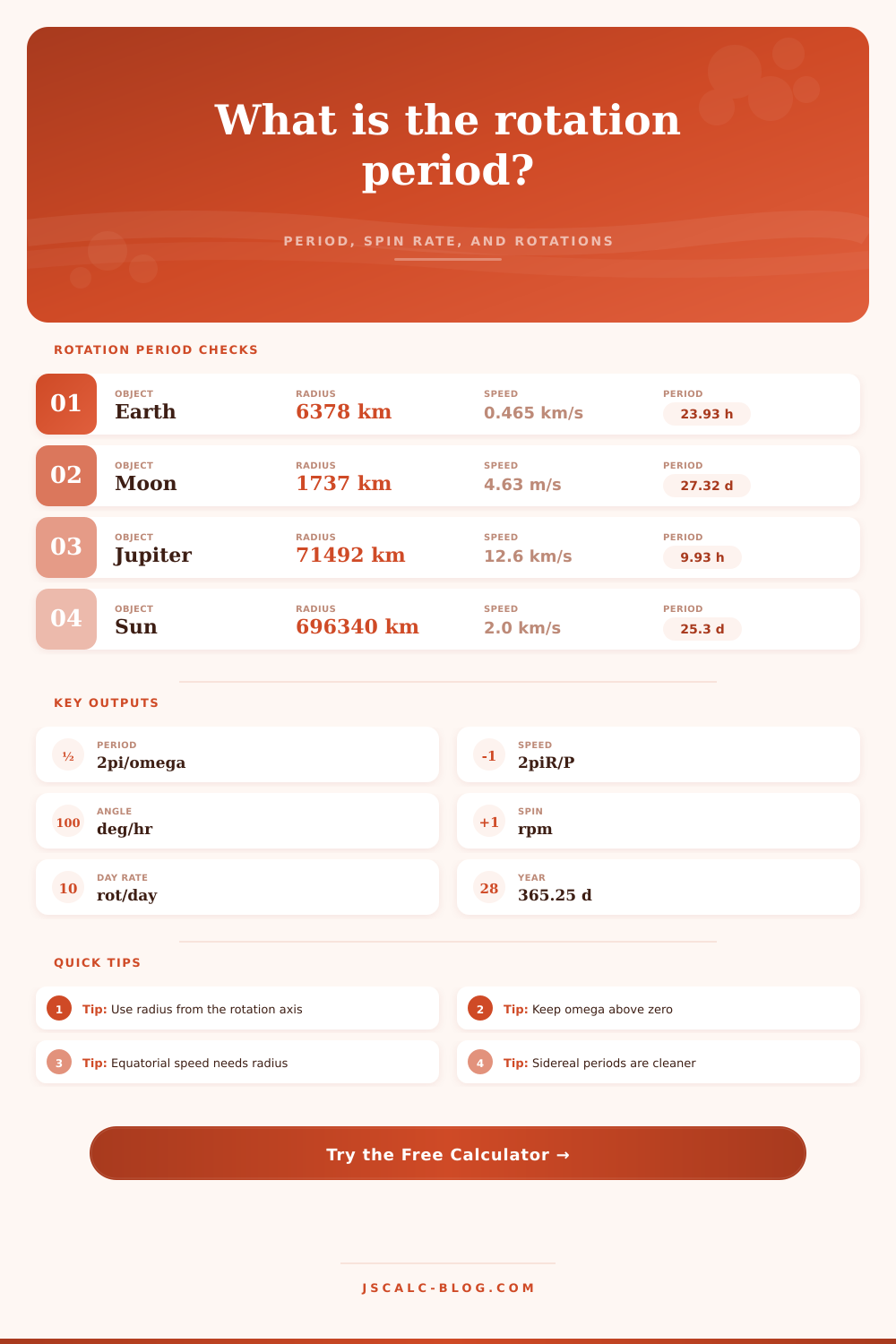
P = 2π / ω where P is rotation period in seconds and ω is angular velocity in radians per second.
P = 2πR / v when using equatorial radius R and tangential speed v in matching distance units.
rotations/day = 86400 / P, rotations/year = year days × rotations/day, and deg/hour = ω × 180 / π × 3600.
| Object | Equatorial Radius | Approx Period | Angular Speed | Equatorial Speed |
|---|---|---|---|---|
| Earth | 6378.137 km | 23.934 h | 7.2921e-5 rad/s | 0.465 km/s |
| Moon | 1737.4 km | 27.322 d | 2.662e-6 rad/s | 4.63 m/s |
| Mars | 3396.2 km | 24.623 h | 7.088e-5 rad/s | 0.241 km/s |
| Jupiter | 71492 km | 9.925 h | 1.759e-4 rad/s | 12.6 km/s |
| Sun equator | 696340 km | 25.38 d | 2.866e-6 rad/s | 2.0 km/s |
| Crab pulsar | about 10 km | 0.033 s | 190 rad/s | about 0.64 c |
| Input Unit | Convert To rad/s | Period Formula | Useful For |
|---|---|---|---|
| rad/s | ω = value | 2π / ω | Physics and simulation |
| deg/s | value × π / 180 | 360 / deg/s | Slow tracking mounts |
| deg/hour | value × π / 648000 | 8640 / deg/hour hours | Planetary spin |
| RPM | RPM × 2π / 60 | 60 / RPM seconds | Motors and turntables |
| RPS | RPS × 2π | 1 / RPS seconds | High-speed rotors |
| Rotation Period | RPM | rad/s | deg/hour | Rotations/day |
|---|---|---|---|---|
| 1 second | 60 | 6.283 | 1296000 | 86400 |
| 1 minute | 1 | 0.10472 | 21600 | 1440 |
| 1 hour | 0.016667 | 0.001745 | 360 | 24 |
| 12 hours | 0.001389 | 0.0001454 | 30 | 2 |
| 24 hours | 0.000694 | 0.00007272 | 15 | 1 |
| 7 days | 0.0000992 | 0.00001039 | 2.1429 | 0.1429 |
It’s a number that measures rotation of the Crab Pulsar, which spins at such high speeds, 30 times per second, that a bike wheel would disintegrate in a fraction of a moment. Spin rate is one of those numbers that makes rotation seem easy. It is also the same type of thing that explains why a planet holds its axis, how quickly a record turns during a vinyl play, or whether your shadow will linger longer then usual on the lawn.
But there’s a trap in spin-rate math. You have to know what kind of number you’re dealing with and in what units. If you have a particular speed and radius for an object then the math has been done for you in above calculator. No conversions, no guessing at coefficients needed.
How to Measure Spin and Rotation
First let’s define its rotation; that is how much angular distance (in degrees or radians) it move over some amount of time. It’s a direct method that doesn’t take into account the size of the object at all. A tiny gyroscope and a gigantic gas giant will be treated equally well this way.
But usually, when you’re considering a real object, you probably know how fast something on surface is moving. This is different than this kind of more abstract angular rate. That’s when the equatorial speed mode kicks in. It takes a value representing the radius from the center of rotation out to the point on its surface you wish to look at.
The mistake most folks make lies with that radius detail. The distance from the axis isn’t the entire diameter of the planet. It is the perpendicular distance, which is simply called the radius. This is known as an equatorial radius if you’re talking about the equator. However, as you approach the poles, the distance shortens because of how the surface curves (inward compared to the spin axis).
The tool takes into account the geometry if you plug in the proper distance. It won’t work right if you plug in the equatorial radius but then measure the speed at 45 degrees latitude. You have to match the speed at a particular distance and distance from the axis, otherwise the math doesn’t work.
Machines speak in terms of revolutions per minute, or RPM. For us human beings, that’s an intuitive measurement because we rate motors, wheels, and turntables in that way. No matter what size your circle might be, a single revolution will span a complete circle.
Between those units of measurement on the machine side and the physical constants based off the other hand, there’s a transition point: the calculator converts RPM into angular velocity and from there into period. It even spits out results in rotations per year and per day, so you can understand slower spins better.
If something is rotating in lockstep with its own orbit (like the moon), the period will equal the period of the object around it, meaning, once per orbit for the moon. It’s a gravitationally stable place to be, but it takes some precise calculation to get right. This is laid out in the reference table on the page.
The real world examples range from slow drag of the Sun’s rotation all the way up to the frantic spin of a pulsar. Note how even though Jupiter is so large, it has such a small period. It’s spinning really fast at its equator which balances out the huge radius.
The point is, there is a dance going on between speed and radius. Make the radius larger while keeping the same period, then you have to make the speed larger as well. Make the speed faster (while keeping the radius the same), and now you have a shorter period. Periods, speeds, radii is locked into each other with the constant of pi.
When working with physics, you want to use clean timescales that represent rotational time compared to some distant objects. On such timescales, the rotation is not related to movement around another object (such as the Sun). However, if you include the planet’s movement around the Sun in your timescale (a solar day), there is an extra factor of speed. Because the planet rotates while it moves through space, the solar day is longer than the sidereal (rotation relative to the farthest away) day.
For example, on Earth, these two timescales are close enough; for Venus, rotation is very slow and even retrograde so the difference is substantial. Knowing this will help you avoid mistakes when simulating over long periods of time.
And in the end, this is all about balancing things out, about conservation. It’s about figuring out how long the day is on an exoplanet as much as it is about building a flywheel for storing energy. Size matters, spin matters, and so do time. The relationship between those factors never changes; only the numbers themselves vary.
Find the right entry point. Let the calculator do the work. But use your head to add the context.
And there you have it: Data transformed from raw information into a visual representation of motion. Sure, the Crab Pulsar is spinning, but now you know exactly how to measure its spin; regardless of its size.
Actualy, it could of been harder.