Solar Panel Angle Efficiency Loss Calculator
Find your optimal fixed tilt from latitude, then estimate the annual production loss from a non-optimal tilt using the cosine of the tilt deviation, combined with an orientation factor.
☀Real Tilt Presets
📝Array Inputs
Use the absolute value, north or south. Optimal fixed tilt is roughly equal to this.
0° is flat, 90° is a vertical wall mount.
How far the array points away from true south (north in the S hemisphere). 0° is perfect aim.
Nameplate DC watts, used to show the effective output at your angle.
🔢Formula Snapshot
🗺Optimal Tilt by Latitude
| Latitude | Annual Tilt | Summer Tilt | Winter Tilt | Example Region |
|---|---|---|---|---|
| 10° | 10° | 0° | 25° | Tropics |
| 20° | 20° | 5° | 35° | Hawaii, S. Mexico |
| 30° | 30° | 15° | 45° | Gulf Coast, N. Africa |
| 35° | 35° | 20° | 50° | SoCal, Mediterranean |
| 40° | 40° | 25° | 55° | Denver, Madrid |
| 45° | 45° | 30° | 60° | Minneapolis, Milan |
| 50° | 50° | 35° | 65° | UK, S. Canada |
| 55° | 55° | 40° | 70° | Scotland, Denmark |
📉Tilt Deviation vs Efficiency Loss
| Off Optimal By | Cosine Factor | Efficiency | Annual Loss | Practical Note |
|---|---|---|---|---|
| 0° | 1.000 | 100% | 0% | Ideal fixed tilt |
| ±5° | 0.996 | 99.6% | 0.4% | Negligible |
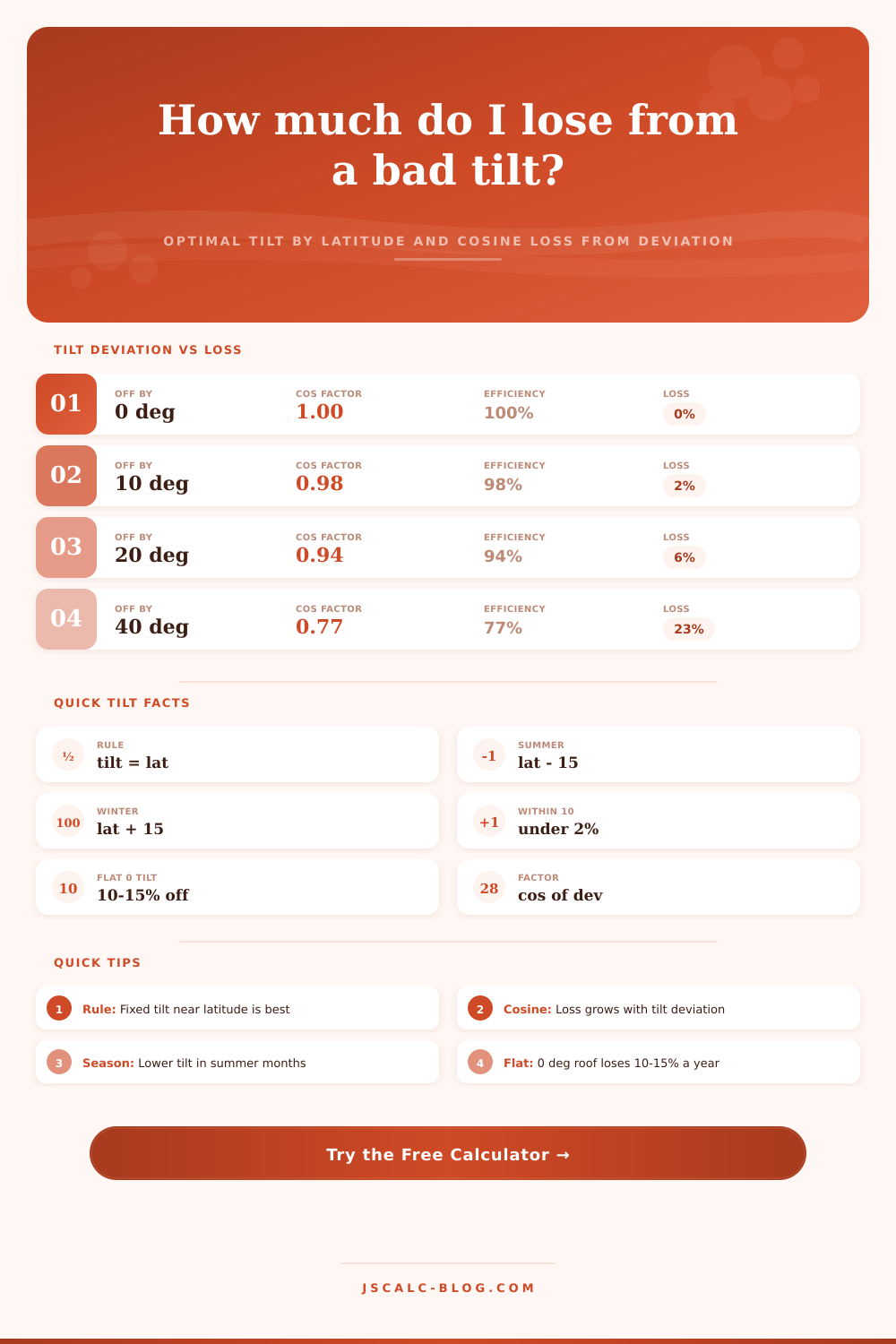
| ±10° | 0.985 | 98.5% | 1.5% | Under 2%, safe zone |
| ±15° | 0.966 | 96.6% | 3.4% | Still minor |
| ±20° | 0.940 | 94.0% | 6.0% | Noticeable |
| ±30° | 0.866 | 86.6% | 13.4% | Flat roof territory |
| ±40° | 0.766 | 76.6% | 23.4% | Significant |
| ±50° | 0.643 | 64.3% | 35.7% | Vertical vs mid tilt |
🔄Seasonal Tilt Adjustments
| Goal | Tilt Rule | At Lat 40° | Why |
|---|---|---|---|
| Year-round | = latitude | 40° | Best single fixed angle |
| Summer boost | latitude − 15° | 25° | High summer sun path |
| Winter boost | latitude + 15° | 55° | Low winter sun path |
| Two-season flip | ±15° twice a year | 25° / 55° | Adds a few % annually |
📊Flat vs Tilted Comparison
| Setup (Lat 40°) | Actual Tilt | Deviation | Efficiency | Loss | Verdict |
|---|---|---|---|---|---|
| Flat roof | 0° | 40° | 76.6% | 23.4% | Poor for winter |
| Low pitch | 15° | 25° | 90.6% | 9.4% | Below ideal |
| Common roof | 20° | 20° | 94.0% | 6.0% | Good enough |
| Near optimal | 30° | 10° | 98.5% | 1.5% | Excellent |
| Latitude tilt | 40° | 0° | 100% | 0% | Optimal |
| Steep pitch | 50° | 10° | 98.5% | 1.5% | Great, winter lean |
| Very steep | 60° | 20° | 94.0% | 6.0% | Winter friendly |
| Wall mount | 90° | 50° | 64.3% | 35.7% | Summer heavy loss |
⚙Full Formula Breakdown
📋Reference Values
| Item | Common Entry | How It Is Used | Effect on Loss |
|---|---|---|---|
| Latitude | 0° to 60° | Sets the optimal tilt target | Defines your zero-loss angle |
| Actual tilt | 0° to 90° | Compared against optimal | Bigger gap means more loss |
| Season goal | Annual / summer / winter | Shifts optimal by ±15° | Changes the deviation |
| Azimuth deviation | 0° to 45° | Orientation cosine factor | Adds a second loss factor |
| Panel rating | 300 to 500 W | Scales effective output | No effect on percent loss |
💡Practical Tilt Tips
At first glance, solar looks like a binary problem. People often think panels is on or off: facing south and humming along, or turned east and going nowhere all day long. The sun doesn’t stay fixed in one spot above us, but travels across the sky. Even a misaligned panel picks up significant power, and many panels can captures lots of energy if their tilt is just slightly off. Knowing about that diminishing-returns curve alters the way you design your roof. It changes goal from chasing a perfect angle to accepting some loss while working around the structure.
To do this, just enter your roof pitch and where you are located into the calculator above, it’ll save you from having to do any conversions or coefficient guessing. Tilt Deviation is the key number here. And it’s nothing more than how far off your actual roof configuration is from the optimal one for your latitude. For those of us living in mid-latitudes (i.e., much of Europe or the continental US) the optimal tilt is basicly equal to your geographical latitude. So if you’re 40 degrees north, then a roof tilted at forty degrees would capture sunlight most efficienty during the entire year. That’s zero loss as a starting point.
Why Your Roof Angle Does Not Need to Be Perfect
The problem? Roofs aren’t textbook. On one hand, a flat commercial roof could require you to put up panels with a near-zero degree tilt. Meanwhile, a residential roof could have a super-steep pitch of sixty degrees or more (or even eighty). According to the cosine rule, the farther away from ideal your panel gets, the more power you’ll lose. It’s not a linear penalty. You can afford to cut five degrees off your ideal angle and lose slightly less than a percent, which is an amount most people wouldn’t notice on their bill. Go another ten degrees, though, and the number leaps to 6 percent. If you go way overboard and push your panels to forty degrees off angle, like sticking flat mounts on a rooftop during winter at a high latitude, you risk losing almost a quarter of your possible power generation.
The season also matters: the sun is lower in the sky during winter months then in summer. There’s no one perfect angle; it’s always a compromise. Optimize for the whole year and you’ll end up with a compromise between summer and winter extremes. With the tool you can move that target fifteen degrees up or down, if you want to focus on extra heating support in January (or July) versus cooling cost. Twice a year adjustable mounts can track the sun and do better at this, but fixed ones has to take the average. Max theoretical yield vs. Hardware cost is a trade-off.
And then there’s orientation, which is typically not as significant than the tilt. Maximum daily exposure comes from being pointed due South, but if you want to hedge against peak afternoon heat and high electrical rates, pointing slightly west may even be better. That “sideways” penalty gets factored into the calculator with what I call the azimuth deviation factor. In practice, most houses has roofs that are within ten degrees of ideal South-facing, keeping losses below two percent. Unless your home was specifically remodeled for maximum PV performance, it’s unlikely you’ll see more than one or two percent improvement by rearranging.
“Also, a couple-degree mistake in tilt isn’t nearly as significant as local weather and shading. If a tree casts some shade over your panel at high-noon, that will negatively affect output much more than if it were tilted a bit to flat.” Panels gather pollen and other dirt no matter what angle they are on, which is another type of silent energy killer. Regular cleaning may recapture even more energy than tilting the panels an extra three degrees can. The setup sets the limit on your system; your ability to clean it will determine how near you can come to that limit.
That’s why you have the reference tables. You can compare some common scenarios side by side. And you can see that a sweet spot (the one that balances out winter performance while keeping things structurally simple) is around a 20 degree deviation. That doesn’t mean you need perfect conditions in order to operate a profitable solar array. All it means is that you know where your losses lie, and whether it makes sense to pay to address them. Usually a loss of a few percent wouldn’t of been more expensive than dealing with local building codes or gravity. The idea is not geometric perfection (but rather good enough). This makes it a manageable home improvement project, rather than a complex piece of engineering.