Solar Panel Azimuth Angle Calculator
Find the optimal compass direction for your solar array by hemisphere and goal, then see how much annual output you give up when the panels face off the ideal azimuth. Includes true versus magnetic correction.
☀Real Azimuth Presets
📝Site & Panel Inputs
Enter latitude magnitude, 0 to 90. Sign is set by the hemisphere.
0 = north, 90 = east, 180 = south, 270 = west.
East declination is positive, west is negative. Used for compass bearing.
Optional. Used to estimate kWh lost from the deviation.
🧭Azimuth Reference Points
📉Deviation vs Output Table
| Deviation From Optimal | North-Hemi Facing | Approx Output | Rating | Practical Note |
|---|---|---|---|---|
| Enter values above to see where your array falls on the deviation curve. | ||||
🧭Compass Directions & Degrees
| Compass Point | Azimuth Range | Center Degree | Hemisphere Use | Solar Note |
|---|---|---|---|---|
| North (N) | 337.5–22.5° | 0° / 360° | Optimal in south hemi | Best true-north facing below equator |
| Northeast (NE) | 22.5–67.5° | 45° | Poor in north hemi | Only morning sun, weak yield up north |
| East (E) | 67.5–112.5° | 90° | Morning bias | Roughly 80–85% of due south |
| Southeast (SE) | 112.5–157.5° | 135° | Good north hemi | Favors morning, about 90–96% |
| South (S) | 157.5–202.5° | 180° | Optimal in north hemi | Peak annual energy, 100% baseline |
| Southwest (SW) | 202.5–247.5° | 225° | Afternoon bias | Favors evening load, about 90–96% |
| West (W) | 247.5–292.5° | 270° | Afternoon bias | Roughly 80–85%, good for TOU rates |
| Northwest (NW) | 292.5–337.5° | 315° | Poor in north hemi | Only late sun, weak yield up north |
🌍Hemisphere Optimal & Goal
| Hemisphere | Goal | Optimal Azimuth | Facing | Why |
|---|---|---|---|---|
| Northern | Annual energy | 180° | Due south | Sun tracks across the southern sky |
| Northern | Afternoon TOU | 195–210° | South-southwest | Shifts peak into pricey evening hours |
| Northern | Winter peak | 180° | Due south | Low winter sun stays due south |
| Southern | Annual energy | 0° / 360° | Due north | Sun tracks across the northern sky |
| Southern | Afternoon TOU | 340–350° | North-northwest | Biases output toward the afternoon |
| Equatorial | Annual energy | Flat / either | Near horizontal | Overhead sun makes azimuth minor |
🧲Magnetic Declination Examples
| Location | Declination | Direction | True South = 180° | Set Compass To |
|---|---|---|---|---|
| Seattle, US | 15.5° E | East | 180° true | 164.5° magnetic |
| Denver, US | 8.0° E | East | 180° true | 172.0° magnetic |
| Chicago, US | 3.0° W | West | 180° true | 183.0° magnetic |
| New York, US | 13.0° W | West | 180° true | 193.0° magnetic |
| London, UK | 1.0° W | West | 180° true | 181.0° magnetic |
| Sydney, AU | 12.5° E | East | 0° true (north) | 347.5° magnetic |
⚙How The Azimuth Math Works
💡Azimuth Tips
The sun is high in the sky; it’s bright and casts sharp shadows on your shingles. If only you could use that power! But the way the sun want to go never quite lines up with the way you live. Maybe your roof face due west instead of due south. Maybe it slopes gently different than sharply.
That disconnect; between where the sun wants to go and where you happen to live, is what the azimuth calculator above help solve. It takes those limitations of your home’s architecture and converts them into real numbers for how much energy you’ll get. How much is the price tag of your less-than-perfect orientation?
Understanding Azimuth for Solar Panels
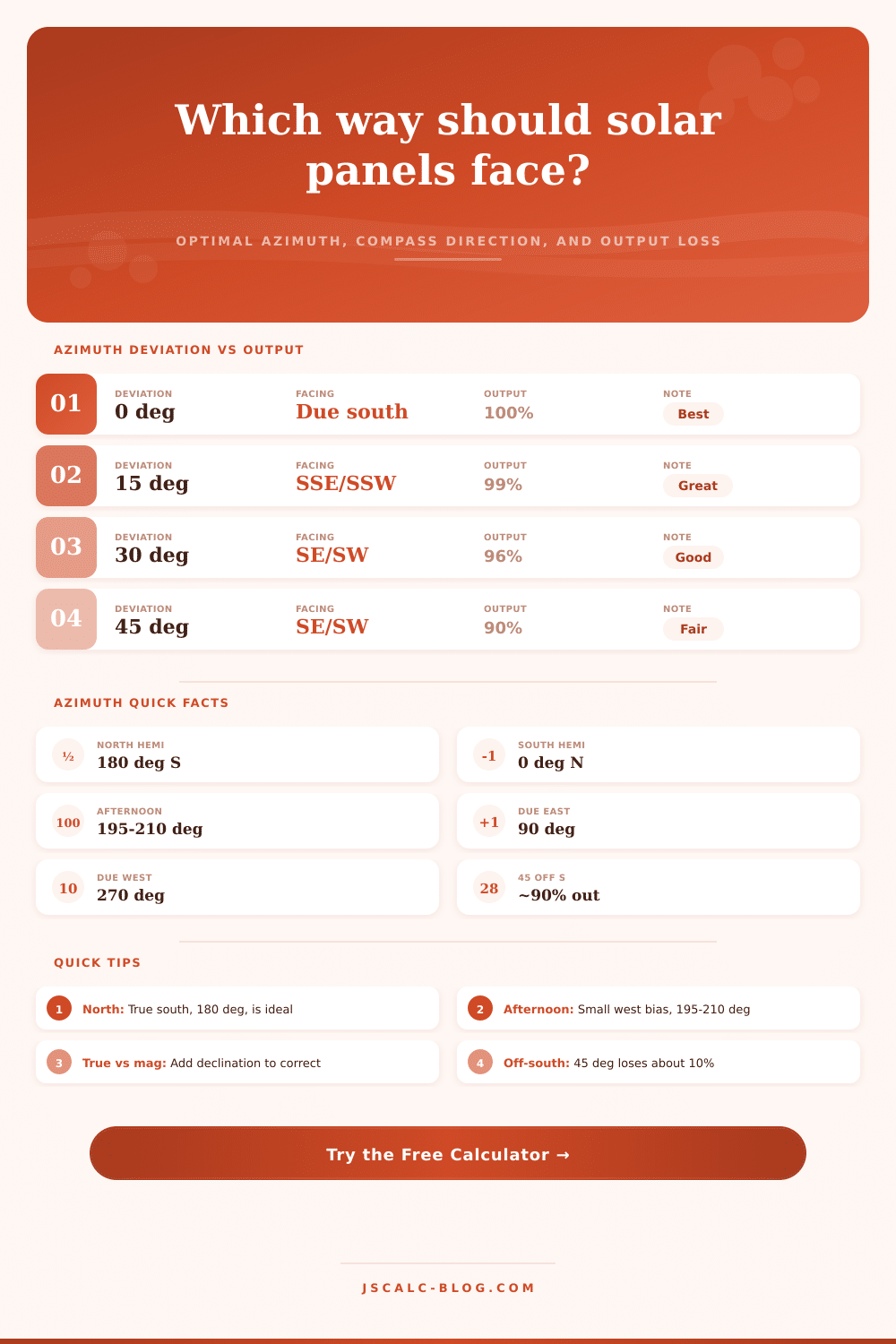
All Azimuth means are the direction your panels point, expressed in degrees from “true” North. For example, in Northern Hemisphere, we’d like them pointing due south (at 180 degrees) because that’s where the sun move all year long, it arcs across the southern sky. Facing true south will get them maximum sunlight during the day. Down under in New Zealand and Australia, turn all that upside down, and point toward true north instead.
Don’t worry, the calculator know which hemisphere you’re in, and adjusts to match; the base-line advice will make sense for wherever you live. Just be aware if you’re up or down equator.
Roofs follow structural lines rather than solar optimization. Roofs exist based off structural lines and wind loads. Unless your house is highly unusual (e.g., a square box with a peaked roof), most residential install face roughly between southeast and southwest.
Solar panels are forgiving. Moving 30 degrees off true south typically result in a couple percentage points less output per year, which is normally acceptable because it allows you to fit an array onto a viable roof plane without crazy racking system. The penalty for deviations appears nicely in the tool’s embedded reference table. This table describe what happens to output when you stray from the ideal, so you can choose whether to keep trying on that particular roof section or to move on.
Energy isn’t everything: It’s also all about timing. For example, you might be on a tiered rate plan where afternoons or evenings is more expensive. In that case, it could of made cents (pardon the pun) to point the panels a bit more to the west than annual production alone suggests. Though of course they’ll produce less over time. Pointing them more southwest will shift the daily production pattern further into the afternoon, lining up with when you’re at home and using electricity.
The calculator lets you specify how much you want to bias the production in the afternoons, which nudge the ideal azimuth a few more degrees toward the west. That’s some clever grid smarts: you get less raw watts but save more on your bill.
Another more subtle tripping point for a lot of DIYers is something called magnetic declination. When you take out a regular old compass it’s pointing at what’s called magnetic north, but not true geographic north. True and magnetic north aren’t the same place. They’re offset by some angle, which changes based on where you live. For example, in New York magnetic north is to the west of true north, whereas in Seattle it’s well to the east.
If you don’t adjust for magnetic declination when setting your panels with a straight-up compass readout, you might end up being off by a few degrees. That’s why the tool prompt for it. It lets you plug in the magnetic deviation between the optimal true azimuth and the real world magnetic bearing you want to dial in on your setup. It connects the dots between the theoretical geometry versus getting it dialed in on the ground.
The calculation use a cosine function as the underlying math to represent the impact of angle on sunlight. Low-slope roofs is more sensitive to change in azimuth (since they’re not angled towards the sun’s arc), while steeper roofs are less so. Your roof pitch is included in the calculator’s loss factor, resulting in a more exact estimate for what your roof loses specifically.
You can also provide an estimated annual production number and it’ll calculate exactly how many kilowatt-hours you lose through misalignment. That converts abstract percentages into something that really matters: actual units of energy that will make a difference for your wallet.
Nobody has a perfectly oriented roof. It’s about what works rather than perfection. An optimally oriented array that never sees the light of day is less effective then a decently oriented array that you get built. Let the tool guide you from best direction down to what fits on your roof. Those panels will be better than a theoretical best you keep on paper. Set ‘em and forget ’em.
The sun doesn’t care about how you read a compass, just where it needs to go.