Labrador Dog Age Calculator
Convert your Labrador or large-breed dog’s age into human years using a vet-style aging table or the AKC log formula, then see the matching life stage, aging rate, and estimated life expectancy remaining.
🐕Labrador Age Presets
📝Your Labrador Details
Used only for the weight-status note, not the age math.
🔢Aging Method Snapshot
📊Labrador Age to Human Years Chart
| Dog Age | Human Years (Table) | Human Years (Log) | Life Stage |
|---|---|---|---|
| Enter an age above to highlight the matching row. | |||
🐕Labrador Life Stages
| Life Stage | Dog Age Range | Human Range | Typical Traits |
|---|---|---|---|
| Puppy | 0 to 1 year | 0 to 15 | Fast growth, teething, socializing |
| Young adult | 1 to 3 years | 15 to 29 | High energy, peak training window |
| Mature adult | 3 to 6 years | 29 to 44 | Settled, steady weight matters |
| Senior | 7 to 10 years | 49 to 64 | Slower pace, joint and dental care |
| Geriatric | 10 years and up | 64 and up | Frequent vet checks, gentle exercise |
⚖Large vs Small Breed Aging
| Dog Age | Small Breed | Medium Breed | Large / Labrador | Giant Breed |
|---|---|---|---|---|
| 1 year | 15 | 15 | 15 | 14 |
| 2 years | 24 | 24 | 24 | 22 |
| 5 years | 36 | 37 | 39 | 45 |
| 8 years | 48 | 51 | 54 | 66 |
| 10 years | 56 | 60 | 64 | 80 |
| 12 years | 64 | 69 | 74 | 93 |
Large and giant breeds add more human years per dog year in later life, which is why Labradors are counted as seniors earlier than small breeds.
🩺Labrador Health Focus by Age
| Dog Age | Human Age | Life Stage | Care Focus | Vet Visits |
|---|---|---|---|---|
| 6 months | ~10 | Puppy | Vaccines, crate and leash training | Every few weeks |
| 1 year | 15 | Young adult | Neuter choice, joint-friendly play | Yearly |
| 2 years | 24 | Young adult | Consistent exercise, lean weight | Yearly |
| 4 years | 34 | Mature adult | Dental care, weight control | Yearly |
| 6 years | 44 | Mature adult | Baseline bloodwork, joint watch | Yearly |
| 8 years | 54 | Senior | Joint supplements, softer exercise | Twice yearly |
| 10 years | 64 | Senior | Mobility support, weight and heart | Twice yearly |
| 12 years | 74 | Geriatric | Comfort, ramps, senior diet | Twice yearly |
| 14 years | 84 | Geriatric | Pain management, quality of life | Twice yearly |
⚙How the Math Works
💡Labrador Aging Tips
You get yourself a yellow Labrador and picture lots of fun times together: long walks in the woods, chasing balls in the yard. Before you know it, those puppy-dog eyes turns into adulthood. Time seems to pass different when measuring your dog’s life in dog years, making it hard to do the math on human years. And the old “seven times his age” formula doesn’t work when dealing with larger breed dog such as Labradors. That’s because growing up isn’t linear (biology disagree).
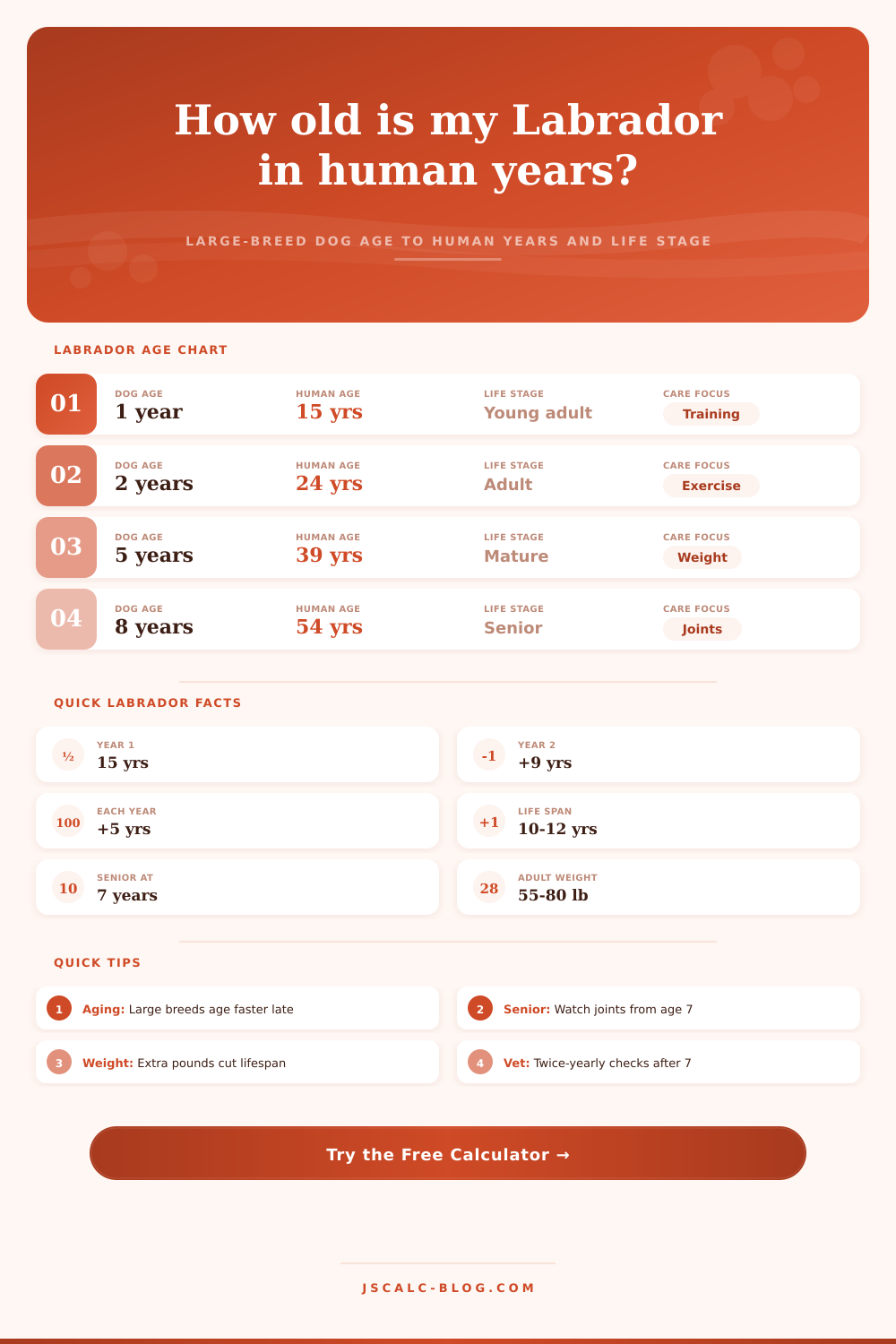
Now we have a better idea of our dog’s age and weight. We also know those first few years is important. It’s time to use the calculator (above) to do the math for you. Why? Because while dogs do age different than humans, early growth occurs at an extremely fast rate physically. For example, if your dog were a lab, they would be about fifteen human years old at their first birthday. Add on another nine by their second birthday and you’re looking at total of twenty four. That’s how quickly they develops (think: teeth, bones, organs).
How to Convert Dog Years to Human Years
The second birthday also marks when time seems to slow down dramaticly. On average, each additional year of your dog’s life are roughly equivalent to five human years for a Labrador. Size is very important. A giant breed will naturaly age more quickest than a medium-size or small one. You can control the size class, which change the rate of aging slightly into adulthood. So if you compare a six-year-old Chihuahua to a six-year-old Lab, you may find that the Chihuahua is still youthful and the Lab are already middle-aged. Big dogs has a metabolic cost to their larger size, and eventually, they’ll reach the point of cell breakdown that we call their senior years.
Weight is something many owners overlook until it’s too late. While extra pound may seem like a cosmetic issue, they puts added stress on the body daily. That added stress increases joint degeneration in dogs with hip dysplasia (like many Labradors). Maintaining your dog’s leanness will help you stretch his or her lifespan past the norm of 10 to 12 years. Use the calculator to see what his/her expected lifespan is given today’s norms… But know that your everyday decisions can increases these numbers.
While raw age isn’t as helpful as life stages. Because care requirements differ by life stage… Young adults (under 3-6 yrs) need ongoing training/exercise for energy management. At maturity (three to six years), they needs weight control/maintenance. After seven years (about fifty-four in human terms), your Lab reaches seniorhood. At this stage, twice-a-year vet checkups are advised. Their dental health and bloodwork may change, but you won’t necessarily see any sign.
Sometimes you’ll also find one that says it’s the AKC logarithmic formula. What this means is they are using a natural log calculation instead of a linear table method. Sometimes that will produce a bit of a difference, especially early on. It doesn’t matter which way you go, as long as you know the direction.
Life isn’t all the same when it comes to aging. Early years are about growth and development. Late years are about slow decline. The first few years make up your whole life. When you understand this transition, you’re able to adapt your dog-care routine in advance of any stiffness setting in. No more waiting until they’re stiff before taking action. Instead, you can work ahead to keep them limber through proper exercise, supplemented by a proactive approach to health (supplements). You also know that 10-year-old playtime fetch is not like 2-year-old fetch. Playtime’s still fun, but it has to be appropriate to what their body can handle. It is about listening to the dog rather than simply the clock.
Age conversion isn’t so much a science as it is an exercise in perspective. You view your labrador in human terms and value them for the short life they have been given. If you’re present enough, that bright coat will leads you through each phase. You learn from the math where they are, yet you determine whether they’ll live well the rest of the way.