Solar Noon Calculator
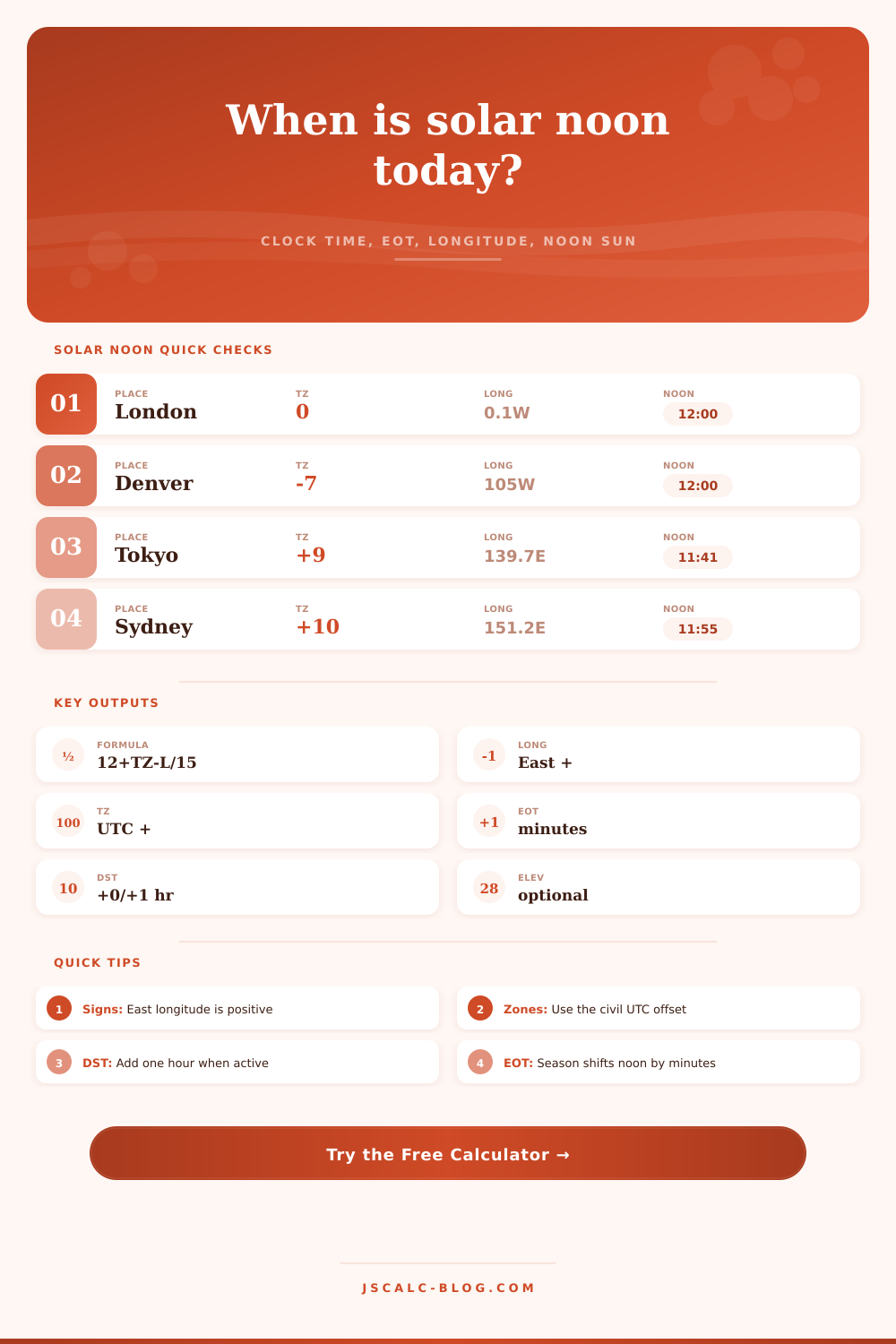
Find the local clock time when the sun crosses your meridian, including longitude, time zone, equation of time, daylight saving, and optional noon elevation.
Solar Noon Result
Longitude
Every degree east moves apparent noon about 4 minutes earlier against a fixed time zone.
Time Zone
The UTC offset shifts the displayed clock time by full hours or civil half-hour offsets.
Equation Of Time
Earth orbit and axial tilt add a seasonal correction of roughly -14 to +16 minutes.
Daylight Saving
When active, civil clocks usually display solar noon one hour later than standard time.
| Location | Latitude | Longitude | Standard UTC Offset | Standard Meridian |
|---|---|---|---|---|
| Greenwich Observatory | 51.4769° N | 0.0005° W | UTC +0 | 0° |
| New York City | 40.7128° N | 74.0060° W | UTC -5 | 75° W |
| Denver | 39.7392° N | 104.9903° W | UTC -7 | 105° W |
| Los Angeles | 34.0522° N | 118.2437° W | UTC -8 | 120° W |
| Honolulu | 21.3069° N | 157.8583° W | UTC -10 | 150° W |
| Tokyo | 35.6762° N | 139.6503° E | UTC +9 | 135° E |
| Singapore | 1.3521° N | 103.8198° E | UTC +8 | 120° E |
| Sydney | 33.8688° S | 151.2093° E | UTC +10 | 150° E |
| Approx Date | EOT Minutes | Solar Declination | Clock Effect | Noon Sun Pattern |
|---|---|---|---|---|
| Jan 1 | -3.3 | -23.0° | Solar noon later | Low in northern latitudes |
| Feb 11 | -14.2 | -14.0° | Latest seasonal shift | Winter recovery in north |
| Mar 20 | -7.4 | 0.0° | Solar noon later | Equinox geometry |
| May 14 | +3.7 | +18.8° | Solar noon earlier | High northern sun |
| Jun 21 | -1.5 | +23.4° | Slightly later | Northern maximum height |
| Jul 26 | -6.5 | +19.3° | Solar noon later | Still high in north |
| Sep 22 | +7.4 | 0.0° | Solar noon earlier | Equinox geometry |
| Nov 3 | +16.4 | -15.0° | Earliest seasonal shift | Lower northern sun |
| UTC Offset | Standard Meridian | Example Region | Best Longitude Match | Noon Shift Rule |
|---|---|---|---|---|
| UTC -10 | 150° W | Hawaii | Near Honolulu | West of meridian is later |
| UTC -8 | 120° W | Pacific Time | California coast | East of meridian is earlier |
| UTC -5 | 75° W | Eastern Time | New York area | Close to standard noon |
| UTC +0 | 0° | Greenwich | Prime meridian | EOT dominates |
| UTC +1 | 15° E | Central Europe | Central meridian | Western areas are later |
| UTC +8 | 120° E | Singapore / China | China coast | Singapore noon is later |
| UTC +9 | 135° E | Japan | Western Honshu | Tokyo noon is earlier |
| UTC +10 | 150° E | Eastern Australia | Sydney area | Near standard noon |
| Step | Expression | Sign Convention | Meaning |
|---|---|---|---|
| 1 | longitude / 15 | East positive, west negative | Converts longitude degrees to solar hours. |
| 2 | EOT / 60 | Positive EOT subtracts time | Converts equation of time minutes to hours. |
| 3 | 12 + timezoneOffset - longitude/15 - EOT/60 | UTC offsets east are positive | Returns local standard solar noon clock time. |
| 4 | + daylight saving adjustment | Usually +1 hour when active | Converts standard result to civil clock time. |
| 5 | 90° - |latitude - declination| | North latitude and north declination positive | Optional sun elevation above the horizon at noon. |
Enter your date and location in the calculator above, and exact moment of solar noon for that day will be computed for you. No guessing at conversions or coefficients required; the calculator do all the math and converts orbital information directy into a moment of time on your wall clock.
By default, most of us imagine the sun crossing the sky at twelve o’clock. That’s a fair enough guess since our daily routines and clocks is set to this expectation. But the sun doesn’t often stick to this program. Over the course of a year, you’ll notice that solar noon drift as much as fifteen minutes.
Why Solar Noon Is Not Always 12 O’Clock
Why does it move? Turns out there are two astronomical reasons behind its shift in timing. Knowing why is more informative then simply knowing when.
Longitude is the first one. Political boundaries called time zones require all people inside their lines to synchronize to the same hour. But sun doesn’t respect those lines. Instead it travels overhead at a constant pace with respect to planet’s spin: each degree of longitude correspond to a movement of the sun in sky of about four minutes. This means your location within your time zone matter. Depending on whether you are near centerline or outer edges, your personal solar noon will occur earlier or later then what the zone’s centerline suggests. And here we get the geometrically predictable effect. Depending on how close you are to your time zone’s centerline, you’ll see a slight shift in solar noon relative to 12 o’clock in standard time. That table on the page give it for some big cities. For instance, New York City is actualy located somewhat to the west of centerline of the time zone in which it resides. This causes solar noon to shift by a few minutes after midday in standard time. It is small difference. But if you’re shooting photos or aligning your solar panels for max efficiency, it can makes a difference.
The second factor is less obvious. Our planet does not move in a perfect circle around the sun; also, our axis tilt. The result: At certain times of year, the sun appears to race through the sky compared to mean time. Other times of year, it seem to lag behind. This difference is called the equation of time by astronomers. It cause solar noon to vary seasonally. When combined with longitude shift, that effect pushes solar noon to its latest position in November. Then it pulls solar noon forward once more in early February.
That’s the day-to-day variability that the calculator handle. It figures out how many minutes to subtract or add, preventing you from having to remember some complicated curve.
It gets even more complicated when daylight saving time enter the picture. Clocks springing forward makes it seem like solar noon skip ahead by one hour on clock face. But that’s just a change in administration; it isn’t an astronomical change at all. It doesn’t mean the sun jumped an hour later on the clock face; just that numbers did. Fortunately, there’s a button for that. So that output is what you’ll see on your watch. All you have to do is remember if your region happens to be on daylight saving time right now.
Architects know that the sun’s noon location affect building heat gain and shading. Photographers understand that the golden hour is related not to the clock but to where the sun happens to be. An elevation check is available as an option on the calculator. That would estimated what the elevation of the sun would be at its highest point during the day. That depends on your latitude and date (which affects the sun’s declination). Knowing exactly how high up it is can help when you’re creating something like a shade structure or a window: you don’t want too much glare…or do you want maximum warmth?
But you don’t have to be an astronomer to enjoy it. You only have to believe in this: The clock is a simplification. The sky is real. And this tool spans the gap between them, translating how the stars move into something you can read. If your sundial is off by ten minutes, or if you want to track shadows for a garden project, it is because civil time, longitude, and orbit intersect. The sun does what it wants, and now you could of read that too.