Equation of Time Calculator
Calculate E, longitude correction, apparent solar time, and sundial sign interpretation for JSCalc-Blog.com.
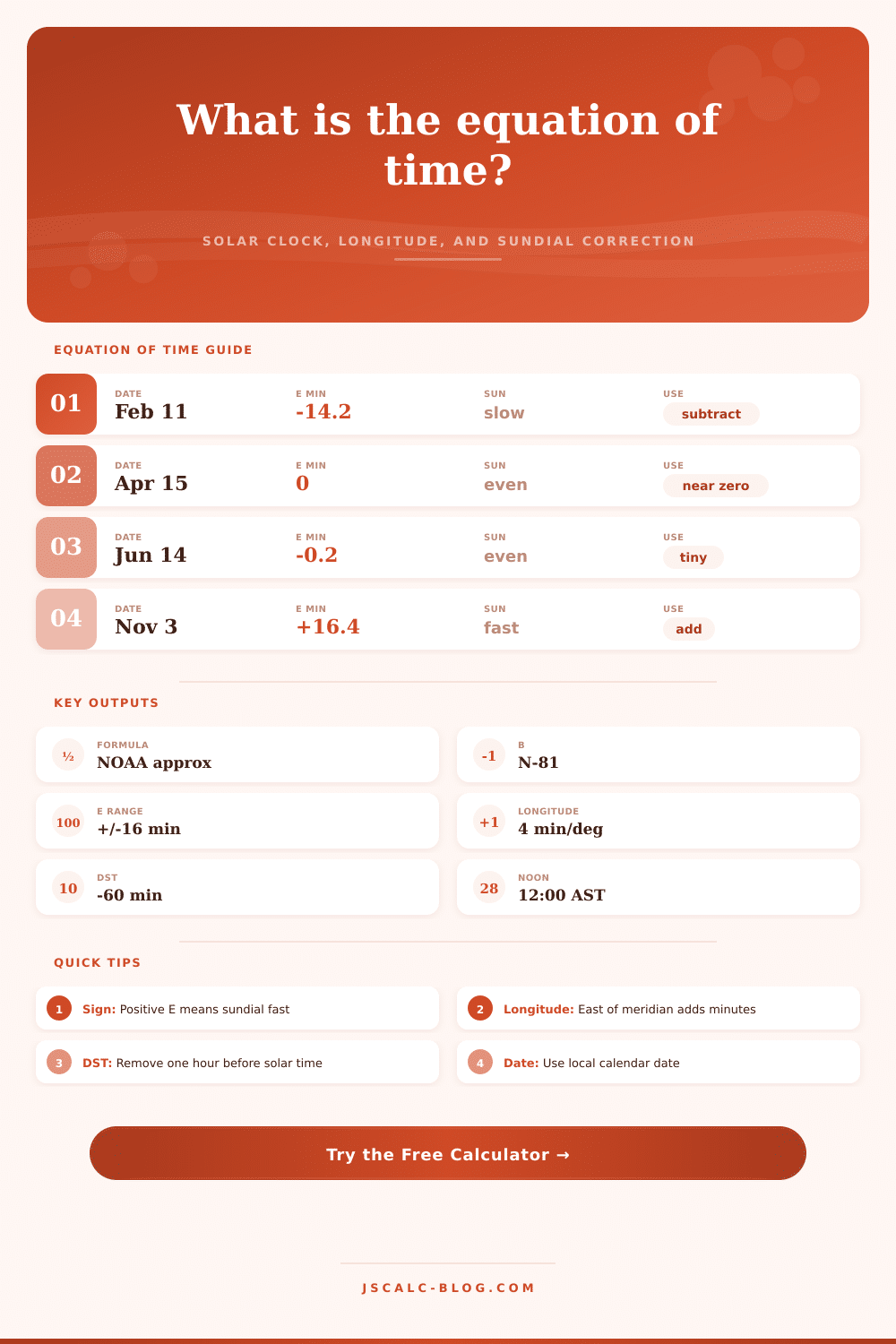
Positive E means apparent solar time is ahead of mean solar time, so a sundial reads fast. Negative E means apparent solar time lags, so a sundial reads slow.
| Approx date | E value | Sundial sign | Plain reading |
|---|---|---|---|
| February 11 | About -14.2 min | Slow | Apparent Sun lags mean Sun. |
| April 15 | Near 0 min | Even | Solar and mean clock time nearly match before longitude correction. |
| June 14 | Near -0.2 min | Even | Equation term is tiny; longitude usually dominates. |
| July 26 | About -6.5 min | Slow | A sundial reads several minutes behind local mean time. |
| September 1 | Near 0 min | Even | Useful check date for longitude-only correction. |
| November 3 | About +16.4 min | Fast | Apparent Sun leads mean Sun by the annual maximum. |
| December 25 | About -0.3 min | Even | Equation term is small again near late December. |
| Position vs LSTM | Longitude term | Clock effect | Example |
|---|---|---|---|
| 5° east of meridian | +20 min | Solar time later | Longitude -70° in UTC -5 zone |
| 2° east of meridian | +8 min | Small positive offset | Longitude 32° in UTC +2 zone |
| On meridian | 0 min | No longitude shift | Longitude -75° in UTC -5 zone |
| 3° west of meridian | -12 min | Solar time earlier | Longitude 147° in UTC +10 zone |
| 8° west of meridian | -32 min | Large negative offset | Longitude -83° in UTC -5 zone |
| Preset | Standard zone | Longitude | Why it is useful |
|---|---|---|---|
| New York Feb low | UTC -5 | 74.006° W | Near the negative annual equation-of-time extreme. |
| London April zero | UTC 0 | 0.128° W | Shows a near-zero E with a tiny longitude correction. |
| Denver solstice | UTC -7 | 104.990° W | Shows how a location close to its meridian behaves. |
| Tokyo July slow | UTC +9 | 139.650° E | Combines east longitude with a negative E date. |
| Sydney Nov high | UTC +10 | 151.209° E | Near the positive annual equation-of-time extreme. |
| Mumbai December | UTC +5:30 | 72.878° E | Useful half-hour zone example with small late-year E. |
| Value | Sundial reads | Correction sign | Meaning |
|---|---|---|---|
| E > 0 | Fast | Add E to mean time | Apparent solar time is ahead of local mean solar time. |
| E = 0 | Even | No E term | Only longitude and daylight-saving adjustments remain. |
| E < 0 | Slow | Add the negative value | Apparent solar time is behind local mean solar time. |
| Total correction > 0 | Later AST | Clock plus minutes | Your apparent solar time is later than standard clock time. |
| Total correction < 0 | Earlier AST | Clock minus minutes | Your apparent solar time is earlier than standard clock time. |
This calculator uses the requested approximation, so results are ideal for practical clock and sundial work. High-precision ephemeris applications may use additional terms.
It’s noon. You look at your garden sundial and it says 10 minutes early. Is your clock out of whack? No, the sun is. That’s the world of the so-called equation of time, where mechanical time doesn’t sync up with our solar one. Sundial users has been irked by this for centuries; now astronomers are trying to understand why, too.
Plug in your location and date into the calculator above and let it do the math. Don’t bother figuring out axial tilt or orbital eccentricity yourself. The problem is, though, that we don’t revolve around the Sun in a nice circular fashion. And secondly, our axis of spin doesn’t happen to be exactly at a right angle to where we’re spinning around the Sun. Those two quirks of geometry make for a changing solar day which changes throughout the year. The Sun occasionally runs ahead of our mean average time; other times it run behind. So there’s a discrepancy, sometimes up to or exceeding 16 minutes difference within a single year… That most people gloss right over. They imagine that time is some kind of rigid constant. But it isn’t. Solar time fluctuate; it’s fluid.
Why Sundials Show the Wrong Time
But the date is only part of the story. Longitude also plays a huge role, and for that reason you must consider more than just the day. Time zones as they are commonly conceived are big swaths of 15 degrees of longitude; in other words, real sun overhead at solar noon could be an hour off official noon of your time zone. That’s if you’re on the eastern fringe of your zone; the closer to the west of your zone, the longer the wait until midday. The tool figures out this difference between your exact location (the coordinates) and center line of the time zone you’ve selected (its so-called “central meridian”).
Confusion also comes from daylight saving time. An hour shift occur in standard civil time when clocks go forward or backward, though the Sun does not move (or retreat) one single inch. Remember to instruct the calculator whether your input time includes or excludes daylight saving. Otherwise, calculated solar time will differ by an hour. That’s easy enough to toggle, yet this mistake is the most frequent in solar timekeeping. Flagging it tells the calculator to simply subtract that hour. Then it knows the time base is right before changing it with the longitude and equation of time correction.
The sign of the result shows if the sundial is running fast or slow: if it’s positive, the apparent Sun is in front of the mean Sun. That means the sundial says something different… Namely, later, then your clock. On the other hand, if it’s negative, the apparent and mean Suns runs side-by-side (the Sun lags). In this case, the sundial says something else, earlier. That’s important when you’re trying to sync up a sundial with your wristwatch. The yearlong reference table on the page presents those sign flips and illustrates why the month of November tends to push the Sun ahead, and February typicaly brings a big lag time.
These adjustments make an otherwise inert garden ornament a dynamic window onto how planets move, and in turn explain the need for all those elaborate instruments by which the ancients charted the skies: astrolabes and such. Today we have our computers to do all the work for us, but the underlying geometry is the same. The Sun still rushes and drags along its ancient orbits just as it has since long before humanity ever existed.
All told, figuring out apparent solar time is humbling. It keeps reminding us that we’ve created arbitrary hours on top of nature’s clock (and nature will not fit inside the box). Whether you are a history buff, a clock lover, or simply a human being confused by how your shadow and schedule seem so out of sync watching those figures line up feels good, like regaining control over something unpredictable. The Sun might be unpredictable, but with some corrections, you can anticipate its temperament down to the minute.