Solar Constant at Distance Calculator
Calculate solar irradiance from distance, planet presets, stellar luminosity, relative brightness, and equilibrium temperature scaling.
Solar Irradiance Results
Solar constant mode: S = S0 / r_AU², where S0 ≈ 1361 W/m² and r_AU is distance in astronomical units.
Luminosity mode: S = L / (4 π r²), where L is radiant power in watts and r is distance in meters.
Temperature scaling: equilibrium temperature follows the fourth root of absorbed flux, so large brightness changes create smaller temperature changes.
| Quantity | Symbol | Default | Role in calculation |
|---|---|---|---|
| Solar constant at Earth | S0 | 1361 W/m² | Baseline flux before inverse-square scaling |
| Distance in AU | r_AU | 1 at Earth | Flux scales as one divided by r_AU squared |
| Stellar luminosity | L | 3.828 × 10²⁶ W | Used directly in luminosity mode |
| Bond albedo | A | 0.30 | Fraction of incoming light reflected away |
| Stefan-Boltzmann constant | σ | 5.670374419e-8 | Converts absorbed flux to blackbody temperature |
| Object | Mean distance | Solar flux | Earth brightness | Ideal temp with A = 0.30 |
|---|---|---|---|---|
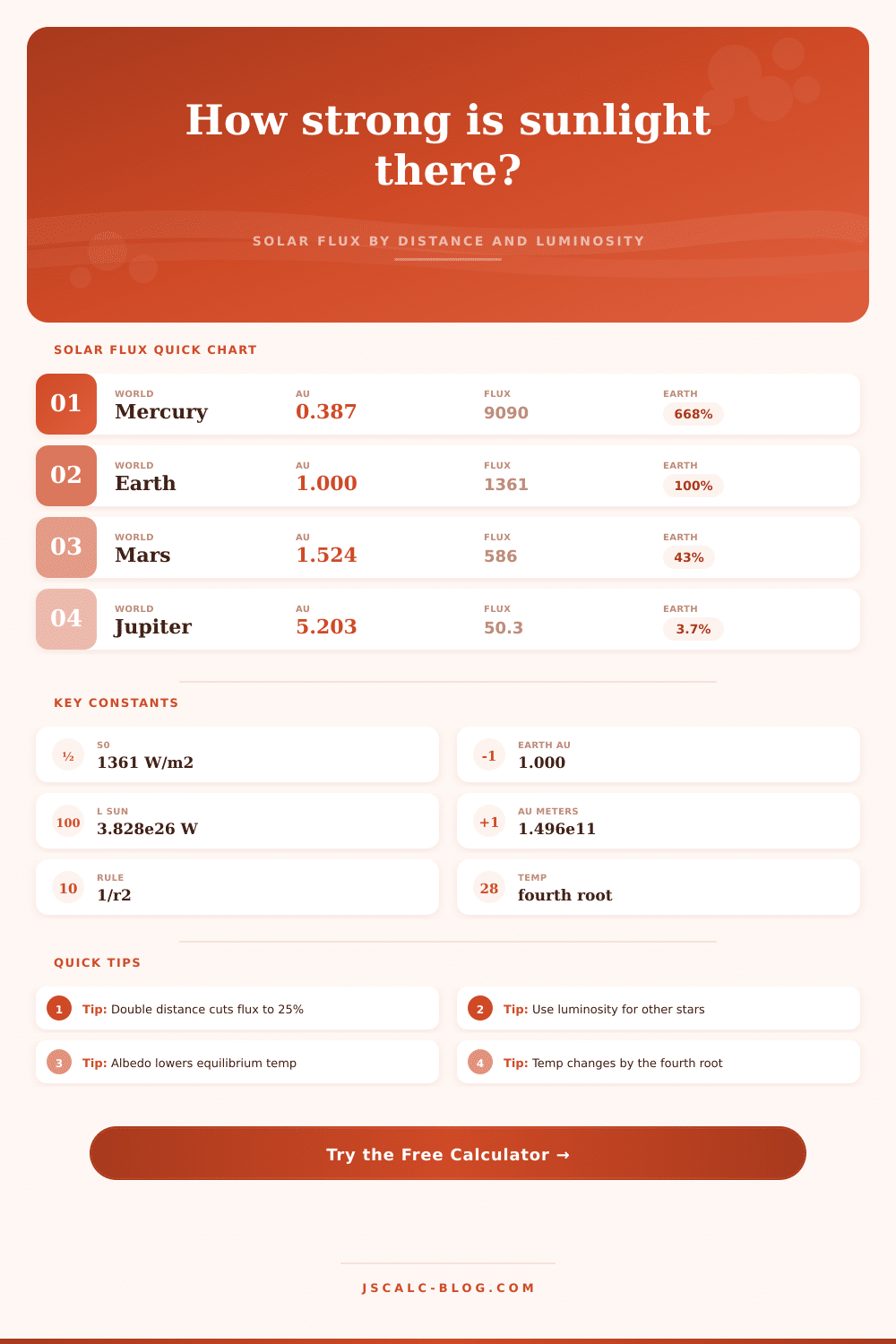
| Mercury | 0.387 AU | About 9090 W/m² | 668% | 410 K |
| Venus | 0.723 AU | About 2610 W/m² | 192% | 300 K |
| Earth | 1.000 AU | 1361 W/m² | 100% | 255 K |
| Mars | 1.524 AU | About 586 W/m² | 43.1% | 207 K |
| Ceres | 2.768 AU | About 177 W/m² | 13.0% | 153 K |
| Jupiter | 5.203 AU | About 50.3 W/m² | 3.70% | 112 K |
| Saturn | 9.537 AU | About 15.0 W/m² | 1.10% | 79 K |
| Uranus | 19.191 AU | About 3.70 W/m² | 0.272% | 58 K |
| Neptune | 30.070 AU | About 1.51 W/m² | 0.111% | 46 K |
| Input unit | Equivalent to 1 AU | Best use | Calculator conversion |
|---|---|---|---|
| Astronomical unit | 1 AU | Planetary orbits | Used directly for S0 / r_AU² |
| Kilometer | 149,597,870.7 km | Mission distances | Divides by 149,597,870.7 |
| Million kilometers | 149.5978707 million km | Readable solar-system values | Multiplies by 1,000,000 km first |
| Miles | 92,955,807.3 mi | Imperial distance entries | Converts miles to meters, then AU |
| Meters | 149,597,870,700 m | Luminosity equation precision | Used directly as radius in meters |
| Solar radii | 215.032 solar radii | Near-star distances | Multiplies by 695,700,000 m |
| Distance | Brightness vs Earth | Flux with S0 = 1361 | Temp ratio | Ideal temp, A = 0.30 |
|---|---|---|---|---|
| 0.25 AU | 16.0x | 21,776 W/m² | 2.000x | 510 K |
| 0.50 AU | 4.0x | 5,444 W/m² | 1.414x | 361 K |
| 1.00 AU | 1.0x | 1,361 W/m² | 1.000x | 255 K |
| 1.50 AU | 0.444x | 605 W/m² | 0.816x | 208 K |
| 2.00 AU | 0.250x | 340 W/m² | 0.707x | 180 K |
| 5.00 AU | 0.040x | 54.4 W/m² | 0.447x | 114 K |
“Light is so weak here, it’s not even like being on Earth,” he says, as he stands up on Mars. “The atmosphere is so thin here that light hitting your visor isn’t even half as strong as it would be back home on Earth.”
Why? Distance, obviously. The closer you get to something, the more photons hits you; the farther away, the fewer. Physics does give a damn about where you are. The Sun doesn’t. But distance matters. Take one step away from the Sun: The world gets darker. Two steps away? Darker still. Three steps? You got it. And the math couldn’t be simpler. To know why Neptune is cold and Mercury is hot requires no degree in astrophysics, only an understanding of the inverse square law, a rule by which every photon exiting sun is tied.
Why Light Fades Fast in Space
After plugging in your desired units and distance, the calculator (above) takes care of all the tricky math for you, no need to wrestle with conversion factors or exponents. Everyone knows the farther you are from something, the darker it gets… though few realize just how quickly it gets dark out there. Light isn’t lost linearly. It’s lost at the square of the distance. Double your distance from the Sun? Don’t expect half as many photons. Expect three-quarters fewer. That’s what keeps Venus so hot compared to Earth: That last quarter.
Now that’s the part that trips up most folks. They use their straight-line thinking while the universe uses its squaring-up approach. It’s simple enough to enter information into the calculator, though you want to pick an appropriate baseline. On average, at Earth’s orbital radius, the solar constant, how much sunlight falls on something, is about 1361 watts per square meter. It’s not unchangeable; it changes over time, but as far as engineering goes it isn’t changing so fast to matter.
For a mission to Jupiter, however, you’d want to know that the sun will deliver only around fifty watts per square meter! This is not nearly enough to run even a modest appliance back home, much less a spacecraft. You can tinker with the stellar brightness value, which comes in handy if you’re wondering what a planet might be like orbiting a slightly dimmer or brighter star. Twice the luminosity of the sun and the habitable zone expands so planets farther out could get same amount of energy as we do here.
Heat flows according to the fourth power of temperature, so our intuitions about how temperatures relate don’t always work out right. Just because something gets more or less sunlight doesn’t mean it gets proportionally more or less warm. If we imagine a world getting 4x as much sunlight as earth, it won’t be 4x as hot. Instead, it will be around 41% hotter (in absolute temperature units). That’s unintuitive! Intuitively, if it got 4x as much light, then it should get 4x as hot. But that isn’t how thermodynamics works.
And that’s why there’s an option for emissivity and albedo in the calculator. No planet is a perfect black body. They all reflect some light. Oceans reflect less. Ice reflects a lot. All these surface factors can have a large effect on whether you end up with ice-worlds or water-worlds, and they matter just as much as distance when predicting what the climate condition will actualy be.
There are also preset buttons you can hit to jump to known places so you can do some quick comparisons. For example, the flux dropped from more than nine thousand watts at Mercury down to less than two watts at Neptune. That really gives you a sense of how big and empty the solar system is. Most of it is a dark place indeed. The inner planets have light bathing them. The outer planets float in that cold twilight. And that gradient explains why no one uses solar panels (instead of nuclear power) for their outer planet mission. Just the sun doesn’t get out there very far at all, let alone meaningfully.
It’s laid out pretty clearly in the reference table on the page. Here is how brightness and temperature shift along the known orbits: This is a nice sanity check if you’re planning a theoretical mission or trying to model a fictional world, but keep in mind that these temperatures are ideal. Atmospheres actualy trap heat. They can render a frozen world hot and a hot world even hotter as well as prevent it from cooling down. The math provides the baseline. What happens next depends on the weather. That requires accounting for thermal inertia, clouds, and speed of rotation. These factors will do far more to affect the surface experience then just distance.
But ultimately, this doesn’t matter. Because the solar constant is exactly that: a start. It is a measure of the energy present, but it says nothing about what happens when that energy reaches us. If you’re planning an orbital satellite, or if you want to know what it’s like on the dark side of some moon, then the rule doesn’t change. What matters most is distance. All else is just background noise. As we race further from the light of the sun, the world dims and cools…but the sun stays the same. You should of seen the math yourself to believe it.