SMOG Readability Calculator
Paste text or enter exact counts to estimate SMOG grade from sentences and polysyllabic words using the normalized 30-sentence method on JSCalc-Blog.com.
📌Named Presets
Load a realistic text sample, then adjust the audience target, count mode, and rounding.
SMOG grade result
Paste text and calculate to see the grade estimate.
🔢Text And Count Inputs
📊Count Summary Grid
🧮Normalized SMOG Method Grid
📚Reference Tables
| Audience Target | Common Grade Goal | SMOG Reading Load | Typical Use | Revision Priority |
|---|---|---|---|---|
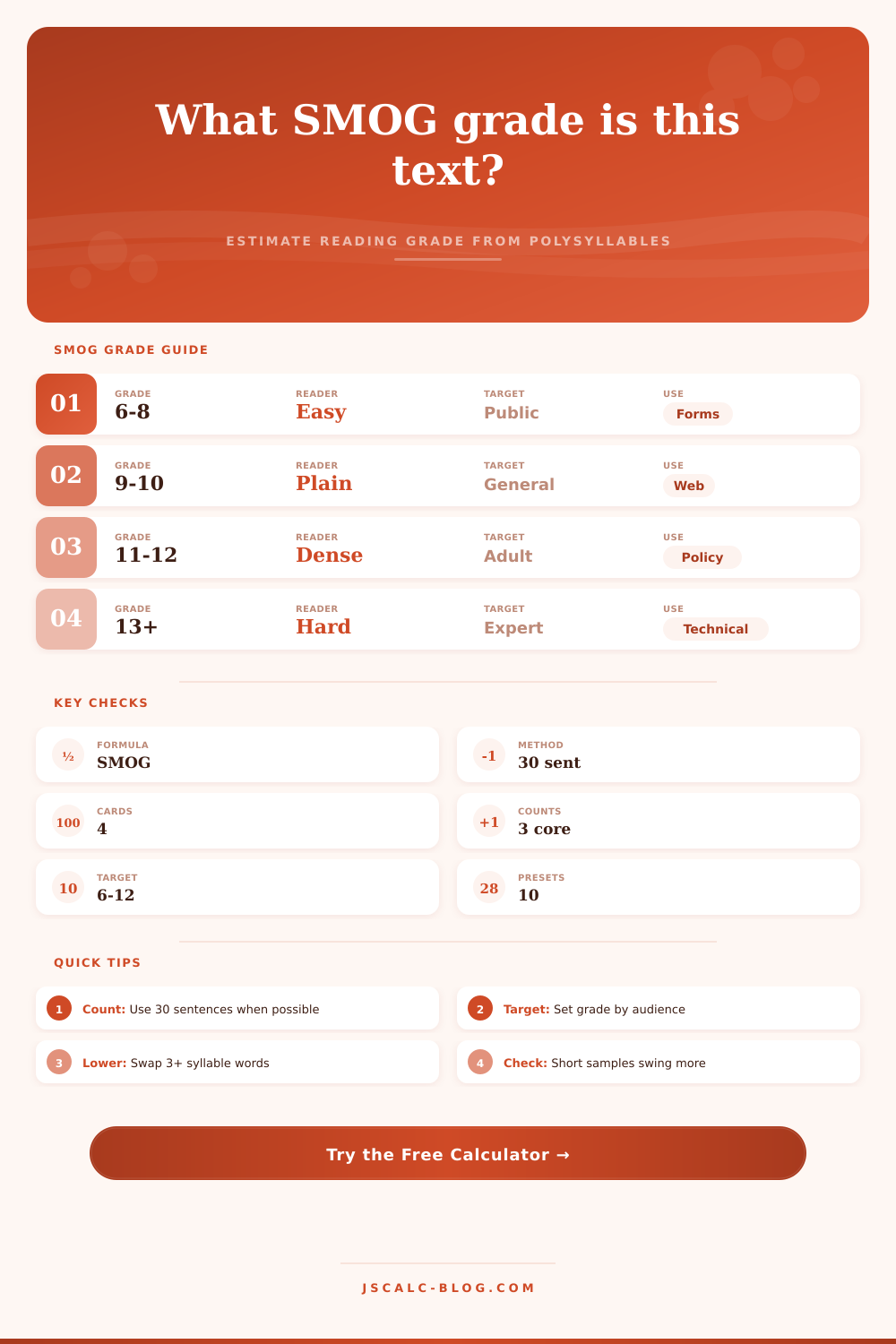
| Public information | 6 to 8 | Easy to plain | Forms, notices, service pages | Cut long words and keep sentences direct. |
| Health instructions | 6 to 7 | High-access public copy | Medication, discharge, safety text | Define terms before action steps. |
| School assignment | 8 to 11 | Student reading range | Essays, handouts, rubrics | Balance precision with short examples. |
| Workplace memo | 9 to 11 | Adult general copy | Internal notices and training | Replace bureaucratic phrasing. |
| Policy or compliance | 10 to 12 | Dense adult copy | Requirements and standards | Keep terms, split clauses. |
| Technical reference | 12 to 14 | Specialist load | Docs, specifications, manuals | Add definitions and examples. |
| Legal or contract copy | 12 to 15 | Specialized precision | Clauses and obligations | Use structure to offset complex terms. |
| Expert academic text | 14 to 18 | Expert load | Abstracts and research summaries | Clarify purpose and define variables. |
| SMOG Grade | Approximate Reader Level | Normalized Polysyllables | Text Signal | Common Next Move |
|---|---|---|---|---|
| 5 to 6 | Elementary | 3 to 8 per 30 sentences | Mostly short, concrete words | Keep essential terms visible. |
| 7 to 8 | Middle school | 9 to 21 per 30 sentences | Plain public copy | Review repeated long terms. |
| 9 to 10 | Early high school | 22 to 42 per 30 sentences | General adult material | Split sentences with multiple ideas. |
| 11 to 12 | Upper high school | 43 to 69 per 30 sentences | Policy or coursework | Define abstract vocabulary. |
| 13 to 14 | College | 70 to 103 per 30 sentences | Technical or academic text | Add examples after dense terms. |
| 15+ | Graduate or expert | 104+ per 30 sentences | Specialist-heavy prose | Decide if the audience supports it. |
| Counting Choice | When To Use It | Sentence Rule | Polysyllable Rule | Accuracy Note |
|---|---|---|---|---|
| Whole pasted sample | Fast draft check | Use punctuation estimate | Auto-estimated from words | Best after proofreading punctuation. |
| 30-sentence sample | Traditional SMOG workflow | Use exactly 30 sentences | Count every 3+ syllable occurrence | Most stable for longer documents. |
| Short sample estimate | Microcopy or brief notice | Use all available sentences | Normalize to 30 sentences | Expect larger swings from one word. |
| Section or chapter sample | Long documents | Sample representative sections | Count the sampled text | Avoid only the easiest paragraphs. |
| Manual audit count | Published or regulated copy | Use reviewed count | Use reviewed count | Preferred for final reporting. |
| Before/after revision | Editing comparison | Keep sampling consistent | Compare normalized counts | Shows whether revisions moved the grade. |
| Formula Part | Equation | Inputs Used | Why It Matters |
|---|---|---|---|
| Normalized polysyllables | polysyllables x (30 / sentences) | Sentences and 3+ syllable words | Places every sample on a 30-sentence basis. |
| SMOG grade | 1.0430 x sqrt(normalized polysyllables) + 3.1291 | Normalized polysyllables | Returns the estimated grade level. |
| Grade gap | SMOG grade - target grade | Calculated grade and target | Shows how many grade levels to lower or raise. |
| Poly density | polysyllables / words x 100 | Words and polysyllables | Identifies whether word complexity drives the score. |
| Sentence load | words / sentences | Words and sentences | SMOG is poly-focused, but long sentences still affect usability. |
💡Practical Tips
Instead, the patient gets discharge forms written in legalese, leaving them more confused than when they arrived (and still with lots of questions). That’s the downside to unreadable writing: it makes reading hard but doesn’t measure smarts. Dense = smart? Not exactly.
Enter the SMOG Readability Calculator. To calculate readability, it avoids sentence length in favor of polysyllables (words containing three or more syllables). Counting these up allow you to guess how well your readers will follow along. That’s why it’s lasted for decades; it’s simple in its design.
How to Use the SMOG Calculator
Here’s how it works: take your sample, count the number of sentences, count the number of long words. Plug those numbers into this thing called a “calculator” and let it adjust everything based off thirty sentences. That’s right, thirty sentences; smaller samples fluctuate too wildly. One complicated word in one little paragraph throw off the whole result. So it smooths away the noise and spits out a reliable estimate of grade level.
All you have to do is figure out what to plug in, and thankfully the calculator does all the math for you (above). No need to guess at coefficients here. Just know what it is you’re counting.
The problem here is that most folks count words and then try to average it out in terms of sentences. They don’t consider weight of their vocabulary. How many heavy lifting word do you have? SMOG doesn’t give a flying fig about how many words you’ve got. SMOG cares about how many of those words is heavy-lifters.
Sure, words like understanding, determination or information appear fine on there own. But wait till you see that all of them are three-syllable words. They makes it harder to think. Stack up a few of those and the grade level sky-rockets. The key is knowing what’s really being measured here. It isn’t your intelligence. It’s the amount of friction you’re creating.
Think about who your audience is. If your goal is a public notice about an upcoming change in a city service, you’re likely aiming at grade six or eight. In other words, plain, easy language. On the other hand, if you’re writing a technical manual for engineers, aim for grade twelve or fourteen. The tool will help you visualize the gap between where you are and where you need to be.
Just because your writing has a high grade doesn’t necessarily make it good writing. It makes it hard, and sometimes that’s okay. More often than not, it isn’t. Decide whether complexity is serving the purpose or simply protecting the ego.
Revision isn’t so much about deleting sentences as swapping words. Decision instead of determination. Use instead of utilize. No loss of meaning. One fewer syllable. Lower grade level. Little difference but big one. Keep the nuance but lose the weight.
And here’s where the reference table on the page comes in handy. Here are your typical targets by context: use the simplest language for health instructions, and slightly more complex language for academic ideas. It’s not meant as an insult to the reader’s intelligence. It’s recognition of the stakes. If they’re stressed or ill, then they has less processing power. Clear writing is a form of safety feature.
One decimal place isn’t everything. Remember: readability scores are approximations. They’re not rules of law. They provide guidance. If yours is 10 while the “target” is a six, you better should of got crackin’. If yours is seven and the “target” is six, you’re in the ballpark. Don’t aim for perfect; aim for aligning.
Conversation is more than a test, it’s writing. Talk at somebody and they won’t listen. Talk up to them and they won’t understand. SMOG keeps you in between those two extremes. It transforms your vague sense that something doesn’t feel right into real numbers you can use to improve it.
Count the big words first. Track the score decline. Your audience will appreciate it.