Gunning Fog Index Calculator
Paste text or enter manual counts to calculate the Gunning Fog grade level, complex-word share, target grade gap, and sentence reduction plan on JSCalc-Blog.com.
📌Named Presets
Load a realistic sample, then adjust the target grade and complex-word exclusions.
Gunning Fog result
Paste text and calculate to see the grade estimate.
🔢Text And Count Inputs
📊Live Count Cards
🗂Fog Grade Grid
📑Reference Tables
| Fog Band | Common Interpretation | Approximate Reader | Typical Use | Rewrite Signal |
|---|---|---|---|---|
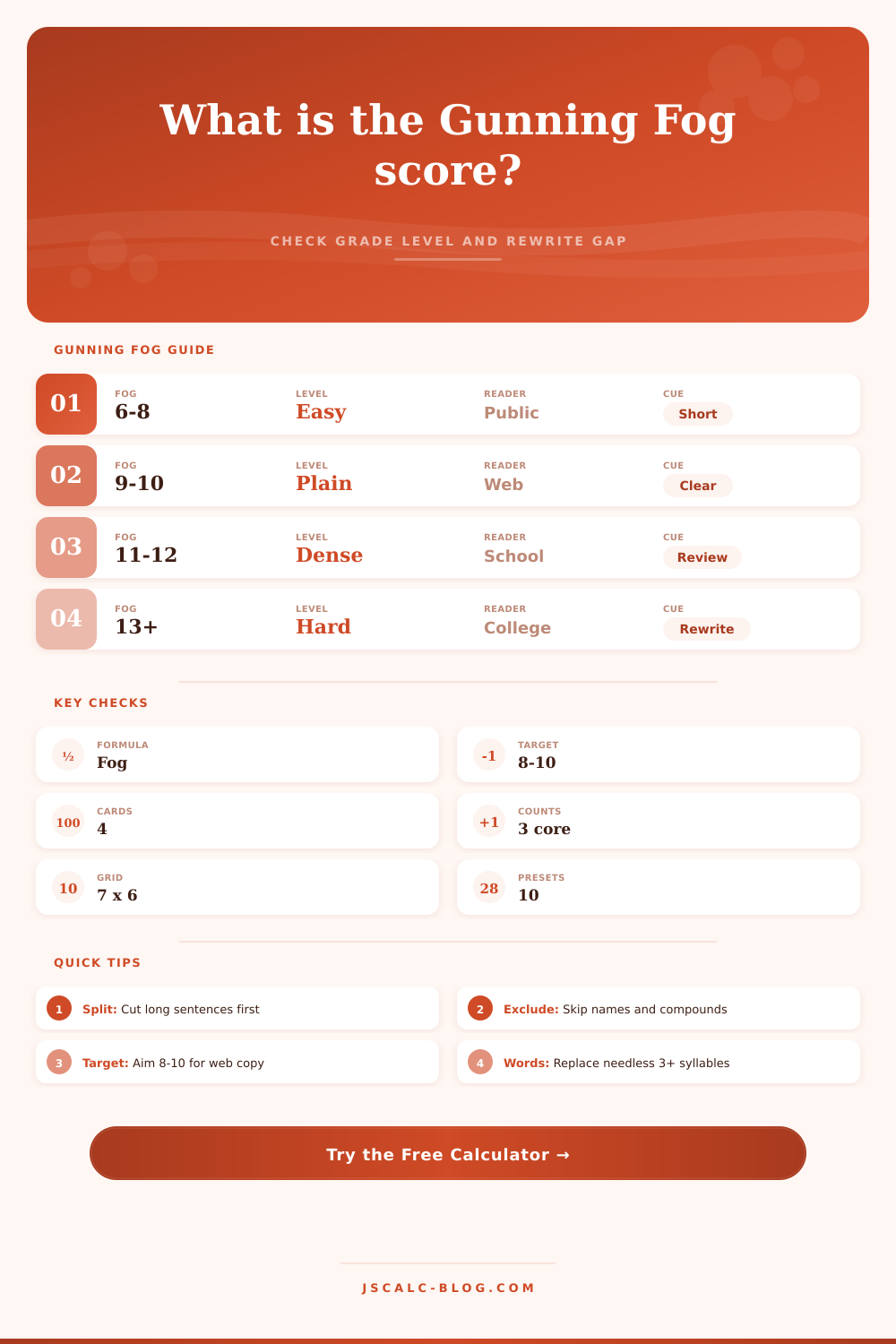
| 5 to 6 | Very easy | Elementary school | Warnings, short notices, basic forms | Usually clear enough for broad readers |
| 7 to 8 | Easy | Middle school | Public service copy and help text | Strong plain-language range |
| 9 to 10 | Plain to moderate | Early high school | General articles, web pages, email | Good target for most public content |
| 11 to 12 | Somewhat difficult | Upper high school | Reports, policy notes, school writing | Split long sentences before publishing |
| 13 to 14 | Difficult | College | Technical manuals and academic material | Define terms and simplify sentence chains |
| 15+ | Very difficult | Advanced college or graduate | Legal, research, and specialist prose | Rewrite unless expert-only precision is needed |
| Formula Step | Calculation | Input Source | Why It Matters |
|---|---|---|---|
| Average sentence length | words / sentences | Text or manual counts | Longer sentences increase the Fog score directly. |
| Complex-word percent | 100 x complex words / words | 3+ syllable words after exclusions | Dense vocabulary can raise the grade even when sentences are short. |
| Gunning Fog formula | 0.4 x (ASL + complex percent) | Sentence and complex-word rates | Creates the estimated years of education needed. |
| Grade gap | Fog score - target grade | Selected audience target | Positive values show how many grade levels to reduce. |
| Sentence reduction | words / target ASL | Target grade and complex percent | Estimates extra sentences needed if vocabulary stays the same. |
| Exclusion Rule | What It Does | Example | Use When |
|---|---|---|---|
| Proper nouns | Skips capitalized names and places | Singapore, Maria, Adobe | Names are not the real reading burden |
| Hyphenated compounds | Skips multi-part compound terms | well-organized, user-friendly | Each part is familiar by itself |
| Suffix forms | Skips simple -ed and -es endings | created, notices | The root word is not complex |
| Strict count | Counts all 3+ syllable words | organization, analysis | You want a conservative high estimate |
| Lenient repeat rule | Counts repeated complex terms once | regulation repeated | A defined term appears many times |
| Rewrite Move | Fog Direction | Best When | Count Impact |
|---|---|---|---|
| Split a 32-word sentence into two | Lowers Fog | One sentence carries several ideas | Lowers words per sentence |
| Replace "approximately" with "about" | Lowers Fog | A shorter word keeps the same meaning | Lowers complex-word share |
| Define a necessary technical word | Improves usefulness | The term must remain for accuracy | May not lower raw Fog but helps readers |
| Turn passive nouns into verbs | Often lowers Fog | Writing feels abstract or bureaucratic | Can cut words and syllables |
| Keep a precise legal term | May keep Fog high | Meaning would change if simplified | Use audience target to judge |
💡Practical Tips
When does a seemingly clear paragraph become challenging for readers? Most readers don’t read word-for-word; they skim content, so how can we help them?
The Gunning Fog Index are a way to measure how hard a text is to read. This metric calculate the number of years of formal education required for readers to understand your words upon initial reading. Why would this matter? Because you want readers to finish the page, not bookmark and return another day.
How to Make Your Writing Easier to Read
Once you’ve pasted your draft into calculator, it does math for you (no need to count syllables by hand!). Then, it’ll break down your score into three components: words, sentences, and complex words. Sentence length are a big concern for many. Long sentences gets tiring, right? But the calculator keeps an eye out for something else, too: hard words… That is, words that have three or more syllables.
Sure, you can keep your sentences short, but if they’re loaded with jargon (“implementation,” anyone? How about “utilization”?), the score’s going to go up. According to index, grammar complexity is just as bad for readability than the density of your vocabulary.
The exclusions also matter to the score’s accuracy, so you ought of to know what’s being left out. In default scoring, proper nouns aren’t considered complex words, nor are hyphenated compounds (e.g., “online”). Even though these examples has three syllables apiece, a reader knows that “Apple,” “online,” etc. To change this behavior, there’s an option to tweak the tool’s rules; that way, you could test technical writing that includes more moddern complex words. If you’re targeting specialists, perhaps stick with a strict count. Otherwise, probably go with standard exclusions, since you’ll be addressing general public. That will swing your grade level by up to one whole year, changing the diagnosis of your writing.
What’s most useful about this is the grade gap feature. You pick your desired level. For example, you might pick an eighth-grade reading level so the content is easy for as many people as possible to read. Then the tool compare this target level with what your real Fog score is. How much of a gap is there?
If it’s two grades, that’s big, which means you’re probably going to have to eliminate some extra adverb and adjective rather than just substituting synonyms in place. The sentence reduction plan estimates how many extra sentence breaks you’d have to insert in order to reach this level. So now instead of vaguely suspecting that the writing is over your head, you’ve got a specific editing task ahead: add these many sentence break.
The score must also be interpreted within context. A 12 may be ideal for a list of course requirements for university students, but disastrous if used to instruct people being released from hospital. The banding and the table of references on the page will help you understand what each score mean. Anything below nine reads as plain English, which works well in most online writing. Anything above thirteen starts to veer towards the worlds of legalese and academia; precision tends to outweigh pace here.
Don’t strive for zero as even explanations of complex concepts requires some complexity. It’s about aligning with your readership rather than making things simple just for the sake of it. Fog isn’t about making content dumber, it’s about eliminating friction. You didn’t change the meaning if you swap “start” for “commence”, but you did reduce amount of work required from reader. You can break a thirty word sentence into two sentences of fifteen words. Now the reader have a beat to catch their breath. These are tiny tweaks that add up fast.
The tool gives you a mirror but you’re still expected to look in it. Read it out loud, check your own work. When you lose your breath, so does the reader. Let the numbers inform your intuition, not take it over. Writing clearly is about caring more about the person on the other end of the screen.