Flesch Reading Ease Calculator
Paste text or enter counts to calculate Flesch Reading Ease from words, sentences, and syllables, then compare the score to a target, grade range, rewrite gap, and technical term adjustment on JSCalc-Blog.com.
📌Named Presets
Load a realistic writing sample, then adjust the target score, audience, and technical term load.
Readability result
Paste text and calculate to see the score.
🔢Text And Count Inputs
📊Live Count Snapshot
📘Score Interpretation Grid
📑Reference Tables
| Flesch Band | Common Interpretation | Approximate Grade | Typical Use | Rewrite Signal |
|---|---|---|---|---|
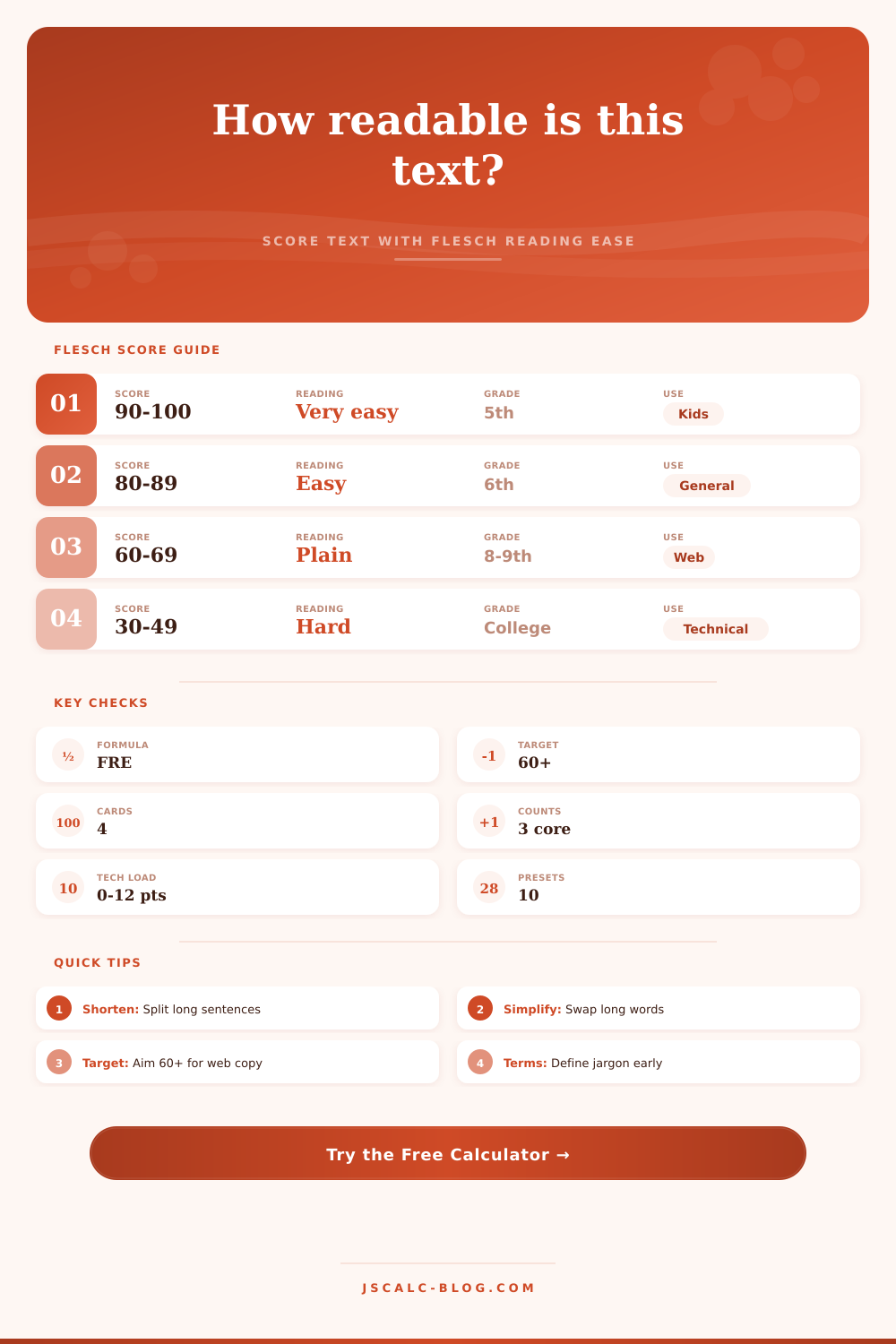
| 90 to 100 | Very easy | 5th grade | Child-facing instructions, warnings, signs | May be too simple for expert tone |
| 80 to 89 | Easy | 6th grade | Customer support, onboarding, email | Strong plain-language range |
| 70 to 79 | Fairly easy | 7th grade | General articles and guides | Usually comfortable online |
| 60 to 69 | Standard or plain | 8th to 9th grade | Public web pages and workplace notes | Good minimum for broad readers |
| 50 to 59 | Fairly difficult | 10th to 12th grade | Business, school, and policy writing | Trim sentences before publishing |
| 30 to 49 | Difficult | College | Technical manuals and academic text | Define terms and split clauses |
| 0 to 29 | Very confusing | Graduate | Legal, research, specialist prose | Rewrite unless expert-only |
| Formula Step | Calculation | Input Source | Why It Matters |
|---|---|---|---|
| Average sentence length | words divided by sentences | Text or manual counts | Long sentences lower the score quickly. |
| Average syllables per word | syllables divided by words | Estimated or override | Longer words carry the largest penalty. |
| Raw FRE formula | 206.835 - 1.015 x ASL - 84.6 x ASW | Sentence, word, syllable counts | Creates the standard Flesch Reading Ease score. |
| Technical adjustment | raw FRE minus selected points | Technical term load | Accounts for jargon that syllables alone may miss. |
| Rewrite gap | target score minus adjusted score | Target score field | Shows how far the copy is from the chosen goal. |
| Audience Profile | Practical Target | Sentence Goal | Word Goal | Notes |
|---|---|---|---|---|
| Children or early readers | 85 to 95 | Under 10 words | Mostly 1 syllable | Use concrete nouns and direct verbs. |
| General web readers | 60 to 75 | 12 to 18 words | Define longer terms | Good for help pages, blogs, and forms. |
| Workplace readers | 55 to 70 | 14 to 22 words | Limit acronyms | Clearer emails and memos reduce rework. |
| High school or college | 45 to 65 | 16 to 25 words | Accept some terms | Complex ideas can still use clean structure. |
| Specialist or technical | 35 to 55 | 18 to 28 words | Explain jargon | Use definitions, examples, and headings. |
| Legal or compliance | 30 to 50 | 20 to 30 words | Precise terms | Keep legal meaning while breaking long clauses. |
| Rewrite Move | Score Direction | Best When | Count Impact |
|---|---|---|---|
| Split a 35-word sentence into two | Raises FRE | One sentence carries multiple ideas | Lowers words per sentence |
| Replace "utilize" with "use" | Raises FRE | Long word has a short equivalent | Lowers syllables per word |
| Define one technical term in plain words | Raises adjusted FRE | Jargon is needed but unfamiliar | Reduces technical penalty |
| Turn a noun phrase into a verb | Often raises FRE | Writing feels abstract or bureaucratic | May cut words and syllables |
| Keep necessary terms unchanged | May lower FRE | Precision matters more than broad access | Use audience target to judge |
💡Practical Tips
Sometimes when you read a paragraph, something just doesn’t sit right with you. There’s no problem with words themselves, but the way they are put together seem to weigh them down. The Flesch Reading Ease formula accounts for that friction in how words is put together.
What does it do? It weighs two factors: How long is your average sentence? And how many syllables per word on average do you use? Reading are an averaging game. The longer your sentences, the lower the score. The more syllables, then the lower the score.
How to Make Your Writing Easier to Read
Enter in your raw text, and the calculator will go to work for you. You’ll be able to see what’s causing drag. The raw score fall between zero and a hundred. The higher it is, easier the text.
A score in the nineties would of being read as a kids’ book. It is good for safety signs. It could sound patronizing in company newsletter. A legal contract scores around thirty-three. It is dense by design.
Match the score to the reader. Aim for sixties or seventies if writing for a general web audience. That range sound accessible. On the page there is a reference table that maps score bands to the grade level. Helpful to have as a benchmark.
Grade level is less important than context. The standard formula doesn’t account for technical terms. Yes, it counts their syllables. But does it know that one are an algorithm and another is a banana? A fifth grader struggle with both of those words. An engineer see them differently.
For this reason, the tool has a technical term adjustment. If your writing contains jargon your audience won’t understand, you can add a penalty. The beauty of this is that result is honest. It prevents you from assuming your text is easier simply because you substituted shorter words.
Use precise vocabulary; make sure to define a term when necessary, as defining something usually increases the score by more than replacing it with a vague synonym. Clarity are the point; simplification isn’t.
Writers tend to assume that they has to change every single word until it reaches their target score. This isn’t the case. Instead, you just cut the corners. More often than not, splitting a long sentence into two short ones will help more then replacing ten words.
Readability is killed by long sentences. They requires the reader to keep too many details in working memory. The sentence need to be cut so the brain has somewhere to rest.
People obsess over word choice rather than structure. Fix the structure first. Once you’ve done that, worry about your vocabulary.
And then there’s that gap thing: where am I in relation to my target? Fifty-two have some room to go before it hits sixty-five. Sixty is about right. It pays less and less if we’re talking about small changes.
Go easy on chasing that perfect number. Perfection in readability often lead to choppy, staccato prose that is annoying. Shoot for readable comfort.
Best writing comes across as conversation. Let the numbers maintain your rhythm. Serve the reader; they’ll flow smoother. When the math keep you honest, the uneasiness dissapears.