Sleep Cycle Calculator
Plan the best bedtime or wake-up time around 90-minute sleep cycles. Add your fall-asleep buffer, pick an age target, and see several cycle-aligned options so you wake between cycles instead of mid-deep-sleep.
😴Real Sleep Presets
📝Sleep Inputs
Ignored when the mode is "going to bed now" (it uses the clock).
Most adults take 10 to 20 minutes to drift off.
Typical range is 80 to 110; 90 is the common average.
🔢How The Timing Works
📊Your Cycle Options
| Cycles | Sleep Length | Bedtime | Falls Asleep | Rating |
|---|---|---|---|---|
| Enter a time above and calculate to build your cycle-by-cycle options. | ||||
👶Recommended Sleep By Age
| Age Group | Recommended Hours | Approx Cycles | Notes |
|---|---|---|---|
| Newborn (0–3 mo) | 14–17 h | 9–11 | Short irregular cycles |
| Infant (4–11 mo) | 12–15 h | 8–10 | Cycles near 50 min |
| Toddler (1–2 yr) | 11–14 h | 7–9 | One or two naps |
| Preschool (3–5 yr) | 10–13 h | 7–8 | Nap may drop off |
| School (6–12 yr) | 9–11 h | 6–7 | Consistent bedtime helps |
| Teen (13–18 yr) | 8–10 h | 6 | Later body clock |
| Adult (18–64 yr) | 7–9 h | 5–6 | 5 to 6 full cycles ideal |
| Older adult (65+) | 7–8 h | 5 | Lighter, earlier sleep |
🌙Stages Within One Cycle
| Stage | Type | Share Of Cycle | What Happens | Wake Feel |
|---|---|---|---|---|
| N1 | Light | About 5% | Drifting off, easy to rouse | Easy |
| N2 | Light | About 45% | Body cools, heart rate drops | Fairly easy |
| N3 | Deep | About 25% | Physical repair, hardest to wake | Groggy |
| REM | Dream | About 25% | Dreaming, memory sorting | Alert if timed |
| End of cycle | Transition | Brief | Near-waking gap between cycles | Best moment |
💤Nap Length Guide
| Nap | Length | Stages Reached | Best For | Grogginess | When To Use |
|---|---|---|---|---|---|
| Micro nap | 10 min | N1 only | Quick alertness | None | Mid-afternoon dip |
| Power nap | 20 min | N1–N2 | Focus and mood | Very low | Before a task |
| Short nap | 30 min | Into N2 | Light recharge | Slight | Low-sleep days |
| Avoid zone | 45–60 min | Enters N3 | Not ideal | High | Skip if possible |
| Full cycle | 90 min | Full cycle + REM | Deep recovery | Low if timed | Big sleep debt |
| Coffee nap | 20 min | N1–N2 | Caffeine + rest | Very low | Drink then nap |
🗂Cycle Comparison Grid
| Cycles | Sleep Length | Wake At 6:30 | Bed At 10:30 | Feels Like | Best For |
|---|---|---|---|---|---|
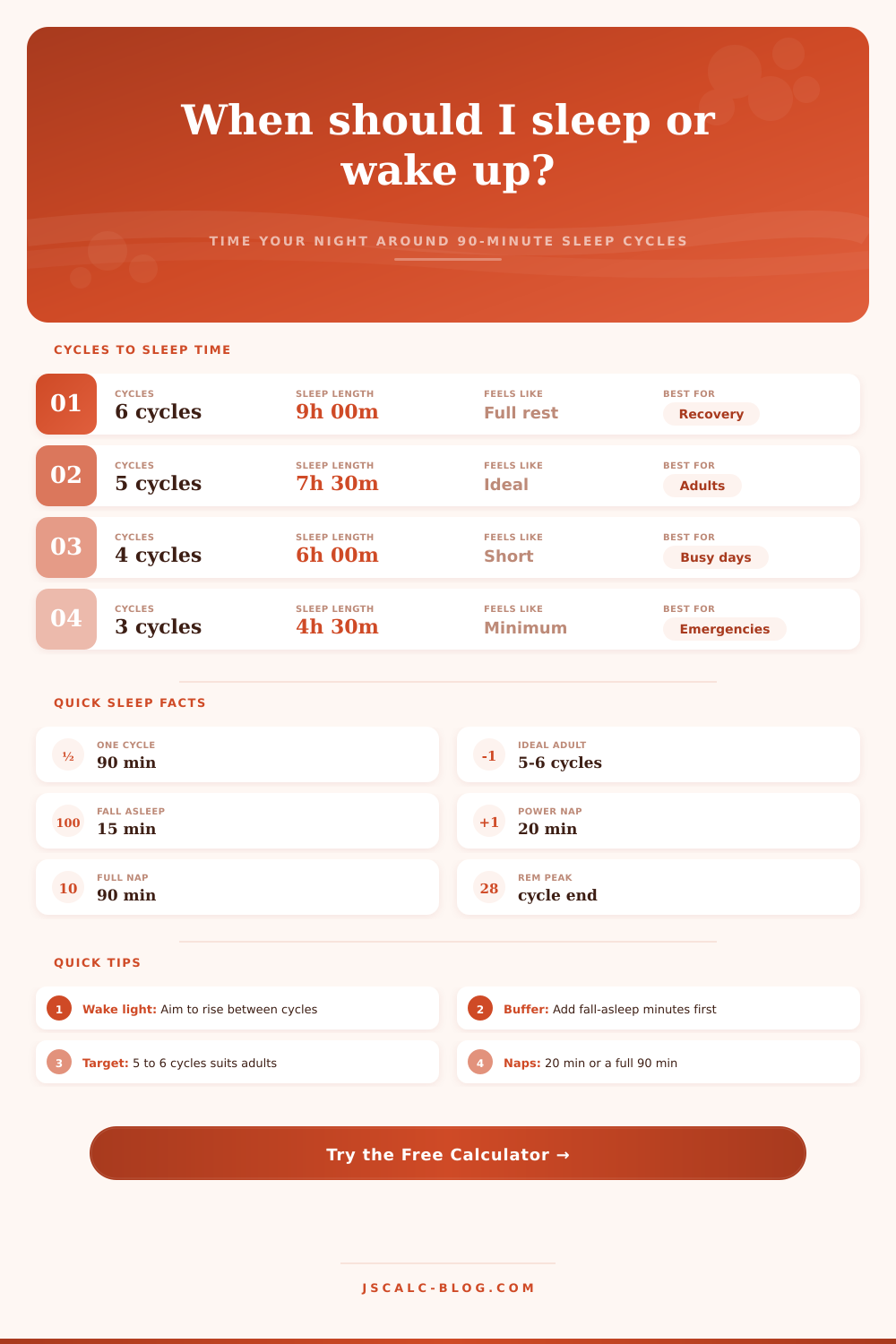
| 6 cycles | 9h 00m | Bed 9:15 PM | Wake 7:15 AM | Fully rested | Recovery night |
| 5 cycles | 7h 30m | Bed 10:45 PM | Wake 5:45 AM | Ideal balance | Most adults |
| 4 cycles | 6h 00m | Bed 12:15 AM | Wake 4:15 AM | A bit short | Busy schedule |
| 3 cycles | 4h 30m | Bed 1:45 AM | Wake 2:45 AM | Minimum only | Emergencies |
| 2 cycles | 3h 00m | Bed 3:15 AM | Wake 1:15 AM | Not enough | Split sleep |
| 1 cycle | 1h 30m | Bed 4:45 AM | Wake 12:00 AM | Nap level | Long nap |
Grid assumes a 15-minute fall-asleep buffer and a 90-minute cycle. Your calculated options above use the exact values you enter.
⚙Full Timing Formula
💡Sleep Timing Tips
After 8 hours of sleep you may not feel well-rested at all, because you did not actualy wake up between your sleep cycles, but in the middle of one. You sleep in 90 minute chunks, each with a different stage (light sleep, then deep sleep, then REM). When you wake up in-between these stages, it feels refreshing. But if you wake up in the middle of a deep sleep cycle, you’ll feel groggy regardless of how long you slept.
The calculator can help identify when you should go to bed / get up so you don’t wake up in the middle of these cycles. Sleep is not a single mass of time off. It’s broken into phases with different functions. REM sleep help regulate mood and process memory. Deep (N3) sleep heals tissues and strengthens the immune system. Both are necessary for working well.
Why You Feel Tired After 8 Hours of Sleep
Waking up during deep sleep makes it hard for the brain to kick in quickly. The lag result in sleep inertia. That hazy feeling. Learning about this cycle shifts the way you think about total sleep duration. Instead of focusing on number of hours, you begin searching for full cycles.
The vast majority of sleep tools don’t account for initial fall asleep duration. When you get in bed, you usually need 10 (20 minutes before falling asleep). That means if you set your alarm for a nine-hour night without allowing extra time for that delay, you’ll probably be awakened partway through one of the cycles. By default, the tool accounts for this fall-asleep period. You specify how long it normally takes you to fall asleep, and it moves the beginning of the first cycle by that amount. This modest change make a big difference in accuracy. Skipping this step is like forgetting to factor traffic when scheduling a drive to a meeting.
The number of sleep cycles you really need depends on your age. Six cycles (or nine hours) are required for teens; five cycles (seven and a half hours) is enough for older adult. You can see the reference table on that page. As we get older, our bodies’ makeup changes. Attempting to force yourself into a nine-hour routine if your body really only require seven will result in broken sleep. Better to align your sleep length with your actual biology.
Sleep cycles apply to napping as well. Napping for 20 minutes puts you in the lighter stages of sleep and restores your energy without making you feel groggy. If you go for 30 minutes, there’s a good chance you’ll get pulled into deep sleep and wake up groggy. Going for 90 minutes allows you to finish out a complete cycle and reap the healing benefits of sleep.
When you’re tired during the day, know what you can handle in terms of time so you can take the appropriate-length nap instead of a half-cycle nap that leaves you feeling even more tired than you did beforehand. The last variable beyond control of calculation is light exposure. Even if your calculation was perfect, it won’t be perfect if you wake up in the dark and go straight to staring at screens, or if you wake up in the bright light of day and then sleep in. If you want your body clock to initiate sleep (or tell you when you’re awake), you need it to be dark (or light). So calculate your best times, and support them by using sunlight and blackout curtains.
Biology works best with structure. Once you line up your schedule with your body’s natural rhythm, you’ll lose the morning fog. You’re not waking up at the right time on the clock, but at the right time in your cycle.