401k Retirement Calculator
Project your 401(k) balance at retirement from salary-percent contributions plus your employer match, apply the match limit and IRS deferral cap, and see how much of the total is free employer money versus your own savings and compound growth.
🎯Real 401k Match Presets
📝Your 401k Inputs
50% means 50 cents per dollar; 100% is a full dollar-for-dollar match.
Employer only matches your deferral up to this share of pay.
🔢Match Formula Snapshot
📊Year-by-Year Balance
| Age | Salary | Your Add | Match Add | Growth | End Balance |
|---|---|---|---|---|---|
| Enter values above to build the year-by-year 401(k) schedule. | |||||
🤝Employer Match Reference
| Match Formula | Match Rate | Limit | Full-Match Deferral | Free % of Pay |
|---|---|---|---|---|
| 50% up to 6% | 50% | 6% | 6% of salary | 3.0% |
| 100% up to 3% | 100% | 3% | 3% of salary | 3.0% |
| 100% up to 5% | 100% | 5% | 5% of salary | 5.0% |
| 100% up to 4% + 50% next 2% | Tiered | 6% | 6% of salary | 5.0% |
| 50% up to 8% | 50% | 8% | 8% of salary | 4.0% |
| 25% up to 10% | 25% | 10% | 10% of salary | 2.5% |
📋Contribution Limit Reference
| Tax Year | Under 50 Limit | Catch-Up (50+) | Total 50+ Limit |
|---|---|---|---|
| 2022 | $20,500 | $6,500 | $27,000 |
| 2023 | $22,500 | $7,500 | $30,000 |
| 2024 | $23,000 | $7,500 | $30,500 |
| Note | Employee deferral | Age 50 and over | Excludes match |
💵Match Value Over a Career
| Salary | You at 6% | Match 50%/6% | Yearly Match | 25-Yr Match | Grown at 7% |
|---|---|---|---|---|---|
| $45,000 | $2,700 | 3% of pay | $1,350 | $33,750 | $85,353 |
| $60,000 | $3,600 | 3% of pay | $1,800 | $45,000 | $113,804 |
| $75,000 | $4,500 | 3% of pay | $2,250 | $56,250 | $142,255 |
| $90,000 | $5,400 | 3% of pay | $2,700 | $67,500 | $170,706 |
| $120,000 | $7,200 | 3% of pay | $3,600 | $90,000 | $227,608 |
| $150,000 | $9,000 | 3% of pay | $4,500 | $112,500 | $284,510 |
⚙Full Formula Breakdown
🗂Contribution Strategy Comparison
| Strategy | You Defer | Match Rule | Free % Pay | Miss If Under | Best For |
|---|---|---|---|---|---|
| Full match capture | 6% | 50% to 6% | 3.0% | Below 6% | Everyone first |
| Dollar-for-dollar | 5% | 100% to 5% | 5.0% | Below 5% | Generous plans |
| Max out deferral | Up to cap | Any | Match cap | High savers | High earners |
| Catch-up 50+ | Extra $7,500 | Any | Match cap | Age 50 plus | Late starters |
| Aggressive early | 8% or more | Any | Match cap | Young savers | Long horizons |
| No-match plan | Your choice | None | 0.0% | Not applicable | IRA compare |
💡Practical 401k Tips
If you’re like most people, there’s money waiting for you from your company’s 401(k) match. It’s not some mysterious stash of cash tucked away somewhere. Your employer’s contribution is listed right on your paystub, it’s called “employer match.”
Too many workers see their retirement savings as something they has to do, not as an investing choice. They think about what they’ll lose today (lower take-home pay) and don’t consider what they’ll gain tomorrow. Enter: this calculator to give you a sense of what you’re getting back when you save into your 401(k).
How to Use Your 401(k) Calculator
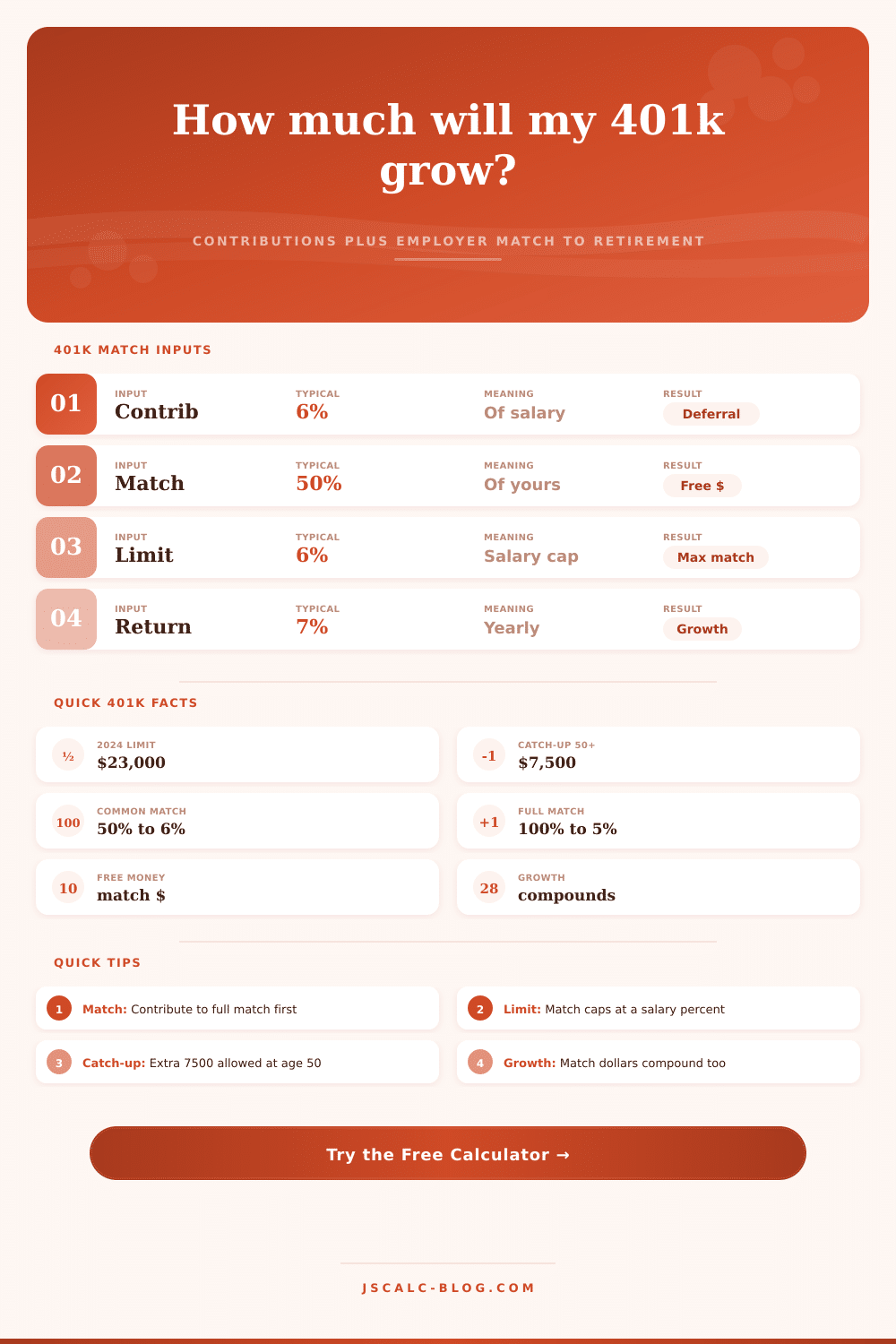
First, get the whole company match. Because the match is free, it’s like getting an immediate return on your money. Something no mutual fund can promise. If your employer matches fifty percent of your contributions, then that means you’re effectively earning a fifty percent return on those dollars. That’s higher then anything else you can find in the market. Not maxing out the match is like saying “no thanks” to a raise at work.
Type in your salary and your company’s matching percentage into the calculator. It will tell you how many free dollars is building up relative to what you put in. Once you have captured the full match, then it’s about compound growth and tax benefits.
For some folks, this means maxing out their contributions during their 20s when they’re young and able to do so. In fact, they may have a lot of debt and want to pay that down before saving. For others, they want to knock down high interest debt, so that make more sense. It all depends on your own finances, both approaches make sense!
Time is the key factor here. Investing money at 25 will give your dollars three or four decades to mature. Investing money at 45 will leave it with fewer years. That’s why your age and starting balance are such important factors in the estimate. A few extra bucks per year invested today could result in tens of thousands of dollar more in your retirement account after thirty or forty years thanks to exponential growth.
The other thing that throws people off is investment returns. We tend to be either overly optimistic about our returns or too conservative. For the stock market specifically, a good benchmark long-term return (adjusted for both volatility and inflation) is around 7 percent per year. That’s assuming you’re able to stay invested through bubbles and market crashes. Your own returns will probably end up being lower if you sell when market dips. You can tweak this number using the calculator and try out different scenarios. It forces you to bring your expectations down to earth (away from either fear or hope).
The catch-up contributions kick in around age fifty. This means you can contribute even more money above normal IRS limit. If you’re behind the eight ball or just got a late start, then this type of contribution can be one of your best tools. By catching up today, you’ll have an opportunity to save more before taxes; which can help make up for previous years’ misfires. The estimate takes into account the extra cash and shows how much it helps boost the final stash.
There’s no such thing as “too late” to begin saving well … provided you increase your contributions rate over time to compensate for lost time. Your retirement plan won’t be straight-line. Markets ebb and flow. Your salary rises or falls. Major life events happen. The key is to have a plan that includes all those variables.
When you understand how contributions work, the power of compounding, and matching rules, you stop guessing and start planning. If you remain consistent, this is what could of happen: That’s just a snapshot. But it puts concrete data behind something that was previously abstract, your worry about the future. You’re no longer wondering “where do I stand?” Now you know where you are and how much more you need to contribute.
Every dollar you push into the future will grow faster than a dollar sitting in your checking account. Free money is still one of the best ways to create wealth.