Concrete Block Calculator
Estimate how many CMU blocks a wall needs plus mortar bags, courses per wall, rebar length, and grout fill for cores. Subtract door and window openings and add a waste allowance for cut and broken units.
🎯Real Wall Presets
📝Wall Inputs
Enter meters when metric units are selected.
Total door and window area. Uses sq meters in metric mode.
🔢Masonry Constants
📊Block Size Reference
| Nominal Size | Face (H×L) | Face Area | Blocks / Sq Ft | Blocks / 100 Sq Ft | Cores |
|---|---|---|---|---|---|
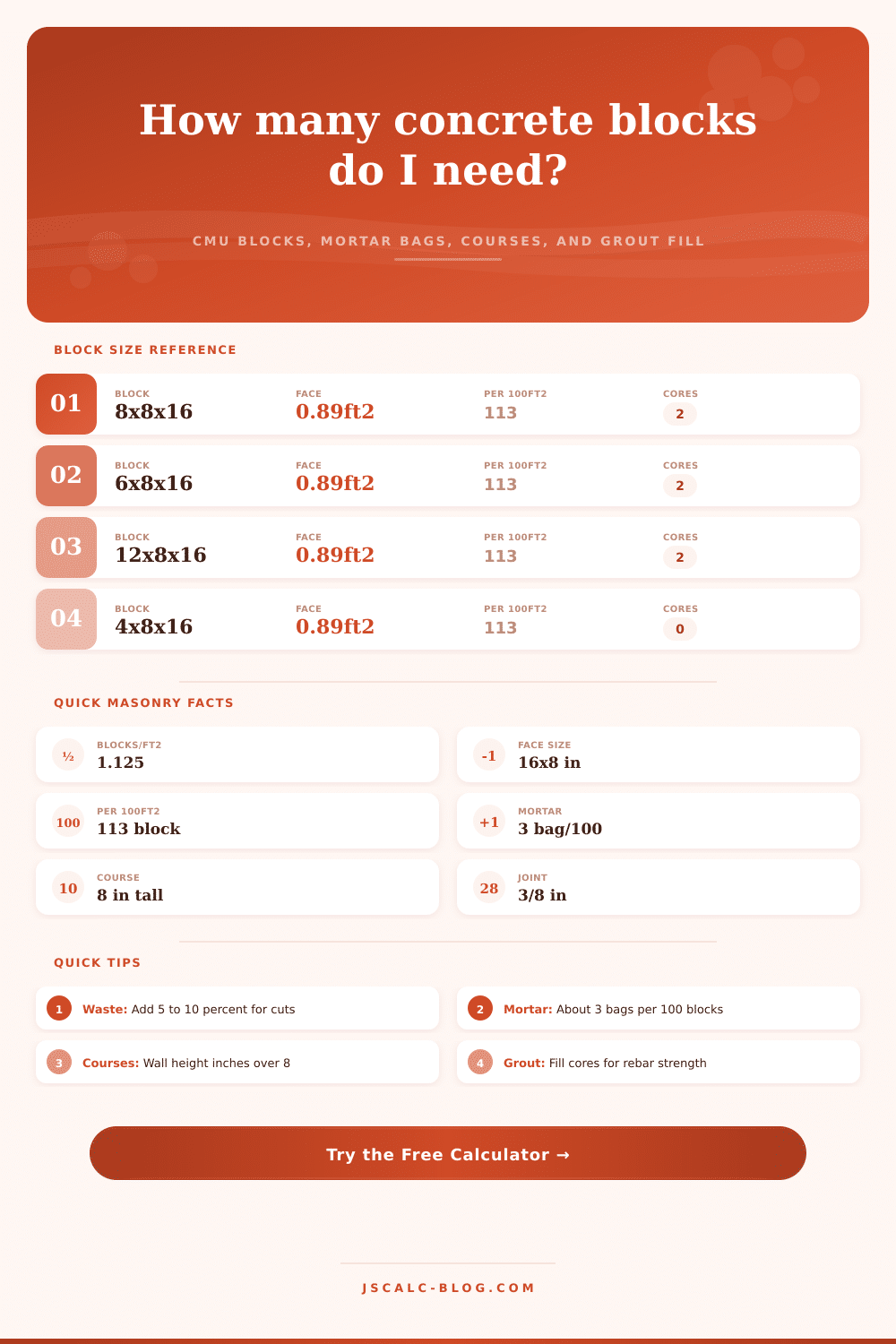
| 8 × 8 × 16 standard | 8 in × 16 in | 0.888 ft² | 1.125 | 113 | 2 (twin) |
| 6 × 8 × 16 partition | 8 in × 16 in | 0.888 ft² | 1.125 | 113 | 2 (twin) |
| 12 × 8 × 16 heavy | 8 in × 16 in | 0.888 ft² | 1.125 | 113 | 2 (twin) |
| 4 × 8 × 16 veneer | 8 in × 16 in | 0.888 ft² | 1.125 | 113 | solid / cap |
| 8 × 8 × 8 half | 8 in × 8 in | 0.444 ft² | 2.25 | 225 | 1 |
All 16 in long units share the same face area, so block count per wall area is the same. Thickness (6, 8, 12 in) changes weight, grout volume, and rebar, not the surface count.
🧱Mortar & Grout Reference
| Blocks | Mortar 70lb Bags | Sand (cu ft) | Filled Cores | Grout (cu ft) | Grout (cu yd) |
|---|---|---|---|---|---|
| 100 | 3 | 9 | 200 | 26 | 0.96 |
| 250 | 8 | 23 | 500 | 65 | 2.41 |
| 500 | 15 | 45 | 1000 | 130 | 4.81 |
| 750 | 23 | 68 | 1500 | 195 | 7.22 |
| 1000 | 30 | 90 | 2000 | 260 | 9.63 |
Grout column assumes fully grouted 8 in block near 0.13 cu ft per filled core pair. Partial fill schedules use far less, shown in your live result.
📐Wall Area Quick Table
| Wall L × H | Area ft² | Blocks (no waste) | +7% Waste | Mortar Bags | Courses |
|---|---|---|---|---|---|
| 10 × 8 ft | 80 | 90 | 97 | 3 | 12 |
| 20 × 8 ft | 160 | 180 | 193 | 6 | 12 |
| 30 × 8 ft | 240 | 270 | 289 | 9 | 12 |
| 40 × 8 ft | 320 | 360 | 386 | 12 | 12 |
| 20 × 4 ft | 80 | 90 | 97 | 3 | 6 |
| 20 × 10 ft | 200 | 225 | 241 | 7 | 15 |
🗂Project Comparison Grid
| Project | Block | Wall Size | Fill / Rebar | Blocks | Mortar |
|---|---|---|---|---|---|
| Garden wall | 8 × 8 × 16 | 25 × 4 ft | Hollow | ~120 | 4 bags |
| Shed foundation | 8 × 8 × 16 | 40 × 2 ft | 48 in O.C. | ~96 | 3 bags |
| Garage wall | 8 × 8 × 16 | 24 × 8 ft | 32 in O.C. | ~232 | 7 bags |
| Retaining wall | 12 × 8 × 16 | 30 × 4 ft | Fully grouted | ~145 | 5 bags |
| Basement wall | 12 × 8 × 16 | 32 × 8 ft | 24 in O.C. | ~309 | 9 bags |
| Partition | 6 × 8 × 16 | 16 × 9 ft | Hollow | ~163 | 5 bags |
⚙Full Formula Breakdown
📋Reference Values
| Item | Common Value | How It Is Used | Effect On Count |
|---|---|---|---|
| Waste allowance | 5% to 10% | Multiply block subtotal | Adds spare units for cuts |
| Mortar joint | 3/8 in standard | Sets nominal face size | Included in 1.125 factor |
| Mortar yield | ~3 bags / 100 blk | Blocks / 100 × rate | Face-shell bedding uses less |
| Rebar spacing | 16 to 48 in O.C. | Length / spacing + 1 | Tighter spacing = more bars |
| Grouted cells | 0.13 cu ft each | Cells × volume / 27 | Full grout needs most yards |
💡Practical Masonry Tips
How many bags of mortar do I need? It’s a question that can cause people to panic. They might be standing in front of rows of concrete masonry units, wondering where to start. Turns out, it isn’t as simple as just multiplying the number of blocks you’re going to build. Too many factors is at play. Height, length) for this task to be as straightforward as you might think.
That’s why we created our Wall Block Calculator. Plug in the measurements of your wall, and the tool does the rest. It converts those numbers into the exact amounts of block, mortar, rebar, and grout required for your specific project. No need to guess coefficient!
How to Calculate Materials for Your Wall
One thing to know up front: Nominal size can be deceptive. A nominal eight-inch block isn’t really eight inches thick; also, it’s not necessarily sixteen inches long. In both cases, the number includes room for mortar joints, typically three eighths of an inch between unit, and the industry assumes these joints. Regardless of how wide your unit (i.e., four-inch veneer vs. Twelve-inch foundation wall), there will always be same amount of face area to cover. You’re looking at about one and a quarter block per square foot of wall surface, regardless.
The volume of grout needed varies, and so does the weight of the material (but not the surface count), which is why many folks are confused when they attempt to visualize individual blocks and guess from there. They gets it wrong because they’re trying to estimate by visualizing individual block rather than calculating total area.
The only variable that can make an otherwise good estimate expensive is waste. You should of always add at least five percent to your block count (that’s better than nothing), but if you have lots of irregular openings or corners. Ten percent is safer. Why? Because every corner means having to cut a full unit in half, and you won’t usually get a perfect match out of the leftovers. And then there’s waste due to handling and delivery, breakage is inevitable. Don’t run out of a single unit mid-course and have to halt your work! Order some spares. This way you’ll never be caught without enough.
Adjust the percentage up/down as your comfort-level dictates, but don’t fall into the trap of underestimating waste. It will end up costing you more in shipping fees for making another trip then the cost of the extra blocks.
Estimating Mortar is no different than mortar itself: precision vs. Approximation. One bag (70lb) usually equals roughly one-hundred blocks… unless they’re laid a certain way. For example, if you’re bedding with face-shell (which isn’t recommended), you’ll use less than if you’re going for a full bed joint to ensure structural strength and/or looks. This may not sound like much per-course…but do that for two-decades worth of wall, then multiply by three (yes, there are other variables too). The calculator’s setting should reflects how you actualy lay, not what some industry-average is.
Rebar and grout add a lot of complexity to this problem. For example, when building a wall where you want some vertical reinforcement, you would use grout to fill certain cores of the wall and hold the steel in place. In most residential walls, it’s overkill to fill all the cores. You end up adding a ton of extra cost and weight. What really matter is spacing. Every 24 inches of rebar will give you great strength without wasting any material filling voids (cores) that don’t actualy require support. The grout volume accounts for these spacing intervals. You’ll only order as many cubic yards of grout as needed to fill just the right amount of cells.
Looking through the tables in the tool reminds me that the quantity of blocks per 100 sq ft doesn’t vary much by block thickness; it’s close enough to one hundred and thirteen no matter what. So you can build up a mental model for say a small garden wall or big basement foundation and it scales pretty easily because the underlying quantities don’t change.
A reminder: raw materials are only part of the story with masonry; there’s also the rhythm and repetition. If you do it right, the math adds up on the back end to reflect what happens out front. You won’t have to stand around with dirty hands wondering when the truck will show up because you didn’t plan ahead.
Once you figure out the relationship between your joints, waste, and reinforcements, you go from guessing to knowing. And that’s all that separates a good plan from an educated guess: just enough material to get the project done cleanly.