Sex Linked Punnett Square Calculator
Cross an X-linked trait to see the odds that sons are affected, daughters are affected, and daughters are carriers. Works for X-linked recessive and X-linked dominant inheritance with a full 2×2 offspring grid.
🧬Real X-Linked Cross Presets
📝Cross Inputs
Recessive needs two affected X in daughters; dominant needs only one.
Uppercase = dominant allele, lowercase = recessive allele.
Splits the projection 50/50 into sons and daughters.
Offspring Punnett Grid
| Father X^A | Father Y | |
|---|---|---|
| Mother X^A | –– | –– |
| Mother X^a | –– | –– |
🧪Gamete Snapshot
📊X-Linked Recessive Cross Patterns
| Cross | Sons Affected | Sons Normal | Daughters Affected | Daughters Carrier |
|---|---|---|---|---|
| X^A X^A × X^A Y | 0% | 100% | 0% | 0% |
| X^A X^A × X^a Y | 0% | 100% | 0% | 100% |
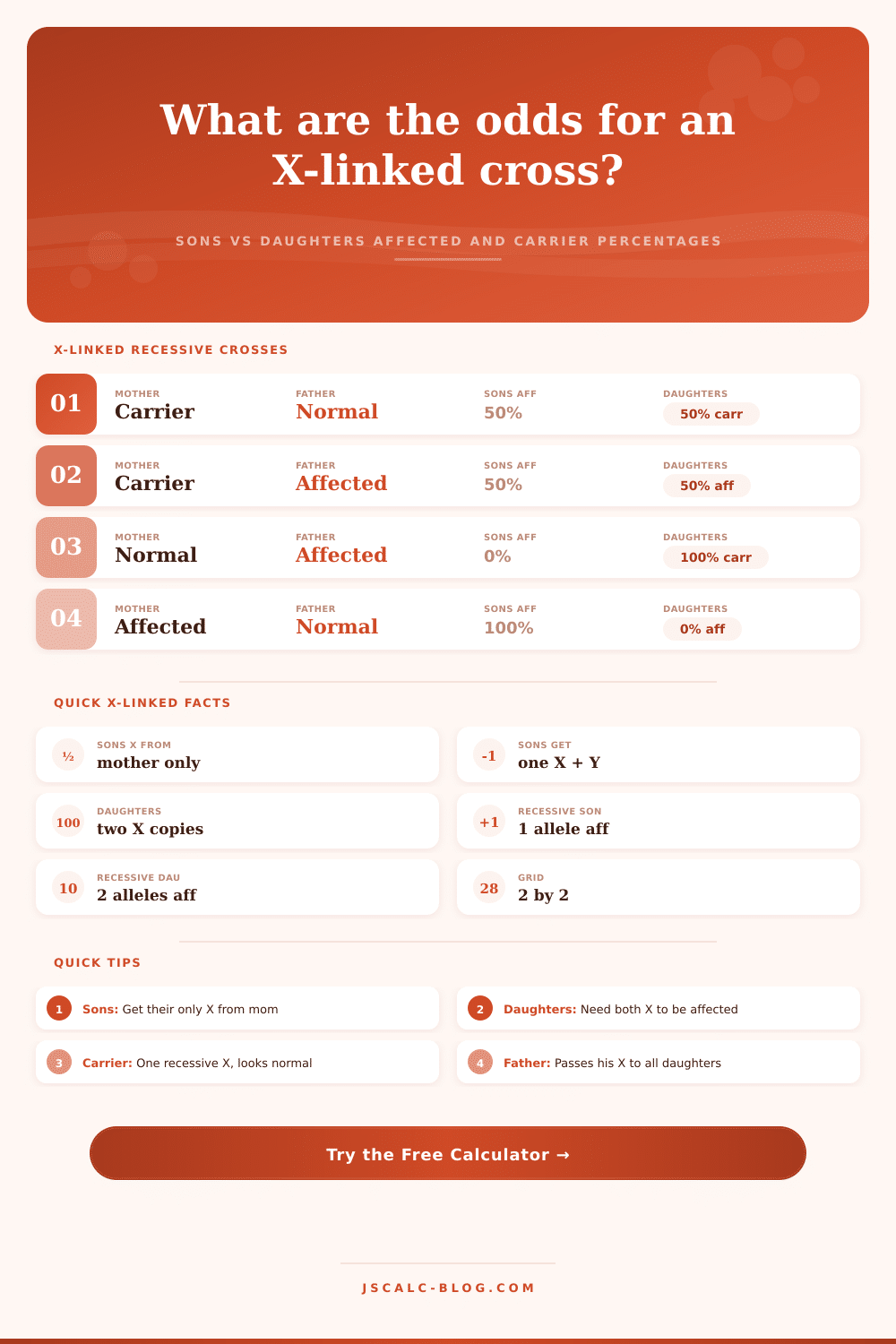
| X^A X^a × X^A Y | 50% | 50% | 0% | 50% |
| X^A X^a × X^a Y | 50% | 50% | 50% | 50% |
| X^a X^a × X^A Y | 100% | 0% | 0% | 100% |
| X^a X^a × X^a Y | 100% | 0% | 100% | 0% |
👩Carrier Mother Outcomes
| Father | Pattern | Sons Affected | Daughters Carrier | Daughters Affected |
|---|---|---|---|---|
| X^A Y | Recessive | 50% | 50% | 0% |
| X^a Y | Recessive | 50% | 50% | 50% |
| X^A Y | Dominant | 50% | 0% (50% aff) | 50% |
| X^a Y | Dominant | 50% | 0% (all aff) | 100% |
⚖Sons vs Daughters Risk
| Factor | Sons (X + Y) | Daughters (X + X) |
|---|---|---|
| X source | Mother only | Mother and father |
| Recessive to be affected | 1 recessive X | 2 recessive X |
| Can be a carrier | No (single X) | Yes (X^A X^a) |
| Dominant to be affected | 1 dominant X | 1 dominant X |
| Father passes to child | Y chromosome | His single X |
| Typical recessive risk | Often higher | Often lower |
🔬Famous X-Linked Traits
| Trait | Pattern | Gene | Notes |
|---|---|---|---|
| Red-green colorblindness | Recessive | OPN1LW / OPN1MW | Common in males, about 8% |
| Hemophilia A | Recessive | F8 | Clotting factor VIII shortage |
| Hemophilia B | Recessive | F9 | Also called Christmas disease |
| Duchenne muscular dystrophy | Recessive | DMD | Mostly affects boys |
| Fragile X syndrome | Dominant-like | FMR1 | Repeat expansion, variable |
| X-linked hypophosphatemia | Dominant | PHEX | Vitamin D resistant rickets |
⚙How The Cross Is Built
📋Genotype Reference
| Genotype | Sex | Recessive Phenotype | Dominant Phenotype |
|---|---|---|---|
| X^A X^A | Female | Normal, not a carrier | Affected |
| X^A X^a | Female | Carrier, not affected | Affected |
| X^a X^a | Female | Affected | Normal |
| X^A Y | Male | Normal | Affected |
| X^a Y | Male | Affected | Normal |
💡Practical X-Linked Tips
By using sex-linked Punnett square calculator, we’ll handle the math for you. More importantly, it will eliminate the confusion often associated with X-linked traits. Instead of just telling you if a child inherit a gene, this tool breaks down the specific probabilities for sons being affected, daughters being affected, and carrier status.
The X chromosome carries hundreds of genes, many of which have no counterpart on tiny Y chromosome. This imbalance make all the difference. To know what your chances are of having an affected son or daughter, you don’t have to memorize strange ratios. You simply follow the pathway of parental chromosomes to childs. The tool breaks this down into easily understood percentages of being carriers, affected daughters and affected sons. In short, it translates complex genetics into real chances you can use.
How to Use the Sex-Linked Punnett Square Calculator
The trick is to understand what you’re seeing. For example: Females carry two X chromosomes; males carry one X and one Y. And it’s that biological detail that explain everything in the grid. A son receives one X from his mother and a Y from his father. That means that whatever X-linked recessive traits is being examined, a boy will receive his entire status only based off the X he inherits from mom. If she passes down the recessive allele? He’s got nothing to cover it up with, and so he’s affected. Because of this, conditions such as red-green colorblindness or hemophilia occur more often among boys. And that’s why the calculator shows this by demonstrating increased risks for sons who has a mother who carries the recessive allele.
It’s a different story with daughters: they each get one X from their father and one from their mother, meaning they need two alleles of the affected gene to exhibit symptoms (i.e., a recessive trait). So they may have one affected and one normal X which means they’re carriers… They appear healthy but could still pass it on to their offsprings. Once you choose your pattern of inheritance, the calculator crunches numbers for you. That’s also how you see some families “skip” a generation. Because grandpa passed down his Y to his boy, he won’t be able to pass along any X-linked traits to his boys. However, he will give all his girls his lone X and they might then be carriers themselves if he was affected. This is explained nicely on the page in a reference table showing you what to expect for common crosses.
If a son has a normal dad and a carrier mom, there is a 50/50 chance he will be affected. Daughters from that couple both have a 50/50 shot of being carriers, but no chance of being affected themselves. Since their father gives them a normal (dominant) X, they cannot get the disease. This is why people mistakenly think that if a woman is a carrier, half of all her children will be sick. No, not true. It’s only half her boys who are at risk; girls are safe from the disease itself even though they inherit the legacy.
Jump over to X-linked dominant traits, however, and the pattern shifts. Here, only one affected allele is required for the condition. Because of that, fathers pass on their single X to their daughters who then all display the trait. They each inherit his Y chromosome instead so they are not affected. That means that each daughter of an affected father will inherit the condition. The calculator shows that jump clearly. Simply change the dropdown from “recessive” to “dominant,” and watch as the probabilities rearrange themselves. It emphasizes how much a father’s contribution matter in dominant traits.
That’s all well and good, but it doesn’t put the abstract into real world context. What about something like X-linked hypophosphatemia, a type of rickets? Or there is Duchenne muscular dystrophy, a very serious recessive disorder mosty found in boys. Having an idea of which pattern holds makes your family planning picture very different than before. And you don’t need a PhD in genetics to try out various what-ifs with the tool. Select some presets for the most common disorders (such as color blindness), or enter in your own genotypes.
In the end, this aims to shed light on what can be biologically realized. It’s less about completing a grid than learning how the genetics work. Many important characteristics flow through that X chromosome like vehicles. Understanding who gets what from whom makes the whole process clear. It means you no longer guess; instead, you calculate, and the odds becomes clear. For parents considering risks or students double-checking their homework, it makes no difference: The math is the same. Break it down: follow the chromosomes, recognize the sexes’ differences, and let the numbers tell you the story of inheritance.