Serial Dilution Calculator
Build a step-wise dilution series across N tubes: cumulative fold chain, concentration in every tube, and the exact transfer and diluent volumes. Or set a target and var it solve the number of steps.
🧪Real Serial Dilution Presets
📝Series Inputs
Enter 10 for a 1:10 step, 2 for 1:2, 3.162 for half-log.
Ignored when mode solves tubes for a target.
Used when mode is solve tubes for a target.
Same unit as volume; used only in manual mode.
Choose whether the stock tube counts as tube one.
🔢Formula Snapshot
📊Per-Tube Dilution Series
| Tube | Step Ratio | Cumulative Fold | Concentration | Transfer In | Diluent | Total Volume |
|---|---|---|---|---|---|---|
| Enter values above to build the per-tube dilution series. | ||||||
🔗Dilution-Factor Reference
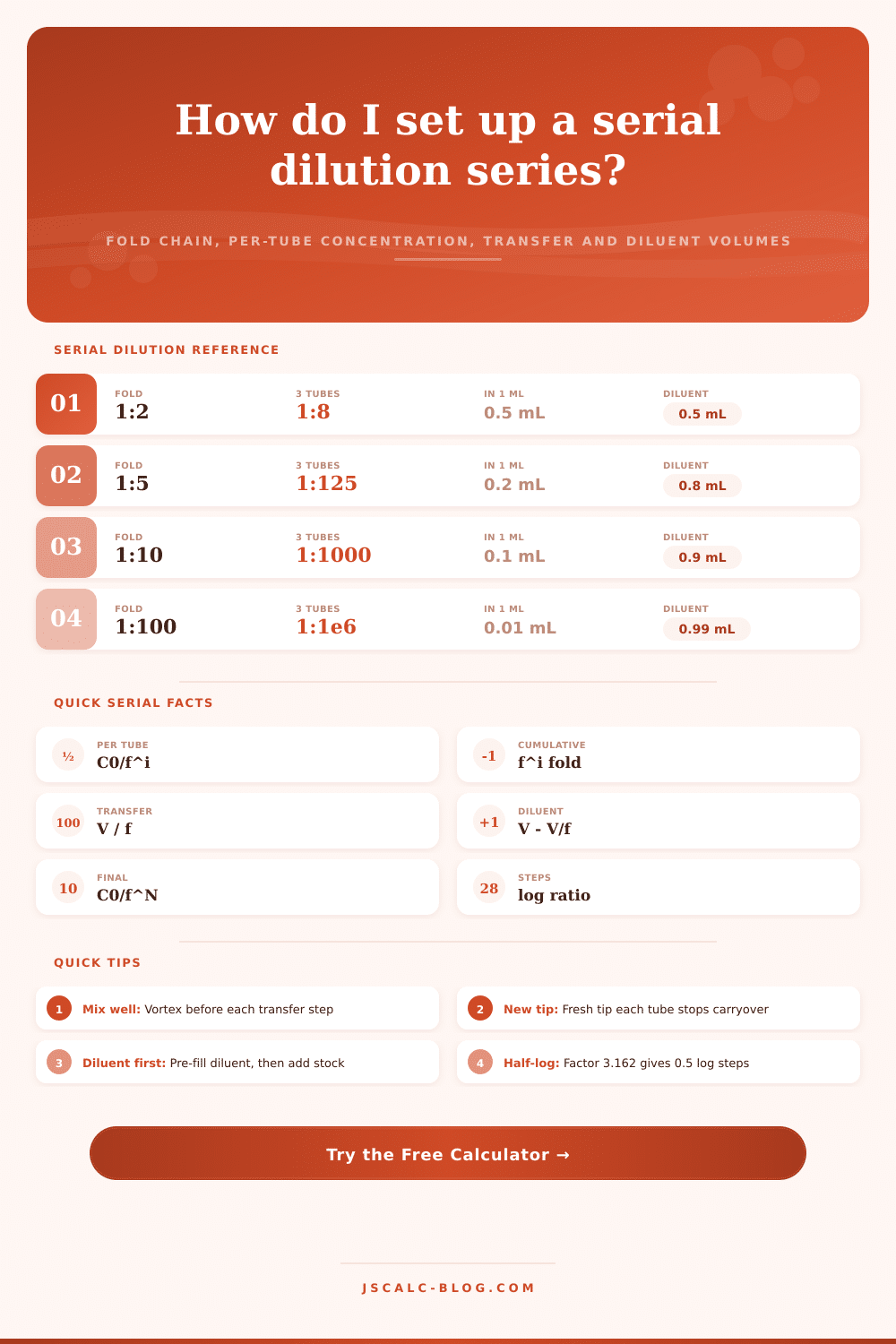
| Step Ratio | Fold (f) | Stock : Diluent | % Stock | Transfer in 1 mL | Diluent in 1 mL |
|---|---|---|---|---|---|
| 1:2 | 2× | 1 + 1 | 50% | 0.500 mL | 0.500 mL |
| 1:3 | 3× | 1 + 2 | 33.33% | 0.333 mL | 0.667 mL |
| 1:5 | 5× | 1 + 4 | 20% | 0.200 mL | 0.800 mL |
| 1:10 | 10× | 1 + 9 | 10% | 0.100 mL | 0.900 mL |
| 1:3.162 | 3.162× | 1 + 2.162 | 31.62% | 0.316 mL | 0.684 mL |
| 1:100 | 100× | 1 + 99 | 1% | 0.010 mL | 0.990 mL |
🔬Fold-to-Percent & Cumulative Reference
| Fold per Step | 1 Tube | 2 Tubes | 3 Tubes | 4 Tubes | Log Drop / Step |
|---|---|---|---|---|---|
| 2× | 1:2 | 1:4 | 1:8 | 1:16 | 0.301 log |
| 3× | 1:3 | 1:9 | 1:27 | 1:81 | 0.477 log |
| 3.162× | 1:3.16 | 1:10 | 1:31.6 | 1:100 | 0.500 log |
| 5× | 1:5 | 1:25 | 1:125 | 1:625 | 0.699 log |
| 10× | 1:10 | 1:100 | 1:1000 | 1:10000 | 1.000 log |
| 100× | 1:100 | 1:1e4 | 1:1e6 | 1:1e8 | 2.000 log |
📈Standard-Curve Series Reference
| Standard | Fold | Tubes | Top Point | Bottom Point | Typical Use |
|---|---|---|---|---|---|
| ELISA 2-fold | 2× | 8 | 500 ng/mL | 3.9 ng/mL | Cytokine standards |
| qPCR 10-fold | 10× | 6 | 1e7 copies | 100 copies | Efficiency curve |
| Half-log | 3.162× | 8 | 1000 nM | 0.316 nM | IC50 dose response |
| Protein BCA | 2× | 7 | 2000 µg/mL | 31.3 µg/mL | Total protein assay |
| Drug 3-fold | 3× | 9 | 30 µM | 0.0015 µM | Wide dose range |
| CFU plating | 10× | 7 | 1e8 CFU/mL | 100 CFU/mL | Viable cell count |
⚙Full Formula Breakdown
📋Serial Dilution Reference Values
| Item | Common Entry | How It Is Used | Series Effect |
|---|---|---|---|
| Fold per step | 2, 5, or 10 | Divides each concentration | Sets the cumulative f^i chain |
| Tubes / steps | 4 to 12 | Number of diluted transfers | Extends how far the series drops |
| Volume per tube | 0.1 to 10 mL | Sets transfer + diluent split | Larger V scales both volumes |
| Transfer volume | V / fold | Carried into the next tube | Defines the realized fold factor |
| Target conc | Any below stock | Solves the step count | Rounds up to reach the target |
💡Practical Serial Dilution Tips
So there’s this: you’ve got a tub of bacteria culture. But it is cloudy; it is no good for science if you only use your eyes. If you’re looking for a precise number of cells, too much cloudiness are scientifically worthless. You can’t just plunk down a whole milliliter of pure sludge onto a petri dish and expect to count each colony. They’ll grow together. You’ll end up with one giant lawn of nothingness all lumped into a lump you can’t lop off.
Enter serial dilution. Dilute the hell out of your sample till it’s small enough to be seen individually. Do this in a way that let you control concentration. On paper, it seems easy. In practice, the mathematics gets squishy quick when you want to hit a specific concentration. Before you even grab your pipette, you have to determine how many tube you’ll use. After setting your initial concentration and your dilution step size (which you do), the calculator handles the heavy lifting.
Simple Guide to Serial Dilution
Enter the concentration of the stock. Decide between half-log, two-fold or ten-fold steps. Enter total volume in each tube. The calculator outputs exact amount of new diluent solution and sample needed for each step. No more hovering over precious chemicals trying to figure out powers of ten by heart; no need to do fractions in your head. If you know what concentration you want, this will solve for the number of tubes needed. This is helpful when planning experiments that require limited incubator or other bench space.
It’s not about the formula. More important is understanding what goes into it. You choose how much you’re going to dilute (the “step”) and that tells you the slope of the dilution/concentration curve. Each time you reduce concentration by a 10-fold, you move down one log unit per tube. That’s fine for a wide range of values, such as cell counts. But if you want to create a dose-response curve with higher precision, use a half-log or two-fold step and get more data points across the concentration range. The dilution calculator will adjust the volume accordingly for each transfer, ensuring that the ratio of sample to diluent remains precise.
In manual transfer mode, just remember to include existing buffer plus the sample volume when calculating total volume. Most everyone makes the same mistake: They don’t account for how little things adds up. Incomplete mixing adds to the slight inaccuracy of the pipettor. If you take an aliquot without properly vortexing the tube first, the concentration gradient within the tube will throw off everything downstream. One bad data point isn’t it. It is a chain reaction.
Always use a new pipette tip per transfer. Avoid carrying over your concentrated stock from the previous tube. Seems like basic hygiene. But people get tired, behind schedule, rush and then they reuse their tips. The carryover can throw a ten-fold dilution into something far weaker different than intended. Throw off all your final calculations.
You can find a page of standard configurations of common assays (e.g., qPCR efficiency curve or ELISA standards) laid out in reference tables. That’s because some experimental designs needs to have a specific dynamic range. Antibiotic susceptibility testing is commonly done using two-fold dilution series. With this approach, you find the minimum inhibitory concentration with great accuracy. If you know which preset corresponds to your assay, it’s faster and less likely to make an error while entering parameters. Then the calculator will tell you what final concentration is in the last tube. And it allows you to check if it is actualy in the detection range of your instrument before you use all your reagents.
There’s another subtlety that doesn’t depend on just numbers: diluents. Depending on what you’re diluting (enzymes? proteins?), perhaps water isn’t appropriate because it lacks salt stabilizers or shifts the pH in ways that cause denaturation. In those cases, use a buffer at the same pH as your assay conditions so the molecules stays intact even when diluted. The calculator won’t hold your hand by judging which solvent is best for you. But it will nag you to add new diluent to each tube before transferring any sample. This avoids volume errors and ensures equal final volumes in each tube.
It’s all about control and predictability. That is at the heart of serial dilution: precision in exchange for volume. Starting with an unknown or too-strong stock, you make a ladder of known concentrations. How reliably can you count colony-forming units? Can you make a standard curve for your immunoassay? Your data hinges on how rigorous this process has been. This tool helps you plot out the rigor; you are responsible for delivering it. Change tips. Mix well. Trust the math. What began as a mystery tub of opaque liquid, now becomes a clear path to measure it.