Bill Split Calculator
Split a restaurant check among any number of people, add tip and tax, choose an even split or uneven shares by weight, round each person up to whole dollars, and see exactly what everyone owes.
🧾Real Split Presets
📝Bill Inputs
The food and drink total the tip is based on.
18 means 18% when mode is percent.
One weight per person, e.g. 2,1,1 means the first pays double.
🔢How The Split Works
👥Per-Person Breakdown
| Person | Share Of Bill | Tax | Tip | Total Due |
|---|---|---|---|---|
| Enter values above to see each person's share. | ||||
📊Even-Split Reference At Common Party Sizes
| People | Per Person | Tip Each | Tax Each | Rounded Up $1 |
|---|---|---|---|---|
| The party-size reference appears after calculation. | ||||
💵Tip Percent Reference For This Bill
| Tip % | Tip Amount | Grand Total | Per Person | Service Level |
|---|---|---|---|---|
| The tip reference table appears after calculation. | ||||
🗂Rounding Comparison Grid
| Rounding | Per Person | Collected | Grand Total | Overage | Notes |
|---|---|---|---|---|---|
| The rounding comparison appears after calculation. | |||||
⚙Full Formula Breakdown
📋Split Method Reference
| Method | Best For | How It Divides | Fairness Note |
|---|---|---|---|
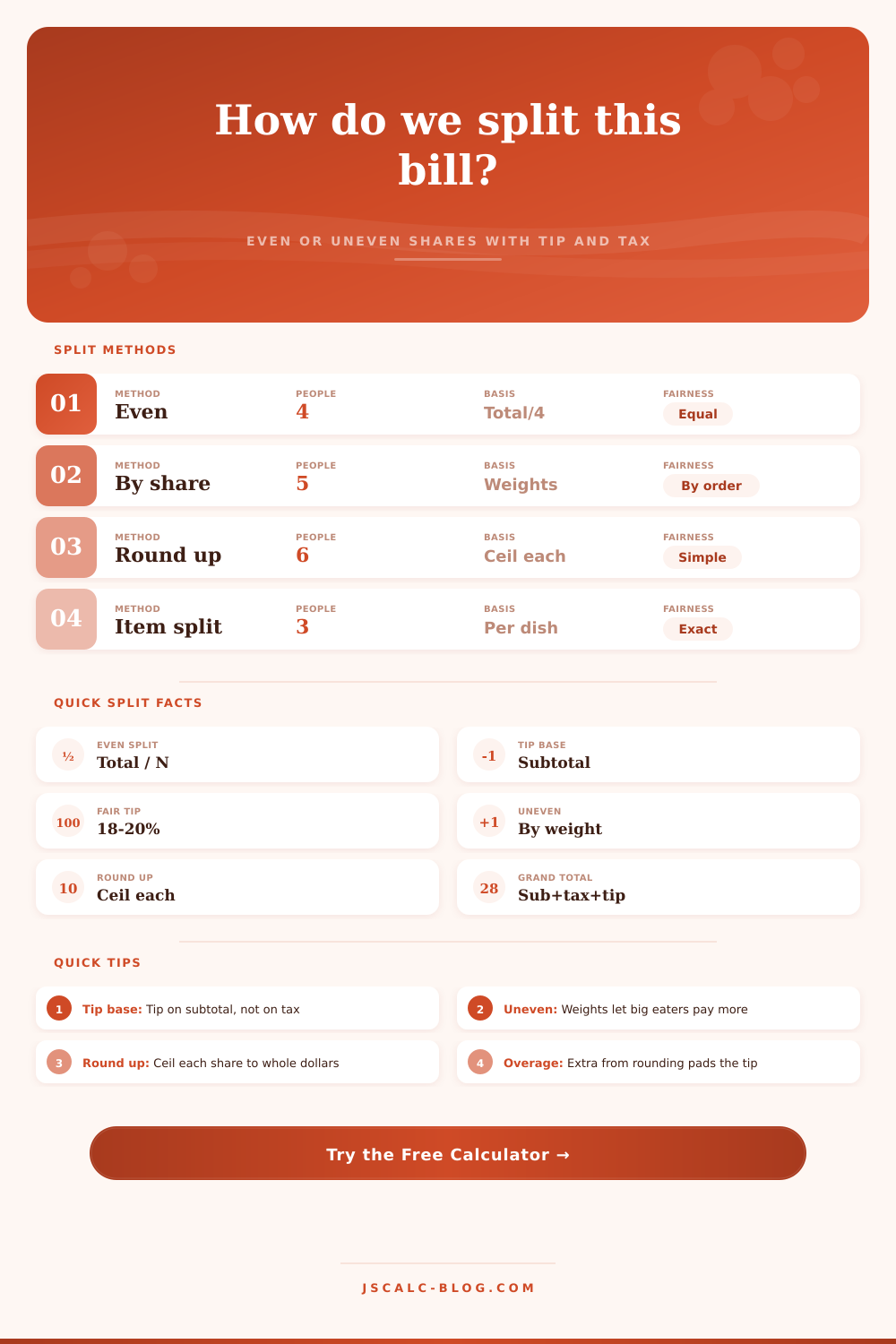
| Even split | Shared plates, similar orders | Grand total / N people | Simple but big eaters pay less |
| Uneven by weight | Mixed orders, some drank more | Total × weight / sum weights | Approximate fairness by share |
| By exact item | Very different orders | Each item to one person | Most fair, most bookkeeping |
| Round up each | Cash tables, quick math | Ceil each share to $1 or $5 | Overage pads the tip nicely |
| One payer covers | Reimbursed later | One pays, others send back | Track shares so nobody forgets |
💡Practical Splitting Tips
Splitting the bill can make people anxious. Who wants to be responsible? If you look around your table, one-half of your party will stare at the check; the other half will scroll on their phone. While it’s elementary-school arithmetic to add up a dozen number, the actual problem isn’t the math but the logistics of how to divvy up that total amount equitably. There are variables that don’t scale linearly; things like tax and tip, that increase the final figure by a random percentage (which only becomes clear when it comes time to write the check).
That’s where calculators like the one above come in. They makes an irregular exercise in mental maths understandable, something everyone can buy into without argument.
How to Split the Bill Fairly and Easily
Restaurant economics are designed so that people tip based off the subtotal. The guy who flipp’d your burger does not get the tax; that gets paid to the state or city. Yet if you’re adding both the tax and the tip to the bill, the total amount grow rapidly. Twenty percent sounds like a reasonable tip. That’s what it would of be in theory. What it becomes in practice is just one more thing to complicate an already-complicated transaction.
You can divide by four easily enough, if everyone is splitting the bill evenly. But maybe one of you had salads and water while someone else ate wine and three course. An even split will punish light eater and reward the heavier diner. It’s fine if you’re a group of close friends, sharing plates and not keeping score. It won’t work in mixed company where everyone has different expectations. That’s part of what makes the weight-splitting thing important; more then you might think.
If you want everyone to be charged according to what they ate, that seems like a fair approach, except you need to know how much everything cost in order to make it work. In practice, most people just guess. For example, they can tell by sight that a pasta dish costs about half as much as a steak. They can then round that up when assigning share weights (double the amount for the person who ordered steak?). That seems reasonable. That is fine. This isn’t forensic accounting. Just make sure no one thinks he got ripped off, and keep the whole experience pleasant.
You can solve another source of headache by rounding up each persons share to the next nearest dollar or fiver. If you’re paying in cash, handling pennies (and those pesky cents) is obnoxious, and you’ll often find it’s not even worth the hassle of exchanging change with your dining companions at the end of the night. Round up for fractions of a dollar. This will give you a tiny cushion that typicaly increases the tip amount. Waiters like you for this much more than they would ever say so.
These calculators also include a set of built-in reference tables that shows you exactly what your bill will look like immediately. No more guessing when it comes to calculating tips; see how different tip percentages impact the total cost-per-person right in front of you. Now you can choose: maybe eighteen percent is normal, but twenty-five percent would be justified if the service is really good. Suddenly, this isn’t some theoretical exercise anymore. It’s real, and it has weight behind it.
And by removing the confusion, it takes away the friction from the dinner table, we all get to see the same numbers so there’s no opportunity for any misunderstanding or shady math. Nobody gets pissed off, and the whole group can get back to finishing the night in peace.
Fairness vs. Generosity: This is the tricky dance of social dining. No one wants to be nickel-and-dimed by their friends, yet no one wants to pick up the entire tab. There’s a sweet spot in-between. Sometimes we need some digital help to find it, and sometimes we need to improve our skills through experience.
Know what your base price includes so you can make an informed decision when splitting the bill. Adjusting the splits based on relative weights may seem more fair, while splitting everything evenly may be easier. Regardless, coming to a mutual agreement beforehand will save you from the “uhh… ” moment after dessert. A dollar amount has no meaning until you give meaning to it for each person around the table. Consciously making this choice will leave everyone happy (and with their pockets intact).