Momentum Calculator
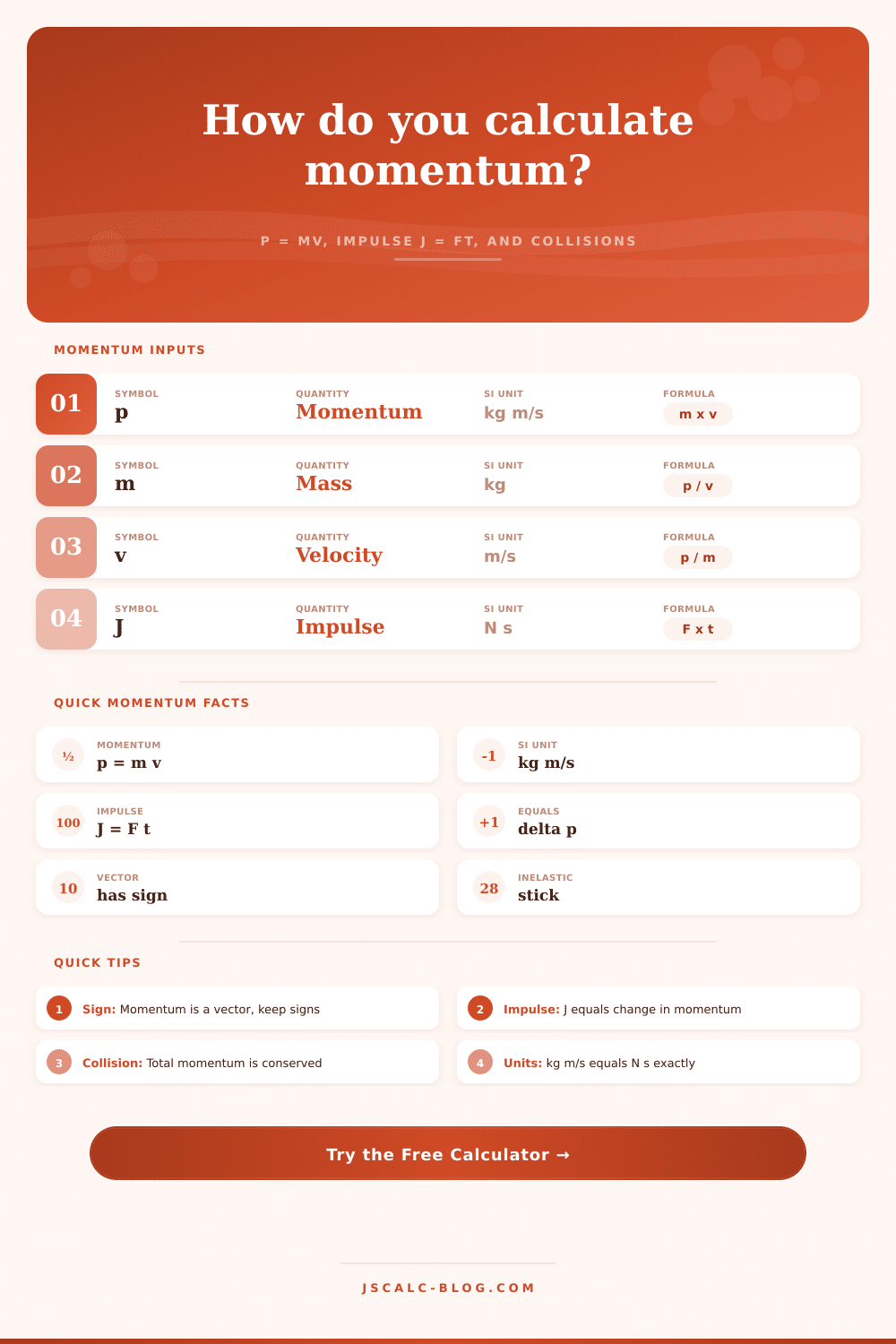
Solve linear momentum from p = mv, find impulse with J = Ft equal to the change in momentum, and model a perfectly inelastic collision where total momentum is conserved. Solve for mass, velocity, force, or time.
🎱Real Momentum Presets
📝Momentum Inputs
Momentum is a vector, so a negative velocity is allowed.
Used when solving for velocity or mass.
Final velocity is found from v0 + J / m.
Use a negative value for a head-on approach.
🔢Symbol Snapshot
📊Momentum of Common Objects
| Object | Mass | Typical Speed | Momentum p | Notes |
|---|---|---|---|---|
| Rifle bullet | 0.004 kg | 900 m/s | 3.6 kg m/s | Low mass, huge speed |
| Baseball pitch | 0.145 kg | 40 m/s | 5.8 kg m/s | Fastball off the mound |
| Sprinter | 75 kg | 10 m/s | 750 kg m/s | Top athlete stride |
| Motorcycle | 300 kg | 28 m/s | 8,400 kg m/s | Rider plus bike |
| Small car | 1,500 kg | 20 m/s | 30,000 kg m/s | City driving speed |
| Loaded truck | 18,000 kg | 25 m/s | 450,000 kg m/s | Highway freight |
💥Impulse and Force Reference
| Event | Change in p | Contact Time | Average Force | Why It Matters |
|---|---|---|---|---|
| Airbag stop | 15,000 kg m/s | 0.30 s | 50,000 N | Longer time lowers force |
| Bare dashboard | 15,000 kg m/s | 0.02 s | 750,000 N | Short time, brutal force |
| Catching a ball | 5.8 kg m/s | 0.10 s | 58 N | Give with the hands |
| Tennis serve | 4.3 kg m/s | 0.005 s | 860 N | Racket to ball impulse |
| Rocket burn | 200,000 kg m/s | 5.0 s | 40,000 N | Thrust equals F = J / t |
🔗Unit and Conversion Reference
| Quantity | SI Unit | Equivalent | Conversion Tip |
|---|---|---|---|
| Momentum p | kg m/s | N s exactly | 1 kg m/s = 1 N s |
| Impulse J | N s | kg m/s | Impulse equals change in p |
| Speed km/h | m/s | divide by 3.6 | 100 km/h = 27.78 m/s |
| Speed mph | m/s | × 0.44704 | 60 mph = 26.82 m/s |
| Mass grams | kg | divide by 1000 | 500 g = 0.5 kg |
🗂Collision Types Comparison
| Collision Type | Momentum | Kinetic Energy | Objects After | Restitution e | Everyday Example |
|---|---|---|---|---|---|
| Perfectly elastic | Conserved | Conserved | Bounce apart | e = 1 | Billiard balls |
| Nearly elastic | Conserved | Mostly kept | Bounce apart | e near 0.9 | Superball drop |
| Partly inelastic | Conserved | Some lost | Separate slower | 0 < e < 1 | Car fender tap |
| Perfectly inelastic | Conserved | Most lost | Stick together | e = 0 | Clay ball hits wall |
| Explosion | Conserved | Increases | Fly apart | not defined | Firework, recoil |
| Cars coupling | Conserved | Large loss | Move as one | e = 0 | Train cars link |
⚙Full Formula Breakdown
📋Reference Values
| Symbol | Meaning | Common Entry | Role in Result |
|---|---|---|---|
| m | Mass | 0.004 kg to 18,000 kg | Scales momentum directly |
| v | Velocity | –30 to 900 m/s | Sign sets the direction |
| F | Force | 1 N to 750,000 N | Drives impulse over time |
| t | Contact time | 0.005 s to 5 s | Longer time cuts the force |
| m2, v2 | Object 2 | Any mass, signed speed | Sets the shared velocity |
💡Practical Momentum Tips
Take, for instance, a slow-moving freight train on a railroad track. Now imagine a bullet flying quickly through the air. Naturaly, we might think that because the bullet travels so much faster, it must carry greater momentum. That’s true, but mass also plays a role here. Think of momentum as the combination of these two factor. Even if something is very light, traveling at a reckless pace can still produce same force as something heavy going at a modest clip.
Plug in your numbers into the calculator above and let it do the work for you. Instead of having to multiply and convert units, the momentum calculator will solve for whatever variable you don’t know. There’s nothing complicated about the formula at its heart. It’s easy enough to remember. And difficult enough to misuse if you don’t pay attention to directions/signs.
How to Use the Momentum Calculator
Momentum is a vector quantity. It possesses direction as well as magnitude. Two cars traveling toward each other in a head-on collision will has opposite signed velocities. You don’t just add ’em blindly. No, you subtract one from the other. Inputting negative numbers for your opposite direction entries does that for you automatically: the tool accounts for it. That’s the bit people mess up the first time trying to replicate these collisions themselves on paper.
Momentum is a state of being, while impulse is its transition through time: it’s the change in momentum divided by some interval of time. Traditionally, it’s written as Force times time. That’s the equation that tells you how an airbag saves lives in a crash. Your mass determines the impulse that has to be applied to bring your body to a halt, and the speed at which you’re traveling sets the initial conditions. If you can spread out that change across more time, then the peak force acting on you is much smaller. A pad or cushioning surface prolongs the contact time, that decreases the average force to something survivable. And it does so based off only Newton’s laws, because they work.
The calculator use a non-bouncy model for its default collision. This means that when two things collide they stick together. That’s good if you’re coupling train cars together or if you want to understand what happens during a rear-end collision. All kinetic energy isn’t lost, though it does go into deformation and heat. Total momentum will be conserved. Final common velocity is determined by their initial momentum plus the combined mass of the two objects. Restitution coefficients don’t come into play because you now has one object moving afterwards.
A table provided in the tool explains it well. It shows what happens in various collision scenarios: Will momentum be preserved? And will energy?
Next, we will look at what happens when you collide. If you know the total momentum but are missing one component, you need to solve for either mass or velocity. Imagine you’re an engineer figuring out how much mass was shot from a gun by measuring the recoil. Perhaps you are a physicist calculating the speed of an asteroid based off its gravitational pull. You can switch back and forth between solving for p, m, or v with ease thanks to the inputs in calculation mode. Just make sure you have units that match up before pressing the button. Putting in kilograms with grams or kilometers per hour with meters per second wouldn’t of resulted in anything sensible.
These relationships has more than book answers; they can be applied every day, whether it’s in sports, in designing safe products or for our own protection. When athletes land from a jump, they bend their knees, which increases the time they spend in contact with the ground. That means less impact force on their joints. The companies that make equipment for sports like basketball, tennis, baseball, etc., design balls and rackets to increase the impulse transferred so there is as much power as possible while minimizing injury.
Momentum matters for space missions not just when rocket stages separate in the vacuum of space, but also because every action has an equal and opposite reaction. What this really means is that total momentum can’t dissapears. Momentum teaches us to understand the connection between speed and heaviness, forcing us to think not only about speed but direction as well. Whether we’re thinking about how to design a safer car, or how a football tackle will work out, the principles are the same. Raw potential for impact is mass times velocity. How that energy feels? That’s force over time. Knowing the difference makes abstract physics a clear way to understand motion and collision in the physical world.