Dice Probability Calculator
Find the odds of rolling any sum with N dice of S sides. Get exactly, at least, at most, or between a target, plus the full sum distribution, ways count, expected value, and most likely roll from exact combinatorial math.
🎲Real Dice Presets
📝Dice Setup
One to twelve dice keeps the outcome space exact.
Used only when sides is set to custom.
Upper bound when query type is between.
Added to every roll, e.g. 2d6 + 3.
🔢Model Snapshot
📊Full Sum Distribution
| Sum | Ways | Probability | At Least | At Most |
|---|---|---|---|---|
| Enter your dice above to build the sum distribution. | ||||
🎯2d6 Canonical Odds
| Sum | Ways | Probability | Odds | Rolling Example |
|---|---|---|---|---|
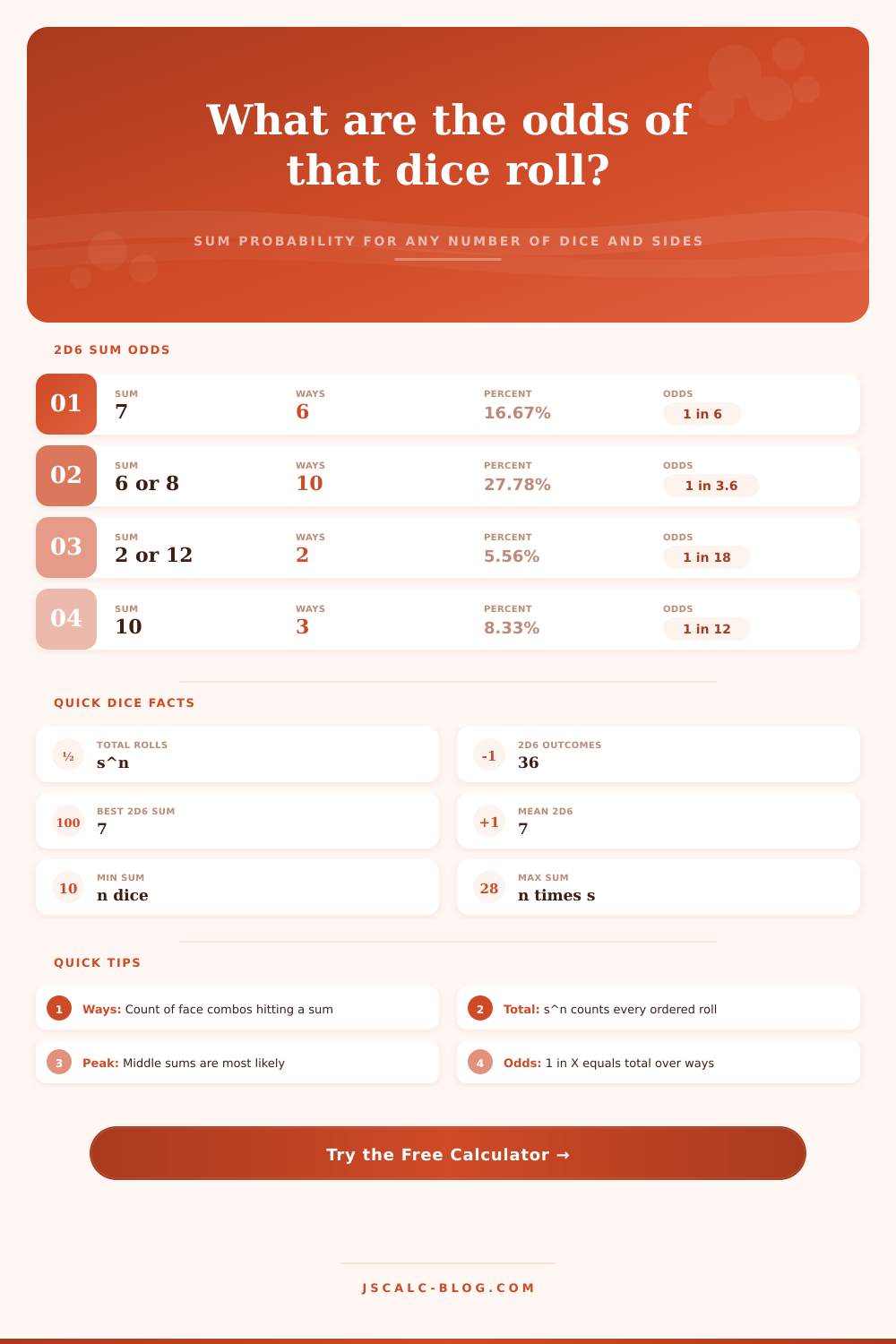
| 2 | 1 | 2.78% | 1 in 36 | 1+1 only (snake eyes) |
| 3 | 2 | 5.56% | 1 in 18 | 1+2, 2+1 |
| 4 | 3 | 8.33% | 1 in 12 | 1+3, 2+2, 3+1 |
| 5 | 4 | 11.11% | 1 in 9 | 1+4 up to 4+1 |
| 6 | 5 | 13.89% | 1 in 7.2 | 1+5 up to 5+1 |
| 7 | 6 | 16.67% | 1 in 6 | peak of the curve |
| 8 | 5 | 13.89% | 1 in 7.2 | 2+6 up to 6+2 |
| 9 | 4 | 11.11% | 1 in 9 | 3+6 up to 6+3 |
| 10 | 3 | 8.33% | 1 in 12 | 4+6, 5+5, 6+4 |
| 11 | 2 | 5.56% | 1 in 18 | 5+6, 6+5 |
| 12 | 1 | 2.78% | 1 in 36 | 6+6 only (boxcars) |
🎲Single Die Reference
| Die | Sides | Each Face | Mean | Variance |
|---|---|---|---|---|
| d4 | 4 | 25.00% | 2.5 | 1.25 |
| d6 | 6 | 16.67% | 3.5 | 2.92 |
| d8 | 8 | 12.50% | 4.5 | 5.25 |
| d10 | 10 | 10.00% | 5.5 | 8.25 |
| d12 | 12 | 8.33% | 6.5 | 11.92 |
| d20 | 20 | 5.00% | 10.5 | 33.25 |
🗂Common Roll Odds Grid
| Scenario | Dice | Query | Ways | Probability | Odds |
|---|---|---|---|---|---|
| Lucky seven | 2d6 | Sum = 7 | 6 / 36 | 16.67% | 1 in 6 |
| Snake eyes | 2d6 | Sum = 2 | 1 / 36 | 2.78% | 1 in 36 |
| Craps natural | 2d6 | 7 or 11 | 8 / 36 | 22.22% | 1 in 4.5 |
| Point of six | 2d6 | Sum = 6 | 5 / 36 | 13.89% | 1 in 7.2 |
| Beat a 14 DC | 1d20 | Sum ≥ 15 | 6 / 20 | 30.00% | 1 in 3.33 |
| Natural twenty | 1d20 | Sum = 20 | 1 / 20 | 5.00% | 1 in 20 |
| Fireball average | 3d6 | Sum ≥ 11 | 108 / 216 | 50.00% | 1 in 2 |
| Big damage | 2d8 | Sum ≥ 10 | 28 / 64 | 43.75% | 1 in 2.29 |
⚙Full Formula Breakdown
📋Reference Notes
| Concept | Meaning | How It Is Used | Effect On Odds |
|---|---|---|---|
| Number of dice | How many are rolled | Sets exponent in s^n | More dice, taller bell curve |
| Sides per die | Faces on each die | Sets the base s | More sides, wider range |
| Target sum | The value you want | Picks the ways bucket | Middle sums are likeliest |
| Query type | Exact or a range | Adds ways across sums | Ranges raise the probability |
| Modifier | Flat bonus or penalty | Shifts the sum window | Slides odds, not the shape |
💡Practical Dice Tips
When playing board games you’re almost at the end and one die roll will win it for you. The dice is random and you hope you can make the odds work in your favor. Gut instinct tells most people what they think is right, but humans are naturaly wired to look for patterns that do not exist in the physical world.
The dice tool takes away math work from your brain. Simply put in the dice layout and let calculator do the rest. It’s all about managing risk. Certainty isn’t something you’ll find.
How Dice Probabilities Work
The key idea is called combinatorics, just painstakingly counting. If you roll two, six-sided dice then there are 36 possibilities (six choices on the first die times six choices on the second), with no overlap between them. You tend to assume that if I roll a two, it’s just as likely as if I rolled a seven. You’re wrong. There are six ways to get a seven: two + five; three + four; four + three; etc. And there’s only one way to get a two: one + one. Exactly this probability comes out of the calculator.
What it tells us is that center of the curve is where you’re most likely to see things. Most rolls won’t scatter around wildly, instead they’ll gather around the mean. The more dice you have rolling around, the greater this impact. With three dice your chances of getting an incredibly high or low roll are greatly lowered. There’s a solid area in the middle.
Multiple dice for damage and character generation (and many other things) in a lot of tabletop games does this. They dampen down variance. It helps designers predict what happens and prevents a single lucky roll from derailing an entire campaign.
In the tool, you can modify the number of sides to see how various types of dice performs. For example, a twenty-sided die has an equal chance of any result, making it fair but less tense because the results is so consistent. These small design details affect the pacing.
Then there’s modifiers which most people gets wrong. A flat +2 doesn’t just increase your odds by a set amount; it shifts the entire range of possible outcomes relative to your target number. If I’m rolling for a fifteen on a twenty sided die with a +2 on my roll then what I really need is a thirteen on the unmodified die. It matters because cumulative distribution function isn’t linear and it changes the odds of success dramaticly. That allow you to make decisions about going for a flat bonus versus going up in dice. Dice rely on luck to balance everything out, while bonuses change how much you need to succeed. Both are worth having each serving a different strategic goal.
Every die roll can go either way regardless of what you know about probabilities. There’s enough random chance, even built into the manufacturing process, to make every roll unpredictable. But knowing things gives you new tools to play with. It keeps you from pursuing false hope on a losing bet just because it feels lucky. It alerts you when taking a risk might pay off because the potential reward is more different than the potential cost. And while there are plenty of edge cases, table on the page spells all of the obvious ones out for you.
Without needing to run through an equation each time, you have a simple way to gauge your chances. You stop worrying over whether or not you’re just unlucky. Instead you find yourself viewing the game in terms of probabilities that can be managed. That’s worth more than any one critical hit should of had.