Down Payment Savings Timeline Calculator
See exactly how many months it takes to save your down payment goal with regular monthly deposits plus interest growth at your savings APY, get a target calendar date, and back-solve the monthly amount you need to hit a deadline.
🏠Choose a Mode
🎯Real Saver Scenarios
📝Savings Inputs
Purchase price of the home you are targeting.
Percent of price to put down, such as 3, 10, or 20.
Optional. Extra percent of price to also save, 0 to skip.
Money you already have set aside for this goal (PV).
Amount you add every month (D). Used in Timeline mode.
Annual rate on the account. 0 means no interest growth.
Back-solve mode: months until you want the goal ready.
When deposits begin, used for the target calendar date.
🔢Formula Snapshot
💵Down Payment Goal by Price and Percent
| Home Price | 3% Down | 10% Down | 20% Down |
|---|---|---|---|
| $200,000 | $6,000 | $20,000 | $40,000 |
| $300,000 | $9,000 | $30,000 | $60,000 |
| $400,000 | $12,000 | $40,000 | $80,000 |
| $500,000 | $15,000 | $50,000 | $100,000 |
| $600,000 | $18,000 | $60,000 | $120,000 |
| $750,000 | $22,500 | $75,000 | $150,000 |
| $1,000,000 | $30,000 | $100,000 | $200,000 |
📊Months to Save by Monthly Deposit
| Monthly Deposit | $40k Goal | $60k Goal | $80k Goal | $100k Goal |
|---|---|---|---|---|
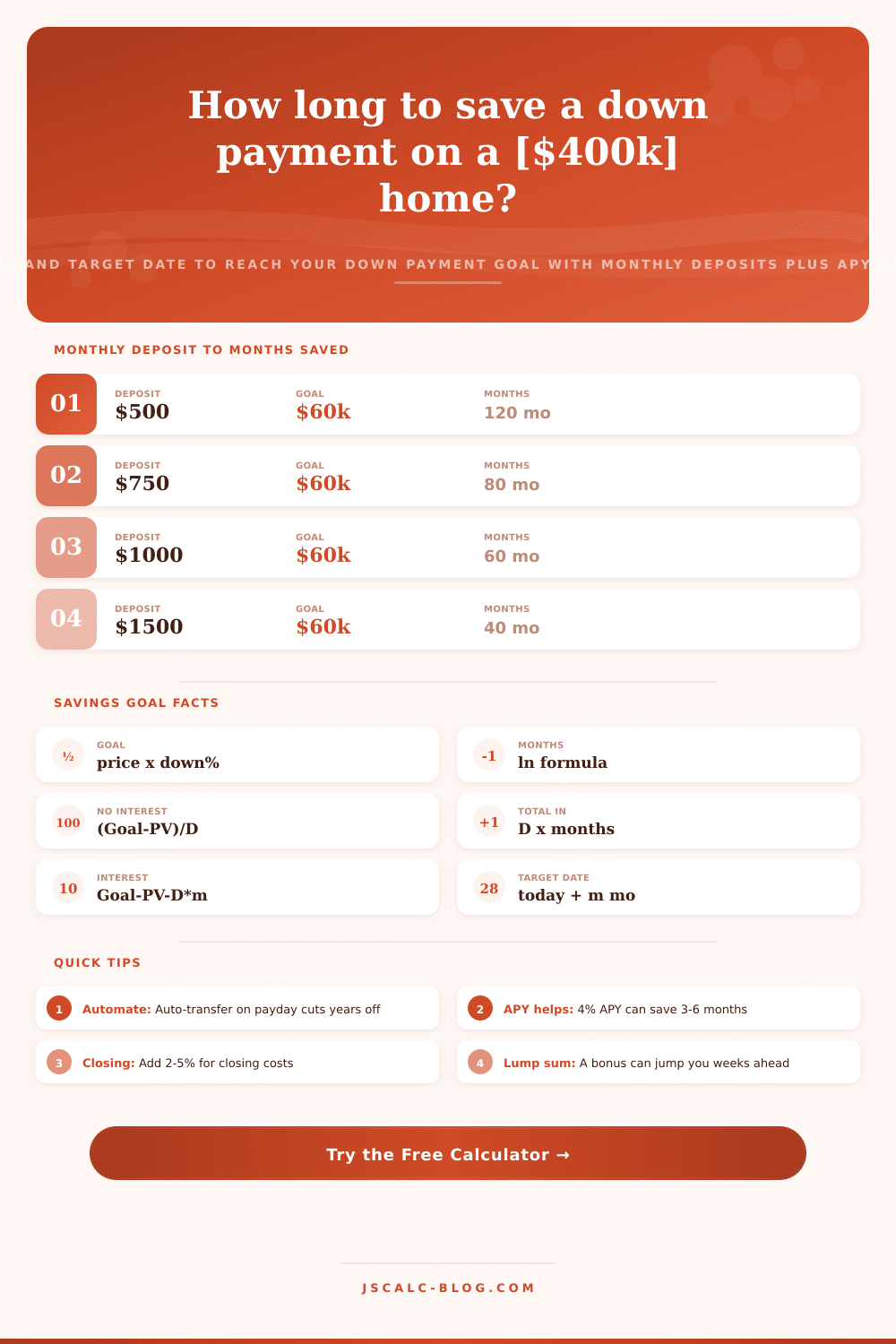
| $500 / mo | 80 mo | 120 mo | 160 mo | 200 mo |
| $750 / mo | 54 mo | 80 mo | 107 mo | 134 mo |
| $1,000 / mo | 40 mo | 60 mo | 80 mo | 100 mo |
| $1,500 / mo | 27 mo | 40 mo | 54 mo | 67 mo |
| $2,000 / mo | 20 mo | 30 mo | 40 mo | 50 mo |
| $2,500 / mo | 16 mo | 24 mo | 32 mo | 40 mo |
| $3,000 / mo | 14 mo | 20 mo | 27 mo | 34 mo |
Assumes 0% APY and no starting balance, so months = goal divided by deposit, rounded up.
💵Savings Goal Quick Facts
| Item | Formula | Meaning |
|---|---|---|
| Goal amount | price × down% (+ closing%) | Cash you must have on hand |
| Monthly rate i | APY / 12 / 100 | Interest applied each month |
| Future value | PV(1+i)^m + D((1+i)^m-1)/i | Balance after m months |
| Months (i>0) | ln((Goal×i+D)/(PV×i+D)) / ln(1+i) | Time to hit the goal |
| Months (i=0) | (Goal - PV) / D | Simple case, no interest |
| Total contributed | D × m | Sum of your deposits |
| Interest earned | Goal - PV - D × m | Growth the account added |
🗃Monthly Deposit Comparison Grid
| Monthly Deposit | Goal | Start Balance | APY | Months | Target Date |
|---|---|---|---|---|---|
| $500 / mo | $60,000 | $0 | 4% | 106 mo | May 2035 |
| $750 / mo | $60,000 | $0 | 4% | 74 mo | Sep 2032 |
| $1,000 / mo | $60,000 | $0 | 4% | 57 mo | Apr 2031 |
| $1,000 / mo | $60,000 | $10,000 | 4% | 47 mo | Jun 2030 |
| $1,500 / mo | $60,000 | $0 | 4% | 39 mo | Oct 2029 |
| $1,500 / mo | $80,000 | $0 | 4% | 51 mo | Oct 2030 |
| $2,000 / mo | $80,000 | $20,000 | 4% | 30 mo | Jan 2029 |
| $2,000 / mo | $80,000 | $0 | 0% | 40 mo | Nov 2029 |
| $2,500 / mo | $100,000 | $0 | 4% | 37 mo | Aug 2029 |
| $3,000 / mo | $100,000 | $25,000 | 4% | 25 mo | Aug 2028 |
Target dates shown from a July 2026 start for illustration. Your live result uses today and the start month you pick.
⚙Formula Breakdown
💡Practical Savings Tips
A house isn’t a home, it’s a decision. Specifically, it’s a decision regarding whether you’re willing to cough up cash. Most people realize that buying a house require a downpayment. However, not many are sure of how long it will actualy take them to save for that down payment. The difference between “that closing table check” and whatever sits in your bank account feels like an abstract number. It stays an abstract number until you convert it into time.
From there, you begin measuring progress in terms of months different than dollars, and that’s when the Down Payment Savings Timeline Calculator over at JSCalc-Blog.com kicks in. It transforms an unclear financial hill into a series of doable monthly moves, illustrating exactly when (given your interest rate + savings behavior) your goal becomes achievable.
How Long It Takes to Save for a House Down Payment
Your goal amount. This is the starting point of all timelines. And no: It’s not twenty percent of list price. Closing costs are a fact of life. Twenty percent is fine and dandy. Until you realize that you’re looking at eighty thousand bucks when you buy a four-hundred-thousand-dollar house. Add three percent in closing fees (typical), and suddenly you’ve got ninety-two thousand as your target. Twelve thousand might seem minor in the grand scheme of real estate. But that’s several months worth of hard-core saving.
Establishing your attainable number up front is crucial. Everything else hinges on this figure. Shortchange yourself on the goal, and you’ll shortchange yourself on the timeline. From there, it’s a matter of two opposing forces. How much do you save each month? And how much interest will your money earn? The latter is where things get interesting (read: nonlinear), what you’re doing isn’t simply adding to a growing bank balance. You’re also gaining from the compounding power of your accounts APY.
If you have an online savings account with four-to-five percent yield (a.k.a., high!), it doesn’t just shield you from inflation, it accelerates your progress. By translating the annual rate into a monthly value, then applying it to your initial balance AND all subsequent deposits, tool helps shorten your timeline. Money added to the pot in December will earn barely anything. But money added in January will earn a full 11 months worth of interest. That snowball becomes bigger faster then most people imagine.
When you’re dealing with interest, you solve for the number of months using logarithms, neat in the browser, messy to perform by hand. The equation basically asks: How many times must I compound my balance to reach the goal? When there’s no interest, it’s as easy as division. With interest, the curve gets bent slightly in your favor.
Because you can’t close on a house mid-month, it rounds your duration upward to a whole number of months. And along with that duration, you’ll see a target calendar date. That’s often more motivating than a raw number. Rather than saying “thirty-six months away,” you say “October 2028.” It gives you something concrete to visualize. It gives you a finish line.
Occasionally the date is set. The variable is your monthly budget. Your lease expires in two years. You’d prefer a mortgage purchase before interest rises any higher. Flip it into back-solve mode: Rather than figuring out how long, figure out how much you need to save per month to reach that date. That way you avoid the common mistake of overestimating your affordability. You force yourself to look at your paycheck and trace exactly where the cash originates. Can you sustain this? ensuring the plan is sustainable before you commit to it. If not, don’t bother.
The reference tables below offer quick sanity checks without requiring any input. These illustrate the effects of varying your deposit level across typical goals: 40K and 60K. For example, if you’re aiming for $80K and you increase your monthly deposit from $1k to $1.5k, you’ll save about two years worth of time. That’s some serious life back in your pocket. Instantly load common scenarios into the app with its presets, e.g., saving for a minimum-down-payment starter home vs. Shooting for 20% so you don’t need private mortgage insurance.
By having the transfer happen immediately following payday (and automating it!), we’re removing the temptation to spend it elsewhere. By parking it in an account that actualy pays us interest, our money is working for us as it sits there waiting on us. The calculator doesn’t buy the house for you… But it lays out the path clearly enough that you can see exactly what step comes next. It shifts the worry from “anxiety” to “arithmetic,” and converts the homeowner’s dream into a doable schedule.
You should of checked your budget first.