Closing Cost Estimator
Itemize every buyer closing cost - loan origination, title search and insurance, transfer taxes, appraisal, credit and recording fees, plus prepaid interest and escrow reserves - then see the total in dollars, as a percent of the home price, and as a percent of the loan.
🎯Real Closing Scenarios
📝Closing Cost Inputs
Contract sale price of the property.
Financed amount. Down payment = price minus loan.
Lender charge, usually 0.5 to 1 percent of the loan.
Lender and owner title policy, about 0.5 to 1 percent.
Local deed and mortgage tax rate on the price.
Used for prepaid interest to month-end.
Daily interest times days left in the closing month.
Full-year bill; escrow reserves a few months.
Months of tax collected into escrow at closing.
First-year premium plus escrow reserve.
Extra months of insurance held in escrow.
Appraisal, credit report, survey, recording, attorney.
🔢Cost Snapshot
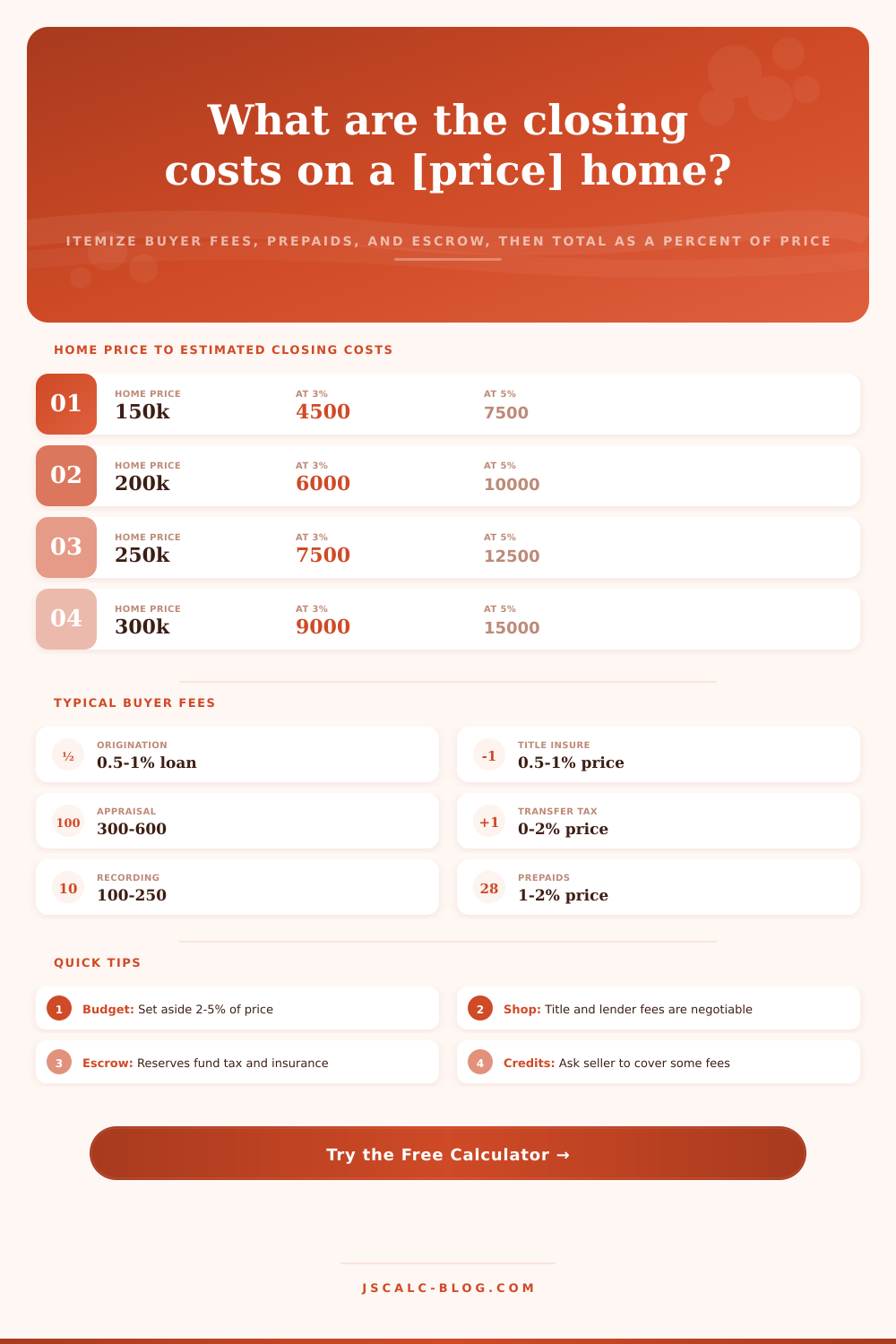
📋Home Price to Closing Cost Range
| Home Price | At 2% | At 3% | At 4% | At 5% |
|---|---|---|---|---|
| $150,000 | $3,000 | $4,500 | $6,000 | $7,500 |
| $200,000 | $4,000 | $6,000 | $8,000 | $10,000 |
| $250,000 | $5,000 | $7,500 | $10,000 | $12,500 |
| $300,000 | $6,000 | $9,000 | $12,000 | $15,000 |
| $400,000 | $8,000 | $12,000 | $16,000 | $20,000 |
| $500,000 | $10,000 | $15,000 | $20,000 | $25,000 |
| $600,000 | $12,000 | $18,000 | $24,000 | $30,000 |
| $750,000 | $15,000 | $22,500 | $30,000 | $37,500 |
💵Typical Buyer Fee Ranges
| Fee | Basis | Typical Range | On $300k / $270k Loan |
|---|---|---|---|
| Loan origination | % of loan | 0.5 - 1.0% | $1,350 - $2,700 |
| Appraisal | Flat | $300 - $600 | ~$500 |
| Credit report | Flat | $30 - $75 | ~$50 |
| Title search + insurance | % of price | 0.5 - 1.0% | $1,500 - $3,000 |
| Recording fees | Flat | $100 - $250 | ~$125 |
| Survey | Flat | $300 - $500 | ~$400 |
| Transfer / recording tax | % of price | 0 - 2.0% | $0 - $6,000 |
| Prepaid interest | Daily x days | 0 - 30 days | $0 - $1,450 |
| Escrow reserves | Months tax + ins | 2 - 8 months | $1,800 - $2,400 |
📊Escrow Reserve Guide
| Escrow Item | Annual Bill | Months Held | Reserve Collected |
|---|---|---|---|
| Property tax | $2,400 | 6 | $1,200 |
| Property tax | $3,600 | 6 | $1,800 |
| Property tax | $6,000 | 4 | $2,000 |
| Homeowners insurance | $1,200 | 2 | $200 |
| Homeowners insurance | $1,400 | 3 | $350 |
| Homeowners insurance | $2,000 | 2 | $333 |
🗃Closing Cost Comparison Grid
| Scenario | Price | Loan | Lender+Title | Prepaids+Escrow | Total Costs | % of Price |
|---|---|---|---|---|---|---|
| $300k Conventional | $300,000 | $270,000 | $4,845 | $5,004 | $9,849 | 3.28% |
| $400k 1% Origination | $400,000 | $380,000 | $9,275 | $6,058 | $15,333 | 3.83% |
| High-Tax $500k | $500,000 | $450,000 | $16,325 | $7,341 | $23,666 | 4.73% |
| $250k FHA | $250,000 | $241,250 | $4,081 | $4,187 | $8,268 | 3.31% |
| Cash-Lite Closing | $300,000 | $240,000 | $3,720 | $2,808 | $6,528 | 2.18% |
| $180k Starter | $180,000 | $174,600 | $2,838 | $3,240 | $6,078 | 3.38% |
| $750k Jumbo | $750,000 | $600,000 | $12,850 | $7,363 | $20,213 | 2.70% |
| $320k VA No Fee | $320,000 | $320,000 | $3,995 | $4,912 | $8,907 | 2.78% |
⚙Formula Breakdown
💡Buyer Closing Cost Tips
Fees are most stressful part of buying a home. You shouldn’t go to closing table with just a general idea of what fees will be. The last thing you want is to come up short and scramble for cash while you’re making your down payment. Everyone’s heard the “set aside 2-5% of house price” rule of thumb for closing costs, but that’s such a broad range it could conceal a few thousand dollars in surprise fees.
The estimator break that percentage into real numbers, letting you see precisely where your hard-earned money is going instead of simply gaping at some vague number on your Loan Estimate. It splits out prepaids, reserves and one-time fees, the latter of which are the biggest factor in how you’ll prepare your liquidity. The “closing cost” is not one number, it’s an entire stack of line items, each of which make perfect sense on its own.
How to Plan Your Home Closing Costs
There’s the part that depends on size of the loan (the origination fee, paid to the lender for working on your mortgage). There’s the part that depend on the sale price (transfer taxes and title insurance). And then there’s flat fees for stuff like credit reports and appraisal costs. To account for all this math, the tool prompts users to enter their loan amount and purchase price upfront.
That’s important, because the bigger the downpayment, the lower your loan balance will be, meaning you’ll pay less in interest during the first month, plus a smaller origination fee. You’ll see a little less in escrow reserves too (some tax payments are based off property value), although that varies from place to place.
Folks get tripped up by the second half of their closing cost because, technically; it’s no such thing. It’s money you collect upfront to pay for obligations you’ll face shortly after taking possession: prepaids and escrow reserves. Prepaid interest is money paid upfront to cover the portion of the month between your closing day and end of the month. Close on the first? You owe nearly zero dollars in interest upfront. Close on the fifteenth? You’re looking at about half a month. Use the calculator to adjust for number of days left until the end of the month.
Escrow reserves work the same way, only they’re earmarked for property taxes and homeowners insurance. Because lenders want those bills covered, they demand that these funds be held in an account where they can write checks when time comes. You owe $3,600 in taxes this year and the bank requires six months of reserves: They collect $1,800 from you at closing. That’s your money, sure. But it’s money that you would of spend on your home anyway. You’re not paying some mysterious person or institution; you’re simply depositing it into an escrow account.
The inputs will help you identify areas you can negotiate. There’s a lot of wiggle room with certain third-party charges and lender fees, while others like transfer taxes and title insurance tend to be set by either market rates or law. You’ll often save hundreds by shopping around for title companies. Another popular strategy is asking the seller for a credit, which is more likely if it’s a balanced market. In those cases, sellers may agree to contribute up to three or six percent of the purchase price towards your closing costs, that goes straight into offsetting amount of cash you’re required to come up with at closing.
The tool’s presets show how various scenarios work out different. A three-hundred-thousand-dollar home with a conventional loan differs significantly from a two-hundred-fifty-thousand-dollar home with an FHA loan, largely because of the way mortgage insurance premiums and upfront fees is structured. To help you compare, the page includes a handy reference table with the average range on those fees. So if your lender’s asking for an origination fee of two percent while everyone else is at one percent, now you know, you’ve got some negotiating power. You have leverage to ask for a reduction or a lower rate.
Closing just before the end of the month is a quick-and-easy way to reduce size of that prepaid interest line. It is a small thing, but it is real money that ends up in your pocket, not the bank’s.
This tool cuts the guessing game out of one of the largest financial transactions you’ll ever undertake, breaking each fee down, from escrow reserves all the way back to origination. See it as a percentage (of the loan and the price), and see it as a hard-dollar figure. That level of clarity makes what should be a stressful unknown into something you can manage within your budget.
Actually, it’s moddern looking tool that helps with the furnitures too. You should of checked this earlier! It dissapears most of the stress.