Buyer Cash to Close Calculator
See exactly how much money you must wire to closing. This tool adds your down payment, total closing costs, and prepaid escrow reserves, then subtracts your earnest money deposit, seller concessions, and lender credits to reveal the true cash to close, its share of the price, and the reserves left in your savings afterward.
🎯Real Closing Scenarios
📝Your Purchase and Credits
Contract price of the home you are buying.
Percent of price paid from your own funds.
Lender, title, and third-party fees. Often 2-5% of price.
Prepaid interest, taxes, and homeowners insurance set aside.
Deposit already in escrow. Credited back to your total.
Seller credit toward your closing costs and prepaids.
Credit from a higher rate that offsets closing costs.
Gift funds or DPA program money applied to your total.
Cash available now, used to show reserves left after closing.
Full payment used to express reserves in months.
🔢Cash to Close Snapshot
📋Down Payment by Price and Percent
| Purchase Price | Down % | Down Payment | Loan Amount |
|---|---|---|---|
| $250,000 | 3.5% | $8,750 | $241,250 |
| $300,000 | 5% | $15,000 | $285,000 |
| $350,000 | 10% | $35,000 | $315,000 |
| $400,000 | 20% | $80,000 | $320,000 |
| $450,000 | 20% | $90,000 | $360,000 |
| $500,000 | 10% | $50,000 | $450,000 |
| $600,000 | 20% | $120,000 | $480,000 |
| $700,000 | 20% | $140,000 | $560,000 |
📊Typical Closing Cost Ranges
| Cost Group | Low | High | Paid To | Notes |
|---|---|---|---|---|
| Loan origination | 0.5% | 1% loan | Lender | May be a flat fee |
| Appraisal | $450 | $750 | Appraiser | Often paid upfront |
| Title and escrow | $1,200 | $3,500 | Title company | Varies by state |
| Lender title policy | 0.3% | 0.6% loan | Title company | Protects the lender |
| Recording and transfer | $100 | 2% price | County or city | Transfer tax varies |
| Prepaid interest | 0 days | 30 days | Lender | Depends on close date |
| Escrow reserves | 2 months | 6 months | Escrow account | Taxes and insurance |
🧾Line Item to Cash Comparison Grid
| Line Item | Category | Example Amount | Effect on Cash | Adds or Subtracts | Who Sets It |
|---|---|---|---|---|---|
| Down payment | Equity | $80,000 | +$80,000 | Adds | You and loan program |
| Closing costs | Fees | $9,000 | +$9,000 | Adds | Lender and title |
| Prepaid escrow | Reserves | $4,200 | +$4,200 | Adds | Lender |
| Earnest money | Deposit | $8,000 | -$8,000 | Subtracts | You at offer |
| Seller concession | Credit | $6,000 | -$6,000 | Subtracts | Seller negotiation |
| Lender credit | Credit | $2,500 | -$2,500 | Subtracts | Rate choice |
| Down payment gift | Assistance | $5,000 | -$5,000 | Subtracts | Donor or program |
| Cash to close | Net total | $85,900 | =$85,900 | Result | All of the above |
💰Earnest and Seller Credit Impact
| Price | 1% Earnest | 3% Seller Credit | Combined Reduction |
|---|---|---|---|
| $250,000 | $2,500 | $7,500 | $10,000 |
| $300,000 | $3,000 | $9,000 | $12,000 |
| $350,000 | $3,500 | $10,500 | $14,000 |
| $400,000 | $4,000 | $12,000 | $16,000 |
| $500,000 | $5,000 | $15,000 | $20,000 |
| $700,000 | $7,000 | $21,000 | $28,000 |
⚙Formula Breakdown
💡Cash to Close Tips
The buyer cash to close calculator at JSCalc-Blog.com will tell you exactly how much money you need to take to closing table. There are a lot of numbers on the loan estimate, but there’s only one number that matters for your bank account: The net total. That’s not just your down payment. That’s not just your closing costs. Cash to close isn’t anything except everything you owe, minus everything they’ve paid or credited to you. This tool will net it all out into one clear number.
It displays what percent of the price it represent and how much money you’ll have remaining in savings by the time those keys is in your hand. There were several subtractions and three additions. These are your total closing costs. These are your total pre-paid escrow items. This is your down payment. The gross funds required equals the total closing costs, plus the total escrow items paid in advance, plus the down payment.
How Much Cash You Need to Close Your House
Buyers really save money on the subtraction side. Escrow takes your earnest money deposit and holds it from Day 1. It’s credited directly back toward your total. Up to program limits, seller credits cuts your out-of-pocket costs dollar-for-dollar. Closing costs is offset by a lender credit in exchange for taking a slightly higher interest rate. Assistance programs or family gifts also help shrink the amount of cash you have to personally wire. All four of those come off the gross funds, and that’s what shows up as your actual cash to close.
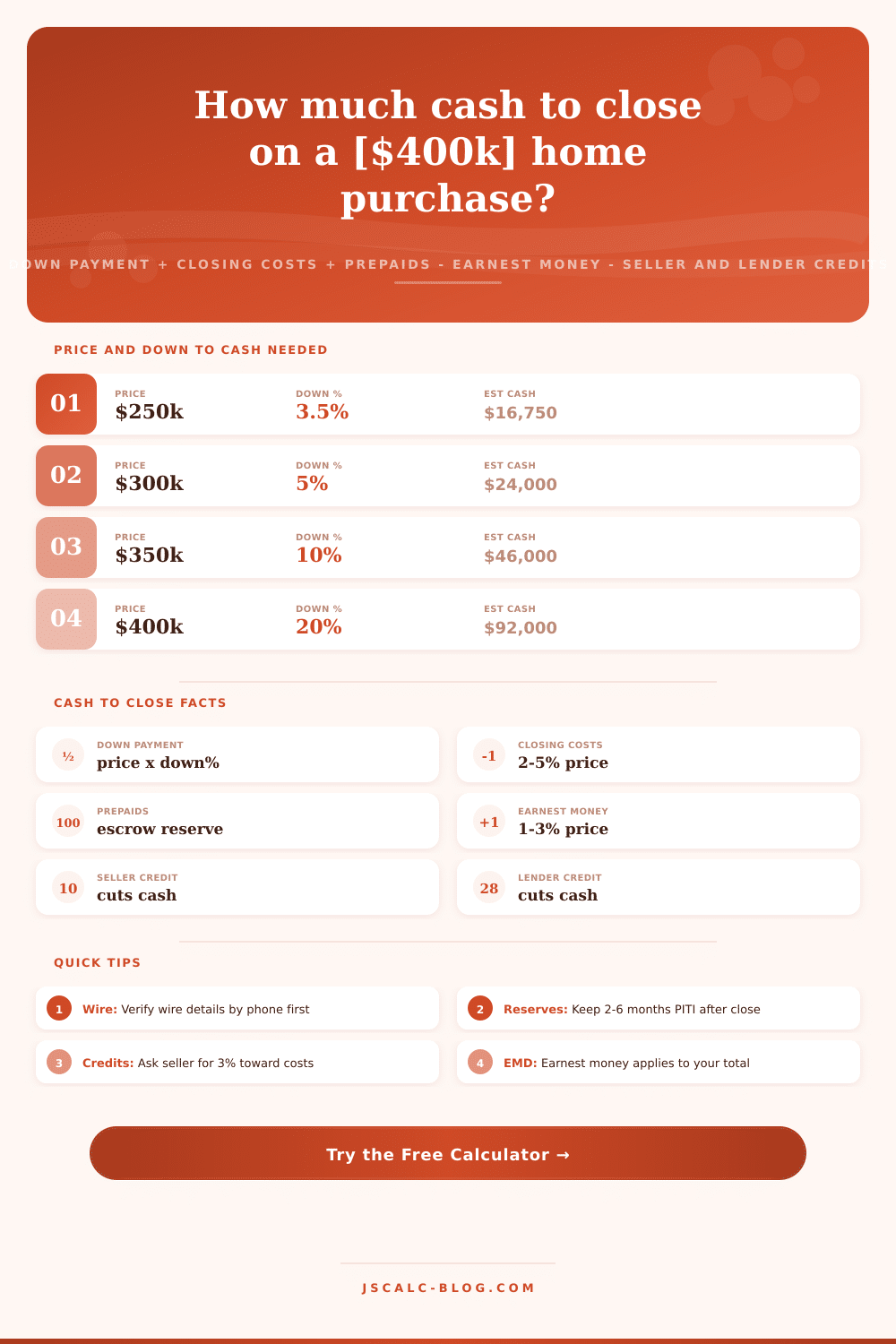
That’s the part they get wrong. They see the down payment and ignore the credits. Once you lay that out, the math is simple: Down Payment + Closing Costs + Prepaid Escrow, Earnest Money; Seller Concessions, Lender Credits, Gift/Assistance = Cash to Close
Let’s say you purchase a $400k house with 20% down, and you have no lender credits, seller concessions or gifts, nor do you want one. So your down payment would of $80k, plus $9k in closing costs, and $4,200 in prepaids, which totals $93,200 in gross funds. But you already put $8k in earnest money down, so your Cash to Close reduces to $85,200. You’ll notice the tool does that swap on the fly as well, so you can watch it change.
Here are four cards that summarize each scenario: The 1st card shows the Total Cash to Close. What you wire to escrow. 2nd card: isolates the down payment to show how much of the total is equity versus fees. Fees). The 3rd card covers Closing Costs and Prepaids. Combined, these make up the “transaction expense” layer. 4th card: Total reduction from earnest money and all credits. You can see that a little concession here… and another there… can add up quick. It shows the value of good negotiating.
You can compare deals of different sizes by using “expressing cash to close” as a percentage of the purchase price. Usually if you put down 20% on a conventional purchase it comes to somewhere between 21-24% including prepaids and closing costs. If you do an FHA purchase with a low down payment, you may only need 5-8% of the price in cash. As you change your inputs, you’ll see that percentage move, which will teach you about the impact of every factor on what you need in the bank.
Remember: Lenders want some reserves left over when you close, but many people barely have enough cash on hand for closing; and promptly forget about it! With this calculator, enter your present liquid savings, and it will deduct your cash to close, revealing how much reserve you’ll still have. That’s expressed as a number of full payments, a “cushion” of two to six months (or whatever) is what most people aim for post-closing. When this calculator displays only a fraction of a month of reserves remaining, it shows time to negotiate additional credits or wait until savings grow back.
With preset scenarios, you can walk through real-world closings and witness how the numbers play out. Load up a scenario. Tweak one parameter. Try a what-if case. This is why you can walk into a conversation with the lender knowing your numbers. There are tons of moving parts in the gap between when you get an accepted offer and close the deal. If you underestimate one prepaid or overlook one credit, you can be off by thousands.
This tool combines all the downpayment costs and prepaids against the gift funds, seller and lender credits, and your earnest money. You start with a preset, fill in the contract specifics, run the breakdown, and read the cards. This ensures the amount you write a check for on closing day matches the amount you planned to write.
It’s really simple. Bring just enough cash to close, while leaving enough behind to sleep well at night.