Down Payment Percentage Calculator
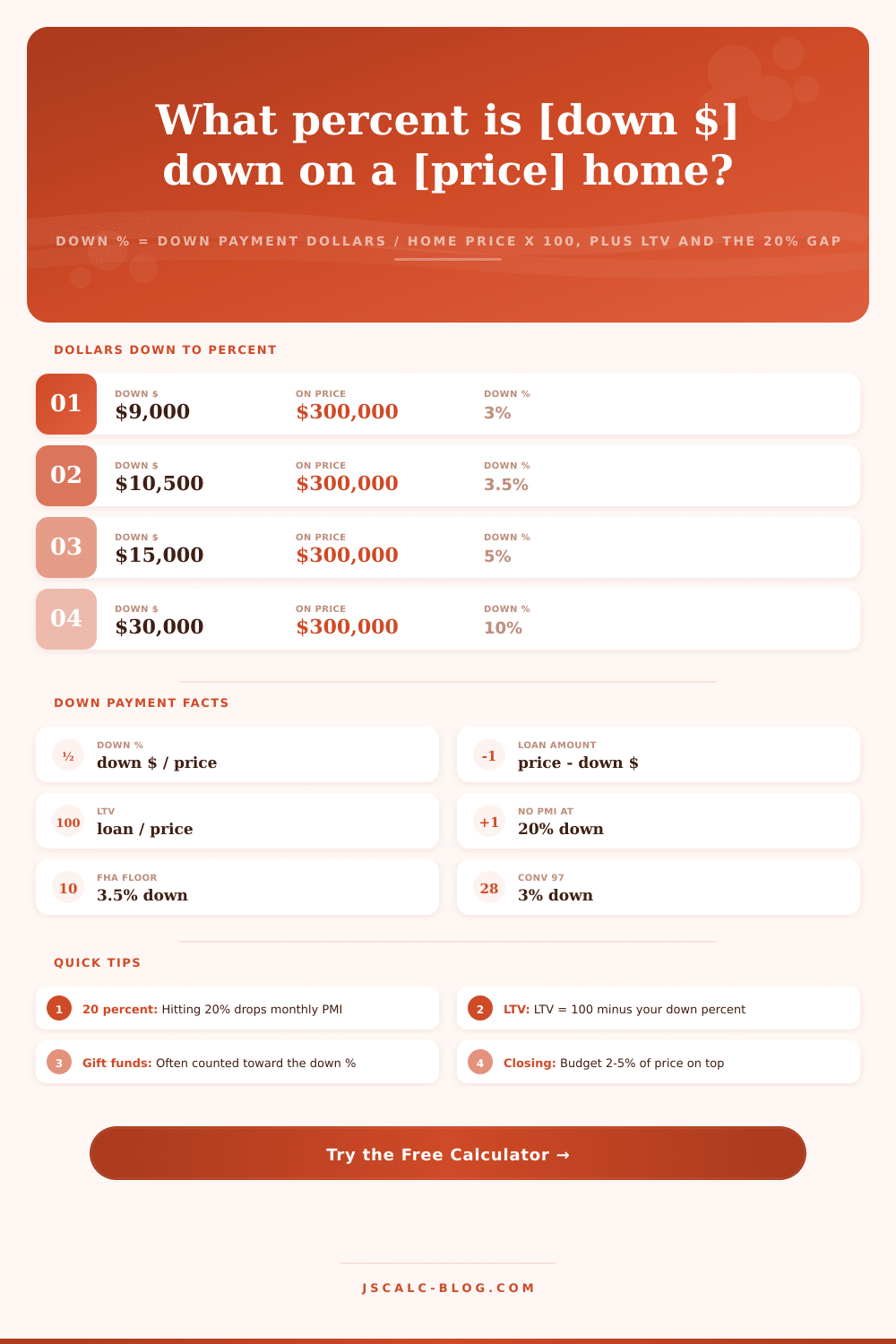
Enter a dollar down payment and a home price to see what percent you are putting down, your resulting loan-to-value ratio, whether PMI is required, and the extra cash it would take to reach the 20 percent no-PMI threshold. The core formula is down percent equals down payment dollars divided by home price times 100.
🎯Real Down Payment Scenarios
📝Your Numbers
The agreed sale price of the property.
Cash you put toward price, before closing costs.
Portion of the down payment that is a gift.
Separate cash for fees; not part of the down %.
Percent used for the extra cash to goal card.
Controls rounding on the percent and LTV cards.
🔢Formula Snapshot
📋Dollars Down to Percent
| Down Payment $ | Home Price | Down % | Reads As |
|---|---|---|---|
| $9,000 | $300,000 | 3.00% | Conv 97 floor |
| $10,500 | $300,000 | 3.50% | FHA minimum |
| $15,000 | $300,000 | 5.00% | Conventional |
| $30,000 | $300,000 | 10.00% | Lower PMI tier |
| $45,000 | $300,000 | 15.00% | Small PMI |
| $60,000 | $300,000 | 20.00% | No PMI |
| $20,000 | $400,000 | 5.00% | Conventional |
| $80,000 | $400,000 | 20.00% | No PMI |
📊Down Percent to Loan Program
| Down % | LTV | Typical Program | PMI / MIP | Notes |
|---|---|---|---|---|
| 0 - 3% | 97 - 100% | VA / USDA only | Funding fee | Eligibility limited |
| 3% | 97% | Conventional 97 | PMI yes | First-time friendly |
| 3.5% | 96.5% | FHA | MIP yes | Lower credit OK |
| 5% | 95% | Conventional | PMI yes | Common baseline |
| 10% | 90% | Conventional | PMI lower | Cheaper PMI tier |
| 15% | 85% | Conventional | PMI small | Near threshold |
| 20% | 80% | Conventional | No PMI | PMI avoided |
| 25%+ | 75% or less | Conventional | No PMI | Best pricing |
📏Cash Needed to Reach 20 Percent
| Home Price | 20% Target $ | If You Have $15k | Extra to 20% |
|---|---|---|---|
| $250,000 | $50,000 | 6.0% down | $35,000 |
| $300,000 | $60,000 | 5.0% down | $45,000 |
| $350,000 | $70,000 | 4.3% down | $55,000 |
| $400,000 | $80,000 | 3.8% down | $65,000 |
| $450,000 | $90,000 | 3.3% down | $75,000 |
| $500,000 | $100,000 | 3.0% down | $85,000 |
🗃Down Dollars vs Percent vs LTV Comparison Grid
| Down $ | Home Price | Down % | Loan Amount | LTV | Program | PMI? |
|---|---|---|---|---|---|---|
| $9,000 | $300,000 | 3.00% | $291,000 | 97.00% | Conv 97 | Yes |
| $10,500 | $300,000 | 3.50% | $289,500 | 96.50% | FHA | Yes |
| $15,000 | $300,000 | 5.00% | $285,000 | 95.00% | Conventional | Yes |
| $30,000 | $300,000 | 10.00% | $270,000 | 90.00% | Conventional | Yes |
| $60,000 | $300,000 | 20.00% | $240,000 | 80.00% | Conventional | No |
| $20,000 | $400,000 | 5.00% | $380,000 | 95.00% | Conventional | Yes |
| $40,000 | $400,000 | 10.00% | $360,000 | 90.00% | Conventional | Yes |
| $80,000 | $400,000 | 20.00% | $320,000 | 80.00% | Conventional | No |
| $25,000 | $500,000 | 5.00% | $475,000 | 95.00% | Conventional | Yes |
| $100,000 | $500,000 | 20.00% | $400,000 | 80.00% | Conventional | No |
⚙Formula Breakdown
💡Down Payment Strategy Tips
When banks look at your savings, they don’t consider it in terms of raw dollars; they look at it as a percentage of home’s price. That’s because that percentage drive their lending decisions, such as whether they will lend. How large?) and insurance considerations (how much do I need?). The calculator will convert your cash into a clear down payment percentage for you. It’s that easy. Just take the down payment amount divided by house price then multiply by 100. If you’re putting down $20k on a $300k house, you’ll get 6.67 percent.
But don’t confuse that with what it costs. Your cost is determined by how much risk the lender sees in your loan-to-value ratio. Take the down payment percentage, subtract it from 100 and you have LTV. So 6.67 percent down = 93.33 percent LTV. Why do lenders care? Because the LTV tell them how much at risk they are if you stop making payments. A larger LTV means bank is at more risk because they own a smaller share of property. That’s why the calculator shows the LTV right away (to emphasize connection).
How To Calculate Your Down Payment Percentage
The math shifts considerably once you reach 20% down. At that point, the LTV become 80%, eliminating the need for private mortgage insurance when using a conventional loan. (You have to purchase PMI in order to cover the lender’s risk if you’re paying less than 20%.) Expect to pay anywhere from half a percent to one and a half percent of your loan balance per year, which amounts to hundreds of additional dollars every month on big loans.
It also shows how much you’re off-target, how many thousands of dollars you are away from hitting 20%. Use that information to determine whether it’s feasible to save more. And at what cost, potentially dipping into your emergency fund.
The amount of money you put down, expressed as a percentage, will restrict you to certain loan programs. Not all programs is available for you to choose. If you are under three percent down, standard conventional loans are off the table; at three percent, you enter Conventional 97 territory, which is designed for first-time homebuyers. Three-and-a-half percent lets you access FHA loans (useful when your credit score is less than ideal). Other conventional purchases often begins around five percent. Different loans come with different rules, fees, etc. See this page’s comparison chart that explains how small down-payment changes move you from one loan product to another.
To achieve those goals, many buyer use gift funds. Even though it’s not earnings saved up, most lenders will apply family gift money towards the 20 percent goal. The calculator distinguishes between savings and gifted cash. Why? Because you should know how much of the down payment came from your pocket… And how much was handed to you by someone else. While both totals represent amount that matters for a down payment to the bank, understanding who contributed what can inform your own plans.
The down payment is different than closing costs. The latter are fees for things like administration, appraisal, and title insurance. Closing costs don’t raise your percentage of down payment; they’re just additional fees that you’ll need to pay with cash at close. So if you want to get into the PMI-free 20 percent range, spending more money on fees won’t achieve this goal. Your goal should of reducing the loan ratio by applying less money to the purchase price (i.e., a larger down payment).
There are preset buttons to run tests, no typing required. Run the same scenario with a $250K house vs. A $500K one and see how a $50,000 down payment behaves differently in each case. Compare a $500K house to see what happens if you put 20% ($50K) down in both cases. For the former, this is awesome! For the latter, not so much. It’s barely enough to qualify for certain conventional loans. That’s the difference between having $25K vs. You have $75K saved up. It highlights how much your home price impact the equation.
This brings us back to percentages: What’s Your Exact Down Payment Percentage? Because there are so many different scenarios for what people consider “affordable,” it’s impossible to guess at the best answer without numbers. By putting them in yourself or letting me choose some presets, you’ll know your down payment percentage, which loan options might be available to you, and how much you’ll need each month.
Once you see those results, read through the result cards to learn more about your downpayment, so when you go talk to a lender, you have an idea of what you’re looking at. Knowing which side of the percentage line you sit on makes all the difference in getting a good deal. Actualy, it helps too.